I have a new guest post up at The Reef Tank blog about science fictional mer-people:
Mer-Women and Fish-Men: Humans Engineered for Ocean Living
Image: Mermaid by Brian Kolm, used with permission of the artist.
Tags:science fiction, genetic engineering
Tuesday, January 26, 2010
Sunday, January 24, 2010
Pumzi : African Science Fiction
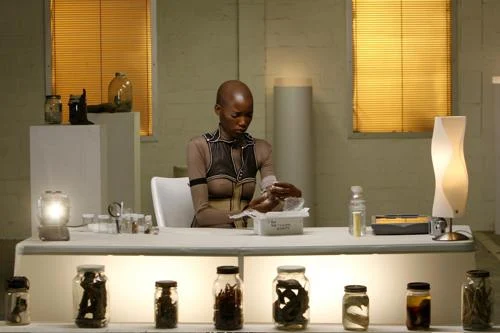
Pumzi is a 20 minute science fiction film by Kenyan director Wanuri Kahiu which had its US premier at the Sundance Film Festival this week. The movie takes place 35 years after World War III, the "Water War":
Nature is extinct. The outside is dead. Asha lives and works as a museum curator in one of the indoor communities set up by the Maitu Council [in East Africa]. When she receives a box in the mail containing soil, she plants an old seed in it and the seed starts to germinate instantly. Asha appeals to the Council to grant her permission to investigate the possibility of life on the outside but the Council denies her exit visa. Asha breaks out of the inside community to go into the dead and derelict outside to plant the growing seedling and possibly find life on the outside.
Watch the trailer:
Kahiu's last movie, the 2008 drama From a Whisper, depicted the aftermath of the 1998 US Embassy in Nairobi and won 5 African Movie Academy Awards.
Kahiu has expressed some frustration in her blog about reporters questioning her decision to make make a science fiction film:
I find the idea that some stories are meant to be told through science fiction to be a compelling one. It's not just that science fiction allows exploration of "what if" ideas, it's that SF settings can be used to tell stories that transcend present-day social and political boundaries. As Kahiu notes:
Yesterday, I did an interview and the reporter asked if Science Fiction is new to Africa. Mmmmm… yes and no. If you listen to the stories that have been told for generations, elements of fantasy, science fiction have always existed within them. [. . . ] I am just a new generation of storyteller, using cinema as my tool. The genre means less to me than the story. PUMZI chose to be Sci-Fi. The story dictated the genre.
[. . .]
Another interview I did a while back in South Africa asked why I would chose to do a Sci-Fi film when there were so many other stories to tell. What? How does that make sense? First, the genre does not dictate the story. Second, (I can feel myself getting hot at the memory) who decides the limitations of imagination? What story am I supposed to tell? Is there a formula that I have to follow because I was born in Kenya? Really? Really????? Aurghhhhhhhhhhh…
PUMZI is based on a futuristic Africa where borders cease to exist and the people who own the resources control the communities. Familiar, no?
According to the Wired Underwire blog, Kahiu hopes to offer Pumzi online, and plans to eventually expand the story into a feature length film.
(via SF Signal)
Tags:science fiction, ecology
Friday, January 22, 2010
Printing New Organs
Anthony Atala shares footage of research from the Wake Forest Institute for Regenerative Medicine, which is developing methods of growing organs in vitro in this TedMed talk:
The lab uses modified ink jet printer technology to build new organs. You can watch a video of the printer printing skin (wmv), which is research sponsored by the U.S. Army to help wounded soldiers. Similar printers are being developed by the US biotech firm Organovo and in Japan.
This technology sounds like it would be more efficient that having to wait for organs to grow from scratch, and doesn't have the ethical concerns associated with organs transplanted from other people or animals. Now the question is how long it will take for the organ printer to be perfected - and whether it will be made readily available for treatment of non-military personnel.
Related Biology in Science Fiction posts:
Tags:organ printing, biotechnology
The lab uses modified ink jet printer technology to build new organs. You can watch a video of the printer printing skin (wmv), which is research sponsored by the U.S. Army to help wounded soldiers. Similar printers are being developed by the US biotech firm Organovo and in Japan.
This technology sounds like it would be more efficient that having to wait for organs to grow from scratch, and doesn't have the ethical concerns associated with organs transplanted from other people or animals. Now the question is how long it will take for the organ printer to be perfected - and whether it will be made readily available for treatment of non-military personnel.
Related Biology in Science Fiction posts:
- Artificial Skin for Terminators (and People)
- Would You Eat Vat Meat?
- Organ-supplying clones - an idea that just won't die
- Caught in the Organ Draft
Tags:organ printing, biotechnology
Thursday, January 21, 2010
More Pandoran Biology

• Darren Naish has written up the Tet Zoo Guide to the Creatures of Avatar
A lot of thought and time obviously went into the design of Pandora's ecosystem and creatures. In part, I'd say that this was a success: a lot of people (even many not that interested in the natural world) have been very much taken in by the movie's xenobiology - if only this inspired them to become interested in, and passionate about, the biology and ecology of the real world.Read his spoilery speculations on the biology of Avatar's creatures.
• io9 interviewed some of the designers who worked on Avatar
Read how the movie's Bio-Lab was inspired by a visit to biotech company AmGen, why the plant life was green instead of cyan, and how human "drivers" might control their avatars from a distance.
• Production designer Rick Carter explained the inspiration for Pandora's bioluminescent wildlife.
Cameron's inspiration for that, Carter believes, came from his deep-sea diving experiences. "The whole idea of (that) bioluminescent world at night is something he'd actually witnessed when he was down at the bottom of the ocean during his 'Titanic' time," Carter says. "That bioluminescence is almost like a nervous system of the planet, and that's what's at stake in the movie, as you start to get past the initial foray into the Na'vi culture and seeing the drama start to emerge between the military-industrial complex that wants to exploit the world."
• At The Intersection Sheril Kirshenbaum shares what she enjoyed about the movie's science
Sigourney Weaver’s portrayal of a research scientist was uncharacteristically good. Instead of the typical caricature we see in Hollywood, she wasn’t socially inept (i.e. typical Rick Moranis roles) or out to destroy everything (i.e. Dr. Evil). Instead, Grace conveyed the natural curiosity about the world that I observe so often in colleagues. Also noteworthy, she was funded by a program with corporate interests, but really using the opportunity to pursue her own research. Sound familiar to anyone?• Peter Watts commented a bit on Pandora's biology in his review of the movie
Someone put a lot of thought into Pandora’s wildlife; it was beautiful to behold, it was amazingly diverse, it even seemed (for the most part) phylogenetically consistent. Across a wide range of species, everything from nostril placement to jaw structure was nicely suggestive of common ancestry. Except for the Na’vi, which are ridiculously anthropomorphic: tetrapod bipeds where everything else on the planet seems to have six limbs; binocular vision on a world where four eyes is the vertebrate norm.Read the post for the rest of his (spoilery) comments.
• Astrobiology Magazine: Avatar's Moon Pandora Could be Real
So far, planet searches have spotted hundreds of Jupiter-sized objects in a range of orbits. Gas giants, while easier to detect, could not serve as homes for life as we know it. However, scientists have speculated whether a rocky moon orbiting a gas giant could be life-friendly, if that planet orbited within the star’s habitable zone (the region warm enough for liquid water to exist).The gist of the article is that moon with life could exist, and if it does, astronomers should be able to detect it.

Related Biology in Science Fiction posts:
Monday, January 18, 2010
(Bio)Chemistry in the Movies

When Mark taught General Chemistry for the first time, he gave the students a 600-word writing assignment. They were supposed to write about the chemistry in a recent newspaper or news magazine. Such an exercise promotes deep learning because the student has to process the issues and decide what is important. Mark was surprised that only 60% of the students completed the assignment and disappointed that some of them wrote about topics such as vaccines, supernovas, etc. without mentioning their chemical aspects. [...] The next two times Mark taught General Chemistry, he projected two of these movies and had the students write about one of them. It was a great success; 95% of the students completed the assignment and the quality of writing was vastly superior.Griep and Mikasen published that finding along with a list of movies with a focus on chemistry in the Journal of Chemical Education*, and that was ultimately expanded into the ReAction!
One of the things that struck me in reading the interview is how many of the chemistry-based movies could also be considered bioscience or at least biochemistry movies as well. Take, for example, Dr. Jekyll and Mr. Hyde, which Griep spent some time analyzing and is one of the major themes of ReAction!:
I love technical geekery like that! What Griep discovered was that the story's chemistry was based on a compound found in a fungus extract that has a physiological effect on the human nervous system - so both chemistry and biology.Even though Jekyll is shown mixing chemicals, Mark was intrigued that the transformative formula was not described in enough detail to know what it was supposed to represent. Stevenson’s original story describes a contaminant in a white powder that changes color when it is added to a blood-red solution but it doesn’t name the powder or the contaminant. Seeking other avenues to pursue, Mark contacted Stevenson scholar Richard Dury to find out whether any scholarship had been done on this topic. Dury told him that Stevenson’s wife Fanny had written a letter immediately before Stevenson wrote the novella in which she says he suffered from hallucinations after being treated with an ergot extract. This episode appears to have inspired Stevenson to write the story. Mark then discovered that ergot fungus is a pharmacological toolbox containing compounds to constrict arteries but also compounds to cause hallucinations. It seems that Stevenson’s doctor had treated him with the ergot extract to stop the bleeding in his lungs. The hallucinogenic side effect was caused by a minor component of the extract. This led Mark to conclude what Jekyll’s compound might be.
And as Doug Fowler points out, at least part of the book tackles movie biochemistry even more directly:
And what about the chemistry of the alien microorganism in Andromeda Strain? I’m sad to report that ReAction! reveals that the mass spectral analysis in the film reports an elemental composition that can’t exist. After a bit of tweaking, the authors suggest that perhaps the alien life form could be alkaloid-like, and that the rock-like substance the life form arrived on could be a siloxane.It's not surprising that the biological and chemical sciences overlap in the movies, since they do in real life too - there is a lot of specialized chemistry that's required for living organisms to function.
Read the whole interview, which includes an interesting discussion of the changing depiction of chemists in the movies, public perception of science, and scientific literacy.
For additional information check out the companion Chemical Movies Blog. It isn't actually very blog-like, considering that each of the ten "posts" are downloadable pdf files, but it does include a list of all the movies discussed in ReAction! and a bit more discussion of some movie chemistry.
* Griep MA and Mikasen ML "Based on a True Story: Using Movies as Source Material for General Chemistry Reports" J. Chem. Educ. 2005 82(10):1501 DOI: 10.1021/ed082p1501
Image: Fredric March as Doctor Jekyll in the 1931 version of Dr. Jekyll and Mr. Hyde
Friday, January 15, 2010
Stories for Haiti
Crossed Genres is organizing a drive to raise donations for Haiti:
Authors and artists who wish to participate will have their contributions linked on the Crossed Genres Post a Story for Haiti page. Authors have already posted some excellent stories in response.
If you are looking for fiction with a biological bent, I'd recommend "Selective Breeding" by Bart R. Leib or the entire issue of M-Brane #12. And if you enjoyed what you read, consider making a donation.
ETA: Since I first wrote this post, many more authors have contributed. With more than 60 stories to choose from I'd say start reading anywhere.
Tags:science fiction, Haiti
Because we’re a magazine, the first idea we had was to involve writers and artists. So we’ve started Post a Story For Haiti. We’ve asked anyone who wants to help to post fiction and art to their blogs, sites, etc. for free, with big DONATE buttons at the top and/or bottom that links to Doctors Without Borders, the Red Cross and Rainbow Fund, or any of the organizations participating in the relief efforts. That way even writers/artists who struggle financially as we do can lend a hand.Crossed Genres is not collecting any money themselves, instead they are directing people who would like to contribute to donate directly to organizations such as the International Red Cross, Doctors Without Borders, or Rainbow World Fund.
Authors and artists who wish to participate will have their contributions linked on the Crossed Genres Post a Story for Haiti page. Authors have already posted some excellent stories in response.
If you are looking for fiction with a biological bent, I'd recommend "Selective Breeding" by Bart R. Leib or the entire issue of M-Brane #12. And if you enjoyed what you read, consider making a donation.
ETA: Since I first wrote this post, many more authors have contributed. With more than 60 stories to choose from I'd say start reading anywhere.
Tags:science fiction, Haiti
Tuesday, January 12, 2010
Science Fiction as Adam's Apple

The Human Words of God speak of the Creation in terms that could be understood by the men of old. There is no talk of galaxies or genes, for such terms would have confused them greatly! But must we therefore take as scientific fact the story that the world was created in six days, thus making a nonsense of observable data? God cannot be held to the narrowness of literal and materialistic interpretations, nor measured by Human measurements, for His days are eons, and a thousand ages of our time are like an evening to Him. Unlike some other religions, we have never felt it served a higher purpose to lie to children about geology.
~ Of the Creation, And of the Naming of the Animals. Spoken by Adam One, founder and leader of God's Gardeners. (The Year of the Flood: A Novelby Margaret Atwood, 2009)
Over the past week an ignorant attack on science fiction by David Cloud of the Fundamental Baptist Information Service has been making its way across the SF blogosphere. I started to write a detailed post about what was wrong with Cloud's reasoning, but once you get past the major underlying problem - that he rejects post-18th century science while claiming that he doesn't - the rest is mostly trivia.
For example, the 5 dead authors Cloud lists (Asimov, Clarke, Heinlein, Vonegut, Sagan, Roddenberry) do not represent all science fiction authors, who come from many different religious backgrounds and sometimes write religious-themed science fiction. There's even a whole blog devoted to religion in science fiction which is a great resource for people who are actually interested in the subject.
Cloud also puzzlingly calls astronomer and science popularizer Carl Sagan a "prominent evolutionary scientist". I suspect that Cloud is using the term "evolution" to mean "science that conflicts with my world view" (i.e., all modern science), which then makes a certain kind of sense to consider an astronomer an "evolutionary scientist" and to claim that science fiction is all based on an "evolutionary worldview". Perhaps that's common usage among Cloud's target audience, and he simply doesn't care that it makes it appear that he is too lazy to look up basic facts to the rest of us. Or he really thinks that all science is evolution (??).
Anyway, beyond my amusement that someone out there seems to believe that most science fiction arose from and is based on evolutionary biology, I actually find myself agreeing with Cloud's basic premise. No, not that evolution is false. Rather that science fiction often gives the appearance of simple entertainment while insidiously promoting a scientific world view.
In most science fictional universes it's assumed that the Earth and the stars are billions of years old, that species - including man - can change over time and be changed by scientists, that our exploration of astronomy and physics and chemistry will eventually carry us to the stars, that there are other wolds that also carry life. Even when the science in SF is inaccurate or scientists are portrayed as evil or immoral, the underlying assumption is that science works. I can well imagine science fiction inspiring in a curious reader (or watcher) a lifelong interest in the natural world or even lead to a career as a scientist.
Add to the mix of entertaining stories and scientific worldview the irreligiousness (or non-Christian religious beliefs) of many SF characters, and it's easy to imagine science fiction leading impressionable minds astray from Cloud's version of Christianity.
And that's not a bad thing at all.
(link via Steven Gould)
Image: Church of the Flying Spaghetti Monster propaganda
Tags:science fiction, evolution
Sunday, January 10, 2010
Not Your Father's Pterodactyls

According to Pterosaur.net, unlike many other prehistoric beasts*, pterosaurs don't seem to get a fair representation on the big screen:
While dinosaurs of all kinds abound (Tyrannosaurs, Diplodocus, Triceratops, Stegosaurus and now Velociraptor seem to make it into every film), the only pterosaurs we ever see are Pteranodon and the occasional Rhamphorhynchus. To make matters worse (for me anyway) the reconstructions are often very poor and rely on outdated ideas about pterosaurs. One can hardly complain about the early films and books, but dinosaurs on the big screen especially have changed dramatically several times over the years reflecting the latest (well relatively recent) ideas in palaeontology, yet the pterosaurs stay the same. Pterosaur research has been no less intense that that on the dinosaurs and our ideas about how they lived have changed as we discover new fossils and new ways of analysing them, but we are left with tooth-y Pteranodons, ‘pterodactyls’, and 5 meter wing-span rhamphorhyncoids!Paleontologist David Hone then goes on to take a look at pterosaurs in the movies, books and in the BBC TV series Primeval. While the going into such detail probably strikes some people as nit-picky, I think it's actually a great resource for people who see or read about such critters and want to know what the real facts are.
Hone sums up my own feelings about inaccuracies in science-in-fiction pretty well:
Believe it or not, I don’t mind too much about ‘dramatic license’ for fiction. My problem is when it is dressed up as scientific accuracy.And happily for geeks like me, "not minding too much" isn't at all the same thing as "not interested in explaining what the science should be". That way I get to enjoy the fiction and learn about the science too.
Check out Pterosaurs in Popular Culture and the related page Myths and Misconceptions about Pterosaur
* I almost called them dinosaurs, but now I know better.
(via Metafilter)
Image: "The Vultures Sing", by paleontologist and pterosaur.net contributor Mark Witten on Flickr. From the description . "A pair of Quetzalcoatlus nothropi raid the nest of Tyrannosaurus rex in what will eventually become the Hell Creek Formation of Montana in 65 million years time. The idea here is that the animal on the right is the more striking male, whilst the drab pterosaur behind him is a female." Go read the whole description, which is a lot more like a blog post than an image caption.
http://www.flickr.com/photos/markwitton/ / CC BY-NC-SA 2.0
Tags:science fiction, dinosaurs
Monday, January 04, 2010
2009 State of the Blog Review
2009 wasn't a particularly good year for me, and I'm hoping for better in 2010. I'm already running a few days behind schedule, and that may not be a good sign.
Anyway, here is a bloggy overview of the past 12 months:
My most exciting project: The Free Science Fiction with Biology directory.
It's currently up to 220 free SF stories and I have at least a few dozen more to add when the dust from holidays has settled. And more free fiction appears online every week, so it's a project that thankfully never will be complete. Current entries span the entire 20th century, and include fiction originally published in Asimov's, Analog, Interzone, Fantasy & Science Fiction, the journal Nature, and many other fine publications. More than 40 of the entries you can listen to as an audiobook or podcast, which is excellent for listening to on your favorite MP3 player while jogging or commuting or cooking dinner or whatever else you might be doing.
Most Popular Posts of 2009
For some reason the 6 of the 10 posts that had the most visitors this year weren't actually new posts. Oldies but goodies!
Most Popular Posts Made in 2009
At least a few of this years posts could compete with the old posts:
Top Referrers
This list doesn't include boring referring sites like stumbleupon. I appreciate the links and hope some of you will make a return visit.
Thank you all for reading and commenting.
Also, special thanks to Cheryl Morgan who included my name here, making me smile during a very stressful and unhappy time.
Tags:science fiction, biology
Anyway, here is a bloggy overview of the past 12 months:
My most exciting project: The Free Science Fiction with Biology directory.
It's currently up to 220 free SF stories and I have at least a few dozen more to add when the dust from holidays has settled. And more free fiction appears online every week, so it's a project that thankfully never will be complete. Current entries span the entire 20th century, and include fiction originally published in Asimov's, Analog, Interzone, Fantasy & Science Fiction, the journal Nature, and many other fine publications. More than 40 of the entries you can listen to as an audiobook or podcast, which is excellent for listening to on your favorite MP3 player while jogging or commuting or cooking dinner or whatever else you might be doing.
Most Popular Posts of 2009
For some reason the 6 of the 10 posts that had the most visitors this year weren't actually new posts. Oldies but goodies!
- Vampirism as Disease? (January 2007)
- Parasites that Control Behavior (October 2006)
- What is Kara Thrace (June 2008)
- Farandolae (September 2007)
- The Depiction of Cloning in Movies (April 2008)
- Genetics of Heroes (Feburary 2007 and way out of date)
- GenPets: Bioengineered Pets Perfect for You (May 2008)
Most Popular Posts Made in 2009
At least a few of this years posts could compete with the old posts:
- Science Fiction, Race and Fandom (March)
- Kyle XY and Einstein's Brain (January)
- Alien Sex and Worlds: Philip Jose Farmer (February)
- Telomeres and Aging (October)
- Is Avatar Science Fiction? (December)
- The Next Phase of Human Evolution? (April)
Top Referrers
This list doesn't include boring referring sites like stumbleupon. I appreciate the links and hope some of you will make a return visit.
- io9.com
- rydra-wong.livejournal.com (from the "Great Race Discussion Linkspam" posts)
- sfsignal.com
- mikebrotherton.com
- blaghag.com
- almostdiamonds.blogspot.com (I'm sorry I didn't get to meet Stephanie at ScienceOnline09)
- seancraven.blogspot.com
- blog.scienceandentertainmentexchange.org
Thank you all for reading and commenting.
Also, special thanks to Cheryl Morgan who included my name here, making me smile during a very stressful and unhappy time.
Tags:science fiction, biology
What Science is Really Like
XKCD gets it pretty much right - although the "actual science" montage should have a few more "whirrrr" panels. (Click for larger image)
Subscribe to:
Posts (Atom)
Note: Links to Amazon.com are affiliate links. As an Amazon Associate I earn from qualifying purchases.