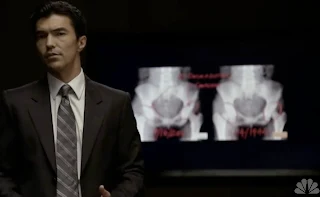
Showing posts with label television. Show all posts

Friday, October 19, 2012

Free Friday Flicks: Tales of Tomorrow: Future Medicine from the Golden Age of SF

The science fiction anthology series Tales of Tomorrow ran from 1951 to 1953, and was the first TV show of its kind. The brainchild of Theodore Sturgeon and the Science Fiction League, the published stories of the SF League's illustrious members were made available for adaptation.

The stories may not seem so cutting edge today, especially since many have been retold on television a number of times. But at the time the series originally aired, the Golden Age SF stories they were based on were still relatively new.

I've listed a few of the tales featuring futuristic takes on the medical profession below. Sure, the doctors are all middle-aged white men - what sets them apart from the "present-day" of the 1950s is novel technology and science, not noticeable changes in society.  Also, women apparently ruin everything.

If you like classic SF and old-time TV, they are worth watching, if only to see the way the future looked a half century ago.

The Little Black Bag
Watch at the Internet Archive or Hulu
The episode is based on the story of the same name by Cyril Kornbluth, which was originally published in Astounding Science Fiction in 1950.

Synopsis: a depressed doctor is ready to quit his practice when he stumbles onto a medical kit that has seemingly miraculous properties. The doctor and his wife can't agree on how it should be used, and there turn out to be unintended consequences (goes without saying, right?)

The Miraculous Serum
Watch at the Internet Archive or Hulu
This episode was adapted for TV by Theodore Sturgeon from Stanley G. Weinbaum's 1935 story "The Adaptive Ultimate".

Synopsis: a doctor invents a treatment that cures any illness or injury by "magnifying their adaptability". He tests it on a destitute woman who decides to use her new-found vitality to take on the world. Can this beautiful power-seeking woman be stopped? (It does seem a bit sexist)

Seeing-Eye Surgeon
Watch at the Internet Archive or Hulu

This episode does not seem to be based on a previously published story.

Synopsis: A neurosurgeon who lacks confidence finds himself leading the operative team performing brain surgery on an important physicist. A pair of special glasses given to him by a mysterious stranger helps see him through. This one seems to be more a tale of magic than science.

Past Tense

Watch at the Internet Archive or Hulu

Synopsis: Boris Karloff stars as a physician who invents a time machine to travel back in time to try to get rich selling penicillin to a pharmaceutical firm. Will he be successful? Could his wife ruin everything?

You can watch most of the series episodes at the Internet Archive and Hulu.

And the collection is available on DVD at Amazon.com (affiliate link) and other retailers.

Wednesday, September 19, 2012

Dinosaurs on a Spaceship: Not enough feathers!

A couple of weeks ago the Doctor Who episode "Dinosaurs on a Spaceship" delivered just what the episode title promised: dinosaurs, on a spaceship. Of course there was much more to the story than that, and the episode had a mix of the silly (the Doctor and his companions riding a triceratops and goofy robots) and the dark (the Doctor hastening the death of the pirate trader who had taken over the ship and killed most if its inhabitants.). But for me the dinosaurs stole the show.


Why were Earthly dinosaurs on the spaceship? Because, in the Whoverse the Earth hosts another humanoid race besides Homo sapiens. There is also a lizard-like race called the Silurians or Homo reptilia, currently hibernating deep underground. But millions of years ago the Silurians had a technologically advanced society among the dinosaurs. When the asteroid that caused the extinction of the dinosaurs was on a collision course with Earth, the Silurians filled a spaceship with dinosaurs and plants to rescue them. Thus dinosaurs on a spaceship.

Of course I don't watch Doctor Who for serious science, so it's no surprise when scientific inaccuracies appear. But Brain Switek has pointed out that the dinosaur designers for the episode missed an opportunity to make the deadly raptors that stalk the TARDIS crew more colorful. As he put it:
... the unidentified “raptors” suffered the curse of the bunny hands and insufficient feathery coats. Filmmakers seem reluctant to drape feathers over dromaeosaurids, but, for any effects artists who may be reading, we know that these dinosaurs had exquisite plumage covering almost their entire body. If you’re going to have raptors, they should be intricately feathery. [...] You may want to laugh at a Deinonychus all puffed up, but that will be the last sound you ever make before it starts to eat you.
I would go further than that.  It was recently found that a distant cousin of Tyrannosaurus rex  called Yutyrannus huali was covered with a downy coat of 6-8 inch long feathers over most of its body. That has lead to speculation that T. rex might have been feathered as well.

Analysis of the fossilized feathers of the much smaller Sinosauropteryx lead to the discovery that the more than 120 million year old feathers contain melanosome cells that store either red or black pigments. The pattern of those pigment cells in the fossils suggest that Sinosauropteryx may have been striped, at least along its tail.

So I'd propose putting those two findings together with a bit of artistic license, giving even the great T. rex on the spaceship colorfully patterned plumage. I think that would have looked awesome and have had the right mix of terror wrapped in whimsy to suit a Doctor Who episode.

It also makes me think about how quickly science fiction stories can become outdated, even when they are set in the past. I'd guess that most of us have read or watched older science fiction stories where the "future" technology became obsolete long ago. The recent discoveries about dinosaur appearance are an example of how scientific progress can change how we view the past. Perhaps plain gray dinosaurs should go the way of telephone booths and horse-drawn carriages in SF.

Apparently the idea of feathered dinosaurs apparently is quite upsetting to young-earth creationists, who don't like the way it supports the hypothesis that modern birds evolved from dinosaurs. Fiction that depicts prehistoric animals based on the most up-to-date fossil evidence not only has cool-looking creatures, but also helps promote science in general.

More feathered dinosaurs please!
----

Get Dinosaurs on a Spaceship at Amazon.com (affiliate link)


Top image:  Sinocalliopteryx gigas as a stealth hunter feeding on the dromaeosaur Sinornithosaurus. Illustration by Cheung Chungtat.  From Xing L, Bell PR, Persons WS IV, Ji S, Miyashita T, et al. (2012) Abdominal Contents from Two Large Early Cretaceous Compsognathids (Dinosauria: Theropoda) Demonstrate Feeding on Confuciusornithids and Dromaeosaurids. PLoS ONE 7(8): e44012. doi:10.1371/journal.pone.0044012.g008. This file is licensed under the Creative Commons Attribution 2.5 Generic license.

Bottom image: Cover of Analog Science Fact & Fiction February 1961. It illustrates "The Weakling" by Everett B. Cole, in which there are great "saurians" used as pack animals, meat and pets on an alternate (or future?) Earth. The story is heavily dependent on "psionics" and mind control as a plot device, if you like that sort of thing. The cover and story are available through Project Gutenburg, and are out of copyright.

Saturday, March 24, 2012

Jellyfish and immortality: would you want to live forever?

Last summer's Torchwood-goes-to-America series (more formally titled Torchwood: Miracle Day) had an interesting premise:  what would happen if people stopped dying?

Plenty of science fiction stories involves humans who have become immortal or whose lifespans are so long that they seem immortal. But unlike fictional future societies like Ian Banks' "Culture", where genetic engineering and advances in medicine have allowed humans nearly unlimited lifespans, the living in Miracle Day live despite suffering unhealed grievous injuries and unchecked diseases. People suffer and yet they live on.

The crude global death rate is about 8.4 deaths per 1000 in the population in 2009. Given a total world population of 6.7 billion that is about 56 million deaths per year or 154 thousand deaths per day.  Without death to intervene Earth's human population grows unchecked.  And many of those who survive are sick and hurt and unable to care for themselves.  The results are horrifying, as are the measures deemed necessary to stave off the possibility of overpopulation.

While Torchwood often seems closer to fantasy than SF, there is, in fact some science behind the fiction. As show writer Jane Esperson described it:
The amazing writer Bryan Fuller told the Torchwood writers room about the species of immortal jellyfish that Christina Colasanto talks about here [in Episode 8] — and we obsessed over it in the room. The idea that some creature here on Earth works in this way is amazing. That line, "Consider the jellyfish..." started echoing around the room, and here it is, in the episode. For a while, we joked that that should be the title of this episode.
The jellyfish Turritopsis nutricula is essentially immortal, as long as it doesn't get eaten or succumb to disease.


As the jellyfish matures it takes on several different physical forms. Fertilized eggs develop into planula larvae which settle on the sea floor. The larvae develop into colonies of polyps which bud off free-swimming medusa jellyfish.  When those jellyfish reach sexual maturity after a few weeks they spawn to create a new generation of jellies.

All animals are able to reproduce and create new offspring, that's not what makes Turritopsis special.  Turritopsis adults are actually able to revert back to the juvenile polyp form through a process known as transdifferentiation. This process renders the tiny jellyfish biologically immortal. See the video above for an overview.

But besides the concept of immortality that nifty bit of jellyfish biology isn't referenced in Miracle Day at all. I suppose having  Gwen Cooper, Captain Jack, and Rex Matheson revert to their juvenile forms in a sort of Torchwood babies episode wouldn't work very well. At the least it would preclude having the usual sex scenes (at least I hope it would).

Miracle Day unfortunately doesn't completely live up to its original premise. The plot is slow to develop, the flashbacks to Jack's early 20th century relationships are long, and the world-wide conspiracy that sets the Miracle in motion I found more confusing than convincing.  I think it could be much better if the 10 episodes were trimmed in half.

Torchwood: Miracle Day will be available on DVD in the US on April 3rd. You can preorder a copy at Amazon.com (affiliate link).

Thursday, January 27, 2011

Is SyFy the New Bravo?

Here's a confession: I really like contest shows - the kind where creative professionals are compete in  challenges.  Top Chef and  Project Runway my current faves.  Top Chef because I like experimenting with cooking, and Project Runway, because I like watching people create clothes, I guess*.  The competitions involving hair styling and "fine art" and interior design, not so much.

That means SyFy's new show Face Off is right up my alley. The competition pits makeup special effects artists with a range of backgrounds against each other. Some competitors have backgrounds doing makeup for movies (mostly B-grade) or have corporate clients, while others are fresh out of school.  What the do looks like a combination of sculpture, painting and acting (or at least thinking like a character).  The show follows a pretty standard formula: a quick challenge at the beginning that gives the winner immunity or other advantage, followed by the major competition.

In tonight's premiere episode, the competitors teamed up to create a human-animal hybrid character. The limitation? They had to use one of three animals as their inspiration: a black beetle, an ostrich, or an elephant.  The winning team created an "elephant man" that looked good even close up.  I think the way their model moved also helped sell the look.  

The Winners. You can watch full episodes of Face Off at SyFy.com


So far, there hasn't been much soap-opera-like squabbling or painting of particular contestants as the "bad guy" or the "prima donna" or other personality stereotypes, which is also a good thing.  Based on one episode, I find it's entertaining.

But I wonder where SyFy is going with this programming?

During the show, there was an ad for yet another new SyFy reality show.  It stars Marcel - the annoyingly arrogant please-not-yet-another-dish-with-foam Top Chef contestant** - and is going to be about molecular gastronomy.  While I think molecular gastronomy's really cool, Marcel's personality  can be annoying, so I have mixed feelings.

Given the choice between Face Off or Quantum Kitchen and yet another Ghost Hunters episode or wrestling, I'll happily take makeup and cooking. But what I really want to see is more SF!

I'm disappointed SyFy canceled Caprica and decided to burn off the remaining episodes in a long single night marathon. I'm disappointed that they decided on a North American remake of Being Human, rather than importing the superior UK original (at least based on the first couple episodes). 

Until Stargate Universe and Eureka return with new episodes, there's really not much reason to turn to on SyFy at all.

It seems like there's a big hole that SyFy could fill -  The Cape is pretty meh, Chuck is getting a bit long in the tooth, Primeval went way downhill when they killed off Nick Cutter. I only just noticed that V hadn't been canceled and was showing new episodes again - I pretty much lost interest and was watching by the end of the fall season.

The only SF show I make a special effort to watch at the momemnt is Fringe, and I'm afraid that its move to Friday night is a signal they are losing Fox's support.

So while I get that SyFy wants to attract some of Bravo's usual audience who might come for the competition and stay for the ghost busting***, as a viewer who actually likes science fiction drama, I feel neglected.  

Some of us would like both a SyFy with science fiction and a Bravo with reality programming - why mix up the two?

(And yeah, I know NBC Universal-Comcast doesn't care a whit about my personal TV preferences. I just had to get that off my chest.)


-----

* I really enjoy Project Runway, even though I am one of the least fashion forward people around. The clothes usually fall into the same neat-to-look-at-but-I'd-never-wear-that category for me (for example) that costumes do.

** The current season of Top Chef is also showing Wednesday nights on SyFy's sister station Bravo. It's probably no coincidence that there was a Top Chef re-run tonight and there was no hint of Marcel's new show until he was eliminated from the competition last week. Hmm.

*** Also, the monster-of-the-week movie SyFy's been advertising looks like the hair, makeup and catfighting were taken from one of the Real Housewives of ___ shows. Another crossover, perhaps?

Monday, October 18, 2010

Are Homo sapiens the only people?

Alien Anatomy
I've been watching the new NBC series The Event. So far it's hasn't been tell-all-your-friends awesome, but I've been finding interesting enough to keep watching.

The premise is that in 1944 a plane carrying aliens crashed in Alaska. While many of the aliens escaped, those who were injured  - and their leader, "Sophia Maguire" - were captured and interred in the secret Inostranka military base.1 In the present day, there have been a series of strange events seemingly precipitated by the aliens who avoided capture.

Unlike the other recent "aliens are among us" series, V, the US government in The Event is more realistically suspicious of the aliens motives.  And unlike V's lizard-like aliens in beautiful human skins,  the aliens of The Event are primates like us.
While the series probably won't reveal the aliens' origins and purpose on Earth for some time, I think the possibilities are intriguing.

Here's the scene in the second episode that shows us what the US government knows about the aliens' biology:


Agent Lee:  Well, as you can see, outwardly they look very much like us, which could indicate a common ancestor, or even a parallel evolutionary process. But there are differences.

Now, initially, scientists were only able to detect small variations in their circulatory systems and blood composition. But over time it became clear that they age at a much slower rate that we do. Meaning that there had to be substantial differences we couldn't detect and that we didn't understand.

Now recent advances in DNA sequencing are starting to change that. We now know their DNA varies from ours by slightly less than 1%.

President Martinez: 1%? So they're people.

Blake Sterling: They're absolutely not. 1% is actually quite significant genetically. A chimpanzee's DNA differs from ours by only 2%, for example.
When I first saw that scene, my first reaction was "Wow, they are closely related to humans", followed by a puzzled "How are they not people?"   I suppose it all comes down to your definition of a "person.

It's true that a difference in genomic DNA sequence of even "slightly less than 1%" is significant.  It would definitely make the aliens a different species than Homo sapiens. They are not modern humans. But while they aren't human, they are more genetically similar to us than our close primate cousins the chimpanzees.

Reconstructed Neandertal family.  People?
Depending on the method you use to calculate similarity, human and chimp genomes differ anywhere from 1% to 6%.  That means you can't really compare the information thrown out in The Event. But the method of genome comparison that shows a 1.2% genomic difference between humans and chimps, shows a difference between the human and Neandertal genomes of 0.3%.

The ancestors of humans and chimps diverged roughly 6.5 millions years ago.  The ancestors of humans and Neandertals diverged between 500,000 and 800,000 years ago.  
I'd put the difference between the DNA of humans and the aliens of The Event somewhere between chimpanzees and Neandertals.  That means the ancestors the "aliens" would have split off from our human ancestors a couple of million years ago.

So what does that mean for the evolutionary origins of the aliens? 

Based on the similarity of their genome to humans, I'd say it would be extraordinarily unlikely that the aliens (or "aliens") originated anywhere other than Earth.  To produce intelligent humanoids more genetically similar to humans than other Earthly primates, evolution would have had to progress identically on Earth and on an alien world for many millions of years. That just couldn't happen – at least not without some sort of supernatural or superhuman intervention.

Where have the "aliens" been all this time? Perhaps they were moved from the Earth to another planet by more technologically advanced aliens.  Or maybe they've been living in an isolated enclave right here on Earth for a million years.  If it turns out they had been living all those millennia on a plateau in the South American jungle, on a tropical island in the Pacific, or in a valley high in the Himalayas, that would be a nice reference to the science fictiony "lost civilization" stories of the early 20th century.

I'm hoping that the origins of the "aliens" turns out to be both interesting and not entirely inconsistent with biology. Of course depictions of evolution in Hollywood unfortunately tend to be really bad, so I'm not going to be too surprised if the story ends up disappointingly silly.

So terrestrial origin or no, that leaves the question of whether the aliens are "people".

Maybe I've watched and read too much science fiction, but I consider any humanoid sentient being to be a "person". The Event's aliens are more similar to humans than Klingons or Vulcans or Minbari or Centauri or Gallifreyans - of course they are people!

Whether they turn out to be "people" with friendly intentions towards Homo sapiens remains to be seen.

---

Watch episodes of The Event on Hulu. (available only in the US, and only for a limited time)

Further technical reading on human evolution:
• Cohen J. Relative Differences: The Myth of 1%.  Science 316: 1836 (2007)(pdf)).
• Green RE et al. A Draft Sequence of the Neandertal Genome. Science 328:710-722. (2010) (pdf))
• Smithsonian National Museum of Natural History: What does it mean to be human? 

Top image: Still from The Event episode "To Keep Us Safe". Agent Lee points out key features of the alien anatomy he knows so well.

Bottom image: Reconstruction of a Neandertal group. © Johannes Krause.  Source: Neandertal Genome Project Press Kit.


1. There is also a plot line with a computer programming genius trying to rescue his sexy fiance  (apparently a scientist of some sort), who has been kidnapped by a homicidal group whose origins and plans are unclear.  Their story line isn't nearly as interesting as the interactions between Sophia and the President Martinez.  Hopefully that will change.

Monday, August 16, 2010

Bio in SF Bits 8/16/10

Cleaning out my (much too long) list of bookmarks:

On the Influence of SF: 

Letters of Note: He was there with you on the bridge
A woman writes to Patrick Stewart about how much pleasure Star Trek: TNG gave her son with muscular dystrophy.
All through last year Wednesday evening was his highlight of the week, his excitement being matched only by his anger if "Star Trek TNG" was cancelled. I think that in his imagination he was there with you on the bridge, free of any disability, sharing to the full in all your adventures - he never missed one.
Big Think: Interview with neurophysiologist Vincent Pieribone
Science fiction is huge, but it doesn’t translate into science reality for students.  They love to go see science fiction films, but I think science is not nearly as exciting today as the science fiction is.  I got a lot of people who show up in the lab and they think every day is going to be like Mr. Spock running around the deck of the Enterprise making huge discoveries and stuff.  And it’s a little slow.  It’s a lot of [pipetting] and you know, things don’t work and like any job, it’s really like any job.
Timmi Duchamp @ Ambling Along the Aqueduct: Because culture, not nature, is the problem (on Helen Merrick's "Engaging the sciences through feminist science fiction")
In this article she argues that feminist science fiction has the potential for bridging the "two culture divide" that persists in feminist scholarship-- the divide between the sciences and the humanities. 

On Science in SF

At ScienceOnline2010:  Tamara Krinsky and Jennifer Ouellette discuss "how online video and social networking tools are playing a part in connecting science, Hollywood and its fans."

Gary Westfahl @ IROSF: No Bark and No Bite
Dogs, in contrast [to cats], appear to be relatively rare in the science fiction futures of all media, with few examples coming to mind. [. . . ] Could the reason be simply that most members of the science fiction community, like myself, tend to like cats better than dogs? Or is there some logical reason for this curious imbalance in the genre's predictions?

Mark Terry @ Tobias Buckell's blog: It's all science fiction, right?
I have a degree in microbiology and public health, spent some times in an infectious disease research lab, then worked about 18 years in a clinical genetics lab before turning to writing full time. So I can safely say that what goes on in those TV shows about forensics have about as much in common with how real crime labs operate as Star Trek has to do with how NASA operates.

Juliette Wade @ TalkToUniverse: Body Models and Metaphors
The aliens we create can similarly have different models and metaphors for the body and its operation, and if you use those things to your advantage, they can influence characters' behavior and judgments, and possibly even the plot of a story. If a character were injured for example, why would or wouldn't he/she decide to get treatment? How would that influence the course of the story? Would two people from different countries in a fantasy world have different ideas of how the body worked and what kind of treatment would be good for it? Might one believe that washing with soap was dangerous (as we used to), while the other believed it was necessary for sanitary treatment?

Deborah J. Ross @ Book View Cafe: Not Just Another Funny Forehead: Creating Alien Characters
Since I loved invertebrate zoology in college, I used the gastropod family as a model [for my aliens in Jaydium]. In doing so, I violated a slew of biological realities (including the limits on size of creatures that don’t have skeletons, internal or external, as well as the limiting rate of oxygen and carbon dioxide exchange). And yet, what I did worked. No one, not even my professor (to whom I presented a copy) railed at me for scientific idiocy.

Mary Catelli: Babies in World Building
One world building error that I find as often in SF as in fantasy:  many, many, many writers neglect to figure out Where Babies Come From and Why It Matters. 
Alien Romances: Pull out the genitalia
[. . . ]we could give the peculiar goolies to the alien villain... as long as he is not a close relative of the hero. This could be quite useful. The heroine doesn't have to see them. The gentle reader only has to hear about them. Yet, the point is made that aliens have evolved differently.


jeremy @The Voltage Gate: The walk from dreamed inspiration to story
It was 12:40 a.m. when I rolled out of bed, only three hours after falling asleep. The dream had ended at what seemed to be a confounding crossroads, but as I paced to the bathroom, groggy, I was already working out what happened next. The story that my unconscious had crafted was now being filled out consciously.'

Written SF

At Tor.com there's an interesting discussion going on of the new Heinlein biography.  See the round up of posts here.

L. Timmel Duchamp reviews Anil Menon's the Beast with Nine Billion Feet for Strange Horizons
The Beast with Nine Billion Feet tells a story in which the characters' personal lives and relationships become inextricably braided into an ideological conflict pitting two takes on the material consequences of biotechnology in bitter opposition.

Metafilter: James P. Hogan, author of Inherit the Stars, died on July 12th


Metafilter: The Waves of Sand Roll On (Frank Herbert and the Oregon Dunes)

Golden Age Comic Book Stories has great scans of Ed Cartier's illustrations for Travelers of Space

JC Hallman @ Bookslut: Jurassic Park and the Utopia Wars
The maddening thing is that when you try to explain something like Pleistocene Rewilding to someone who’s never even heard of it, you discover that before your utopian vision is complete, the dystopian retort is already in place: “Sounds like Jurassic Park to me.” That Jurassic Park might veil an ideology is a fact that many, it seems, would prefer their grave to accepting.

At the Mad Hatter Review Lavie Tidhar reviews Luna: The Genetic Paradise:
In brief, what Moav proposes is the establishment of a society along the lines of selective breeding, a complex structure dictating how many children—and with whom—anyone can have, based on their “humanity index”, a combination of IQ, artistic talent, and social-moral behaviour, with the focus on moral quality. Inherent in this scheme is Moav’s conviction that moral behaviour has a genetic basis, and can be passed on from parent to child.

The Phoenix interviews Paolo Bacigalupi about The Windup Girl:
When I say science fiction, I think of classic Foundation, I think of rocket ships. But there's this other tradition of science fiction, which is sort of the stealth version. It's the stuff you see with Aldous Huxley or George Orwell, where you're extrapolating about who are we, where are we going, what our society looks like, and I feel very connected to that strain of science-fiction writing.
And Bacigalupi was interviewed by Annalee Newitz at io9 about the future of hard science fiction:
I do research, but it's after stuff has percolated for a while. When I was an editor at High Country News I was reading all their stuff. There was a one-liner about checkerspots in [my short story] "The Gambler" - stuff like that, which I've absorbed elsewhere, drops in at convenient places as I'm writing. I'm always reading environmental journalism. Science writers point the way to interesting stories.


John Scalzi interviews Ted Chiang about The Lifecycle of Software Objects:

People routinely attempt to describe the human brain’s capabilities in terms of instructions per second, and then use that as a guidepost for predicting when computers when be as smart as people.  I think this makes about as much sense as judging the brain by the amount of heat it generates.
SF Signal interviews Jeff VanderMeer about The Third Bear
I wanted to show progressions and commonalities of theme or style. For example, "The Situation" with its biotech is followed up by a Dr. Moreau-type tale. A story about trying to find something that can never be found is followed by a story about wanting to be lost. I tried to also vary the length where possible. For example, the longer "Errata" and "Appoggiatura" couldn't really go back to back. "Appoggiatura" didn't feel like a story that could have anything come after it, so it's last. It has the finality of "The Third Bear" but also an openness to its ending. Some, like "Shark God vs Octopus God," are placed as palate cleansers.
Book Trailer for Scott Sigler's Ancestor a "bone crunching tale of high-tech horror"


Kay Holt @ Science in My Fiction: I know why the vampire sparkles!

By now, I’m sure you’re all with me; vampires are bugs. But what kind? It took me a while to figure it out, but now I’m convinced that vampires are nothing more than overgrown, parasitic…

Joel at Twelve Hours Later on "Year of the Rat"
In “Year of the Rat” (é¼ å¹´), published in the May 2009 issue of Science Fiction World, Stanley Chan Qiufan (陈楸帆) gives his unemployable college seniors an opportunity to serve their country by joining up with a rat-fighting brigade. Armed with crude spears, the new recruits hunt Neorats (æ–°é¼ ), genetically-altered rodents that escaped from the incubators where they were being raised for export to international markets. It’s brutal work, particularly as the rats begin to evolve in ways that make them harder to track and kill, but the young men have no other choice [. . . ]

 Elizabeth Bear: long past their woodland days
It will probably come as a surprise to nobody, but I love me some science fiction. 
But recently, an acquaintance asked "Do you believe in science fiction?" Being in a contrary mood, I answered "no." What I meant, I admitted when pressed, was that I did not believe in the valorization of SF as the literature that's going to somehow save the world.
Television

The Science and Entertainment Exchange's has an overview of the "Watching the Watchmen and Cheering the Heroes: The Science of Superheroes" panel at the 2010 AAAS meeting.
The question of how much of who we are is genetically determined, and how much is a factor of environment and the choices/decisions we make, underlies the entire story arc of Heroes, which explores the question of destiny versus free will when it comes to our identity, our abilities -- and our future.
Script PhD interviews the science adviser for Fringe. 

And Popular Mechanics looks at some of the science in the most recent season of Fringe: Fringe Double Feature Plays with Mutation and Exorcism, Does Fringe's Virus Eradication Plan Hold Up?,  Fringe's Killer Biological Weapon is Rooted in Fact


American Physical Society: The Futurama of Physics with David X. Cohen
Futurama Executive Producer and head writer David Cohen on his background in physics:
Cohen knew from an early age he wanted to be a scientist–he was directly influenced by both of his parents being biologists. “It became a matter of which science I would go into,” he recalls. He had always gravitated towards math and physics and computers, and contemplates that his choice to pursue physics in college was perhaps “a pathetic form of rebellion against my parents.”
Regeneration in Doctor Who was modeled on "Acid Trips"

Metafilter post rounds up links to BBC documentary series on British science fiction

Movies

Scott Pierce of Popular Mechanics talks to the CDC about the Franken-Virus in the Crazies
Eisner spoke with the CDC's Steve Monroe to figure out the possibility of manufacturing a virus in a toxin that switches from a waterborne illness to an airborne disease as it mutates. "The filmmakers clearly realized that they were going to stretch reality, but wanted to know about what was possible," Monroe says.
Scott Sigler's AMC column is about the use of protoplasm in Hollywood
When you think of slime creatures in real life, you may first think of the amoeba," says Tom Merritt, a Ph.D. in virology, gene therapy, and human molecular genetics. "These living slime packets are great, as you can throw them into liquid nitrogen -- freezing them instantly and suspending life itself -- then just thaw them out later like nothing happened. I don't think the same can be said for Ted Williams."


io9: The Hyperevolved Fish are Ready for Sexytime in  Humanoids from the Deep

Dayle McClintock @ Tor.com: Mega Piranha: an interview with director Eric Forsberg
I always research my projects. In this case, I did not research genetically-manipulated piranha. I did research food projects ongoing in South America.

Hero Complex: 'Planet of the Apes' Again? Yes Hollywood Still Has a Monkey on Its Back

Stephen Popkes @ Book View Cafe: Understanding Evolution
. . . I saw Cameron’s Avatar a few weeks back. I knew immediately that the aliens (the Na’vi) were not native to the planet.
Why? You might ask.

WolfGnards: How Long Could Luke Survive in a Tauntaun?


Games

GamePro: The real science of StarCraft 2 

GamePro: The real science of Mass Effect 2


Thursday, August 12, 2010

Great FSM! Futurama Mocks Attacks on Evolution!

Tonight's episode of Futurama - "A Clockwork Origin" - spoofed creationist attacks on evolution.
Subtle it was not, but funny it was.

The appearance of the  Flying Spaghetti Monster suggests that at least one of the show's writers is hip to the internet version of the the evolution vs. creationism "debate".

Watch a clip.
FuturamaThursdays 10pm / 9c
Preview - Evolution Under Attack
www.comedycentral.com
Futurama New EpisodesRoast of David HasselhoffIt's Always Sunny in Philadelphia

The episode's robot evolution theme made me think of the finale of Battlestar Galactica, particularly when Bender finds "evidence" of ancient robots  (a spring) at Olduvai Gorge. Yes it's silly, but the ending of BG was pretty silly too.

For a more serious SF take on human evolution, you could read Mike Resnick's "Seven Views of Olduvai Gorge" at Subterranean Press.

For factual information about evolutionary biology, I recommend:
And if you are interested in one of the real recent controversies in primate evolution, check out Brian Switek's  article "Ancestor or Adapiform? Darwinius and the Search for Our Early Primate Ancestors" in the most recent issue of Evolution, Education and Outreach.

Sunday, August 08, 2010

Graboid Biology

Frank Robnik has created an educational film about Graboids for his bachelor's thesis project at the University of Applied Sciences in Augsburg.  It's an excellent introduction to the anatomy and physiology of these desert sharks.


Monstrous Wildlife from Frank Robnik on Vimeo.

And here is some footage of Mongolian Death Worms - close biological cousins to Graboids - interacting with humans in the wild.


If you need more Graboid action, you can watch episodes of the TV series Tremors at Hulu.com.

(Robnik's video via Metafilter)

Tags:, , ,

Tuesday, July 27, 2010

If it's July, it must be Comic-Con: Abusing Science on Fringe

I apparently was caught in a time vortex because all of a sudden I find that it's the last week of July. Where has the time gone?

Anyway, what shook me out of my lack of blogging was the realization Comic-Con had come and gone already. If you aren't familiar with Comic-Con, it's a massive annual convention in San Diego that started out focusing on comic books but has been embraced in recent years by Hollywood. That means movie previews and panels with TV stars along with comics and science fiction fare,

This year a panel on "Abusing the Sci of Sci-Fi" was moderated by Phil Plait (of Bad Astronomy), and included panelists*:
 Now I am a fan of Fringe, so it's not a criticism when I say that it appears to have only a tenuous basis in any sort of real science.  I think that works because Walter Bishop (played by the excellent John Noble) is a mad scientist extraordinaire, who works his genius on the fringes of a wide range of scientific disciplines.  The crazy science on the show is no less believable than having a scientist who is a hands-on expert in astrophysics and microbiology and synthetic organic chemistry and mechanical engineering and everything in between. (And yes, I know they claim that the science on Fringe is based on "reality", but I don't see that.)

And on the panel Stentz confirmed that science plays second fiddle to "story" on Fringe as Eric Wolff reported at Science not Fiction:
“Sometimes you have to break the rules to tell the story you want to tell,” he said, and ran a Fringe clip in which Olivia and Peter realize that Bell has  extracted memories from Walter’s brain by removing actual pieces of Walter’s brain.
“He literally had his memories removed,” Stentz said. “We knew when we wrote it that memories aren’t stored in a discrete portion of your brain.”
That episode - "Grey Matters"  - was indeed especially silly science.  Wolff suggests that it's especially bad bad science because most people don't know it's bad science:
Everyone knows we can’t travel faster then light, so we accept a universe where we all agree that the technology exists. But the brains/memories plot device hinges on the audience being too ignorant to understand the inaccuracy. The rule-breaking isn’t based on the paranormal or on advanced technology. It’s based on the audience not knowing better. That seems like the wrong kind of rule-breaking to me.
When I saw the episode I knew it was ridiculous, but in a fictional universe where a person can be wired to a dead man's brain to retrieve his memories it didn't seem particularly out of place. But Wolff may be right that the way the story was presented most people might not have realized that it was as unrealistic as regular travel between parallel universes. Perhaps that has something to do with the average SF-watcher's knowledge of bioscience as compared to physics?

Apparently the scientists on the panel disagreed that science needs to bend for the sake of drama.

I'm hoping someone posts a video of the panel online, since it sounds like an interesting discussion.

Script PhD also has a write up of that and a few other science and science fiction-related Comic-Con panels.

* The panelists seem like an interesting and intelligent group, but they appear to embody the stereotypes that "science" is the realm of white men working in the physical sciences and that the science in "science fiction" is astronomy and physics.  And it perhaps provides a hint as to why the biosciences are portrayed so inaccurately on SF TV shows.

Tuesday, February 16, 2010

I'm Mind Melding at SF Signal

The latest Mind Meld at SF Signal asks:
Which off-the-air science fiction television show deserves a remake? What changes would you make to update it?

Head over there to read what I - and A. Lee Martinez, Jeffrey Thomas, Matthew Sanborn Smith, Gabriel Mckee, Kevin Maher, Joe Crowe, John Anealio, Ken Fergason, Summer Brooks and Mike Glyer - think. John DeNardo even added some video clips just to refresh your memory of those TV classics.

(bidi bidi bidi)

Sunday, January 10, 2010

Not Your Father's Pterodactyls


According to Pterosaur.net, unlike many other prehistoric beasts*, pterosaurs don't seem to get a fair representation on the big screen:
While dinosaurs of all kinds abound (Tyrannosaurs, Diplodocus, Triceratops, Stegosaurus and now Velociraptor seem to make it into every film), the only pterosaurs we ever see are Pteranodon and the occasional Rhamphorhynchus. To make matters worse (for me anyway) the reconstructions are often very poor and rely on outdated ideas about pterosaurs. One can hardly complain about the early films and books, but dinosaurs on the big screen especially have changed dramatically several times over the years reflecting the latest (well relatively recent) ideas in palaeontology, yet the pterosaurs stay the same. Pterosaur research has been no less intense that that on the dinosaurs and our ideas about how they lived have changed as we discover new fossils and new ways of analysing them, but we are left with tooth-y Pteranodons, ‘pterodactyls’, and 5 meter wing-span rhamphorhyncoids!
Paleontologist David Hone then goes on to take a look at pterosaurs in the movies, books and in the BBC TV series Primeval. While the going into such detail probably strikes some people as nit-picky, I think it's actually a great resource for people who see or read about such critters and want to know what the real facts are.

Hone sums up my own feelings about inaccuracies in science-in-fiction pretty well:
Believe it or not, I don’t mind too much about ‘dramatic license’ for fiction. My problem is when it is dressed up as scientific accuracy. 
And happily for geeks like me,  "not minding too much" isn't at all the same thing as "not interested in explaining what the science should be".  That way I get to enjoy the fiction and learn about the science too.

Check out Pterosaurs in Popular Culture and the related page Myths and Misconceptions about Pterosaur

* I almost called them dinosaurs, but now I know better.

(via Metafilter)

Image: "The Vultures Sing", by paleontologist and pterosaur.net contributor Mark Witten on Flickr.  From the description . "A pair of Quetzalcoatlus nothropi raid the nest of Tyrannosaurus rex in what will eventually become the Hell Creek Formation of Montana in 65 million years time. The idea here is that the animal on the right is the more striking male, whilst the drab pterosaur behind him is a female."  Go read the whole description, which is a lot more like a blog post than an image caption.
http://www.flickr.com/photos/markwitton/ / CC BY-NC-SA 2.0

Tags:,

Monday, October 05, 2009

Telomeres, Aging, and Science Fiction

It was announced today that Elizabeth Blackburn, Carol Greider and Jack Szostack won the Nobel Prize in Physiology or Medicine for their "discovery of how chromosomes are protected by telomeres and the enzyme telomerase." While the winners' biochemical studies have been extremely important in our understanding of how cells divide, what has caught the attention of science fiction writers is the role that telomeres - or more precisely the loss of telomere sequences - plays in the process of aging.

A bit of biochemical background:

When Watson and Crick figured out the double-helix structure of deoxyribonucleic acid, or DNA, one of the cool aspects of their model was that the structure immediately suggested how identical copies could be produced when cells divide: the two strands of DNA could "unzip" and be used as templates to create a new double strand. Research into the actual biochemistry of DNA replication, however, discovered a problem. The enzymes that synthesize the duplicate strand of DNA - DNA polymerases - can only add nucleotides onto an existing nucleic acid sequence called a primer, which is made of RNA, rather than DNA.

When the DNA sequence that is being duplicated is a circle, like most bacterial chromosomes, the head of the growing DNA strand eventually meets up with its tail, completing the sequence. However, the DNA in the nuclei of eukaryotic cells - which includes fungi, plant and animal cells - is packaged into large linear chromosomes. Consider that every human starts out as a single cell but ends up with an estimated 10 trillion (1013) cells after many many cell divisions. If your chromosomes shrank every time a cell divided, they would be severely truncated by the time you were ready to pass on your DNA to your offspring and any functioning genes located near the ends of the chromosomes would be lost.

What chromosomes clearly needed is something to protect its ends during replication, and that "something" turns out to be a telomere. A telomere is a short DNA sequence on the end of the that is repeated many times and folds into a three-dimensional structure that protects the ends of chromosomes. Nobel winner Blackburn had compared telomeres to the plastic tips that prevent shoelaces from fraying.

Imagining biological aglets paints a pretty decent picture of what telomeres do, but doesn't really capture the dynamic nature of chromosome structure. An enzyme called telomerase can extend the repeating telomere sequence, but telomerase is absent from most adult cells, so a bit of the telomere sequence is lost every time a cell divides. Once its telomeres become too short, a cell loses its ability to divide and either ages or self-destructs.

If all that seems too complicated to visualize, check out this nice animated tutorial on "Solving the End-Replication Problem" or watch Elizabeth Blackburn's excellent recent lecture on telomeres and aging.

So how has telomere research been adopted into science fiction? I've looked at a couple of examples below.

Telomeres as Longevity Controls
"Look at me," said McGavin, spreading his arms again. "I'm sixty-two years old, according to my birth certificate. But my cells, my telomeres, my free-radical levels, and every other indicator say I'm twenty-five. And, if anything, I feel younger even than that."

Don's jaw must have been hanging open in surprise. "You thought I'd had a facelift, or something like that?" McGavin said, looking at him. "Plastic surgery is like a software patch. It's a quick, kludgy fix, and it often creates more problems than it solves. But rejuvenation, well, that's like a code rewrite — it's a real fix. You don't just look young again; you are young." His thin eyebrows climbed his wide forehead. "And that's what I'm offering you. The full-blown rejuvenation treatment."
~ Rollback by Robert J. Sawyer

A natural extrapolation from the correlation between the shortening of telomers and aging is that artifical means of keeping telomeres long would reverse - or at least halt - the aging process. That is one of the premises of Robert Sawyer's 2007 novel Rollback, in which the characters undergo anti-aging Rejuvination treatments that includes telomere lengthening. At least that's what the treatments are meant to do.
"We did succeed in lengthening your telomeres, Sarah, but for some reason the new endcap sequences are just being ignored when your chromosomes are being reproduced. Instead of continuing to transcribe all the way up to the end of your DNA, the replicator enzyme is stopping short, at where your chromosome arms used to end."
~ from Rollback by Robert J. Sawyer
I'm finding it hard to imagine how DNA replication would not occur in extended telomeres and be limited to the exact end of the original telomeres, since the extended telomeres should just be repeats of the same DNA sequence1, at least the way I would do it.

The easiest way to extend telomere length is by increasing the activity of the enzyme telomerase. Scientists at the biotech company Geron, for example, have shown that expression of telomerase in adult human cells can signficantly increase the life span of those cells in culture. Extending that to "cure" human aging has been suggested by others, and is not surprisingly the claimed mechanism of action of overhyped so-called "neutraceuticals" currently on the market, as well as some anti-aging drugs that are apparently in development.

It's important to keep in mind, however, that there is a potential downside to allowing cells to divide indefinitely. The adult cells that do express telomerase are usually tumor cells. That's not particularly surprising, since one of the characteristics of cancer cells is that they keep dividing when they aren't supposed to be. While introduction of telomerase can immortalize human cells in culture without causing changes associated with cancer cells , transgenic mice with increased telomerase expression only show an increased lifespan if they don't die from tumors during their first year of life. I don't think that would be acceptable for a human therapeutic treatement.

So while telomeres are an obvious target to increase human longevity, I think we're a long way from safe and practical anti-aging treatments.

1. I haven't read Rollback beyond a few excerpts, so the speculation is all mine and not reflective of the what's in the novel. But to get all pedantic, that a particular passage seems to muddle the action of DNA polymerase enzymes, which replicate DNA, telomerase, which is a reverse transcriptase (a DNA polymerase that uses an RNA template), and "transcription" which is the synthesis of RNA using a DNA template (i.e., not DNA replication). I guess it all sounds good and sciency if you aren't familiar with the terminology. Or maybe there's a better explanation in the text. Clearly I need to put Rollback on my "to read" list.

Telomeres as the Human Equivalent of Tree Rings

While it it's been well established that telomeres get shorter as cells divide and an individual gets older, it wasn't until fairly recently that it was demonstrated that telomere shortening appears to occur at a predictable rate. In 2002 scientists at Kyushu University in Japan published a method of roughly estimating human age from DNA samples (see Tsuji et al. (2002) doi:10.1016/S0379-0738(02)00086-5). That's a nifty scientific device to determine an individual isn't the age he claims to be - say, for example if the character turns out to have been (dun, dun, dun) cloned from an adult cell.

The logic goes like this: as people age, their telomeres get shorter. When a clone is made by transferring the nucleus of an adult cell into an egg, the telomeres are presumably at their adult length, rather than the longer length found in embryos. As the clone ages, its telomeres would always be shorter than uncloned individuals of the same age. Not only would the shorter telomere length give away the fact that the individual was a clone, but the clone's life would be shortened because his cells would stop dividing at an earlier age.

Science fictionally, that was the scenario used on Stargate Atlantis. In the episode "The Kindred" the Stargate Atlantis team discovers an imprisoned Dr. Beckett. That wouldn't have been particularly remarkable if Beckett hadn't died heroically several years before. The man they found looked like Dr. Beckett, had the memories of Dr. Beckett and even was genetically identical to Dr. Beckett - except that his telomeres were 30% shorter than they should have been for a man his age. Sadly, his cells are also rapidly degenerating so that he needs to be kept in stasis until the plot team really needs his help.
Clone Beckett looks at the analysis of his DNA.

Now that we've been cloning mammals for more than a decade, we can ask if that scenario is plausible. The first mammal cloned from an adult somatic cell, Dolly the sheep, did indeed have shorter telomeres than expected for her age, and she died young. However, that doesn't seem to hold true for all other cloned animals. There is evidence from cloned pigs and cloned cattle, for example, that the presence of telomerase enzyme during embryonic development can rejuvinate the length of telomeres in clones. And it's still unclear whether Dolly's shorted telomeres played any role in her death.

And to complicate matters, telomere length isn't only dictated by age. For example, psychological stress has been shown to reduce telomere length to the equivalent of 10 years of aging, and men generally have shorter telomeres than women of the same age. While telomeres may be a good measure of an individuals physiological age, I suspect that they will never provide more than an approximation of chronological age.

----

So to sum it all up: telomere length can affect both the aging and health of cells, in ways that aren't entirely understood. Ideal science fiction fodder!

My related posts:

Top Image: Crystal structure of parallel quadruplexes from human telomeric DNA. The DNA strand (blue) circles the bases that stack together in the center around three co-ordinated metal ions (green). Produced from NDB ID: UD001
by Thomas Splettstoesser for Wikipedia.
Middle Image: Cartoon of a telomere forming a loop at the end of a chromosome. From Wikipedia.
Middle Image: Chromosomes with telomeres stained yellow. From the Human Genome Program, US Department of Energy, 1997.
Bottom Image:
Clone Beckett looks at the analysis of his telomeres. Screen grab by Crystal @ Perspective.

Tags:,

Wednesday, July 22, 2009

Science in Science Fiction at Comic-Con

Update: Script PhD has a transcript of the Mad Science panel! Some of the topics of bio-interest include brain scanning, legal issues regarding the children of clones, where they get their science ideas and the role of science advisors.

There's also this quote from Fringe writer Glen Whitman on why they like to base their plots on biology:
Fringe is a horror show, partly. Creepy and gross is easier with biology and virology, than astrophysics, usually.
Update 2: Science Not Fiction has the scoop on the Unlocking Arkham panel.

Update 3: I've embedded video of the Mad Science panel below. There are more recaps linked here.
==========

For those of you willing to brave the crowds at Comic-Con (and lucky enough to have been able to purchase a ticket before they sold out) you might be interested in the Mad Science: Science of Science Fiction panel on Thursday, from 6pm-7pm:
... explore science as a double-edged sword – it's ethically and morally neutral in and of itself, but science depends on who wields it and how. [. . . It will be ] a lively and fun discussion on science used for good vs. evil."
  • The moderator is Phil Plait of Bad Astronomy
  • Jaime Paglia — co-Executive Producer of Eureka
  • Kevin Grazier — Battlestar Galactica and Vituality science advisor. From his bio: "Grazier earned B.S. degrees in Computer Science and Geology from Purdue University, and a B.S. in Physics from Oakland University, as well as M.S. degrees in physics from Purdue and Geophysics and Space Physics from UCLA. He did his Ph.D. in Planetary Physics at UCLA." Grazier currently is a scientist at NASA's Jet Propulsion Laboratory.
  • Jane Espenson — major scifi writer/producer: Firefly, Dollhouse, Battlestar Galactica, Star Trek: The Next Generation and many other shows
  • Rob Chiappetta and Glenn Whitman — writers for Fringe
  • Ricardo Gil da Costa — cognitive neuroscientist at the Salk Institute for Biological Studies and consultant for Fringe
The panel is co-sponsed by Discover Magazine and the Science and Entertainment Exchange.

Sounds like it should be interesting and entertaining. Maybe someone will post video? Here's the video:


There are a few other events of science in SF interest on the Thursday schedule:
5:30-6:30 The Physics of Hollywood Movies— Join physics instructor Adam Weiner (author of Don't Try This at Home! The Physics of Hollywood Movies) for an interactive presentation employing basic physical principles and a sense of humor in analyzing scenes from favorite Hollywood science fiction, superhero, and action movies, from Iron Man to 2001: A Space Odyssey, and actually learn the physics behind them—both good and bad!
6:30-7:30 The Anthropology of Star Trek – Daryl Frazetti (Department of Anthropology, Lake Tahoe Community College, where he teaches a course by the same name), Ian Morris (UCSB student), John Stivers, Jacob Hurd, and Kanan Miller (Lake Tahoe Community College students) discuss the anthropological themes in the Star Trek universe. Select themes include such topics as politics, religion, identity, technology, the cultural role of the individual, and the anthropological concept of "race." A brief discussion on the subculture of fandom is also included, along with the cultural impact of Trek. Audience participation is encouraged. This presentation spans the franchise and explores the relationship between Star Trek and society throughout the past four decades.

6:30-7:30 Unlocking Arkham: Forensic Psychiatry and Batman's Rogues' Gallery – Arkham Asylum holds some of Gotham City's most disturbed criminals. But do they truly belong there? From the vantage point of a forensic psychiatrist utilizing real-world psychiatric diagnostic criteria, panelists explore the mental disorders of the Dark Knight's Rogues' Gallery, with in-depth analyses of The Joker, Two-Face, Riddler, The Ventriloquist, Mad Hatter, and Mr. Zsasz, among others. Learn as three psychiatrists explain the meaning of such terms as "psychotic," "not guilty by reason of insanity," and "psychopathy." Bring your questions, and join the fun as experts unlock Arkham Asylum and possibly set free some of its "inmates"! Panelists include H. Eric Bender, M.D., University of California, Los Angeles; Praveen Kambam, M.D., University Hospitals/Case Medical Center, Cleveland, Ohio; and Vasilis K. Pozios, M.D., University of Michigan, Ann Arbor.
Tags:, ,
Note: Links to Amazon.com are affiliate links. As an Amazon Associate I earn from qualifying purchases.