Showing posts with label evolution. Show all posts

Thursday, November 29, 2012

Science Tidbits: Sasquatch Genome, Human Evolution, and DNA Up Close

Some fantastic genetics news:

• Suspect Sasquatch Sequencing

Hoax? Viral marketing? or major scientific breakthrough? Texas company DNA Diagnostics,  headed by veterinarian Dr. Melba Ketchum, has announced that they have sequenced not one, but three different Sasquatch genomes. Dr. Ketchum has applied for a patent for a method of genetic analysis of wild and domestic animals, which suggests expertise in DNA analysis. Their claim is that not only that the Sasquatch is humanoid, but that they are hybrids between human females and "unknown" male hominins.
“Genetically, the Sasquatch are a human hybrid with unambiguously modern human maternal ancestry. Government at all levels must recognize them as an indigenous people and immediately protect their human and Constitutional rights against those who would see in their physical and cultural differences a ‘license’ to hunt, trap, or kill them."
So not only some amazing claims but a strong message about ethics to go with them. 

 Over at Teen Skepchick they have dug into the details that are available about Ketchum and Robin Lynne, who put out the press release. It turns out Lynne has made a number of claims about a large Sasquatch family that she has interacted with on her property.
But her evaluation of the evidence is beyond reproach. Apparently she went out one day to her feeding box to find it locked, and when she opened it, the food was gone but there was an opossum inside. She naturally concluded that the Bigfoot family had put the creature in there and locked the box as a joke.
Apparently the original manuscript also claimed that they found "angel DNA" in the samples. The more I read the more this sounds like the work of some serious deluded individuals who may have analyzed a sample of wild animal DNA contaminated with human DNA. Or maybe this is truly a history discovery (but I think not).

Image: Bigfoot statue in Silver Lake, Washington. by Plazak on Wikimedia Commons licensed under the Creative Commons Attribution 3.0 Unported license. May not be scientifically accurate.

Now some more realistic science:

• Human Evolution Enters an Exciting New Phase | Wired Science 

 I don't think it should be a surprise to anyone that humans are evolving. Evolution is not a ladder where humans have reached the top and will never change again.
But a recent detailed study of 6500 human genomes - Americans of European or African descent - did turn up something unexpected: the explosion of the human population over the past 5000-10000 years has resulted in a "vast abundance of rare genetic variants".
"... the results suggest that humans are carrying around larger numbers of deleterious mutations than they did a few thousand years ago. But this doesn’t mean that humans now are more susceptible to disease, says Akey. Rather, it suggests that most diseases arecaused by more than one variant, and that diseases could operate through different genetic pathways and mechanisms in different people." 
One limitation of this study is that it only compared the protein coding sequences of the genomes it analyzed. 98% of our genomes do not encode proteins, so it's possible that whole genome analysis might have told a different story. In fact, I think it would be interesting to compare mutation rates in protein coding and non-coding sequences (some of which is functional, but much of which is junk).

Original paper: Fu, W. et al. "Analysis of 6,515 exomes reveals the recent origin of most human protein-coding variants" Nature Advance online publication, http://dx.doi.org/10.1038/nature11690 (2012).

• Scientists snap a picture of DNA’s double helix for the very first time »

Despite what you might see in science fiction movies and CSI-like TV shows, the DNA double helix is not usually visible under a microscope. In fact Enzo di Fabrizio and his colleagues at the University of Genoa were able to take high resolution photographs of double stranded DNA using an electron microscope in which the DNA double helix is clearly visible.

The image is actually not a single molecule of DNA - it's six DNA molecules wrapped around a seventh, since the energy of the electron beam can break a single DNA molecule. It's hoped that in the future a single DNA molecule can be imaged.

Original paper: Gentile F et al. "Direct Imaging of DNA Fibers: The Visage of Double Helix" Nano Letters Article ASAP (2012)

Image: The famous twists of DNA's double helix have been seen with the aid of an electron microscope and a silicon bed of nails (Image: Enzo di Fabrizio, from Gentile F et al.)

• GATTACA Rises: building structures out of DNA

Last, but not least, a team of French physicists lead by Jean Michel Arbona have designed a new computer model that describes how DNA can fold and knot and weave together into 3-dimensional structures known as DNA origami. See the video here for more details.

Monday, November 12, 2012

Evolution of the Earth and aliens from a religious point of view

What would the discovery of intelligent extraterrestrials mean for humans? And is it even a likely scenario? Read on...

But first a brief interlude:

• Our Story in 1 Minute (YouTube)

This video shows the creation of the earth and evolution of life in under two minutes.  Lovely!
Of course the time scale isn't linear - it it was, the rise of life would pass in less than a blink.

OK, on to the more serious discussion:

• The Myth of the Evolution of ET - Ted Peters (SETI Talks)

In this video Professor Ted Peters of the Pacific Lutheran Theological Seminary talks at SETI Institute about the mythic elements surrounding discussion of extraterrestrial life.  In particular Peters takes on the assumption of some (many? most?) astrobiologists that extraterrestrials will necessarily be more "advanced" than humans, which is not consistent with what we know about evolutionary biology. He argues that if we do discover extraterrestrial life, it's more likely to be microbes than a technologically advanced society. 

It's a provocative position, as much of the excitement about SETI - the search for extraterrestrial intelligence - assumes that if there is life, it must be advanced. And if ETs turn out to be wise and technologically advanced, what does that mean for religion? And does it matter if life originated from God or nature?

You can read more about Peters' thoughts on aliens and evolution what that could mean for ethical first contact from a religious POV in his article for the Journal of Lutheran Ethics "Anticipating Detection of Life in Space: AstroEthical Scenarios".

Watch the video of Peters' talk - what do you think?

Image: View of North America from Apollo 16. Source: NSSDC Photo Gallery @ NASA.

Wednesday, September 05, 2012

HG Wells, the Book of Nature, and the Ever Continuing Processes of Evolution

H.G. Wells , c1890It is sometimes forgotten that the great early science fiction author HG Wells studied biology under Thomas Henry Huxley (known as "Darwin's Bulldog") and earned a Bachelor's degree in Zoology. He taught science for a number of years before becoming a full time writer. He wrote both non-fiction and fiction, with similar themes in both sorts of works. For example, in the 1893 edition of his Text-Book of Biology, he writes of the importance of evolution:
It is in the demonstration of this wonderful unity in life, only the more confirmed the more exhaustive our analysis becomes, that the educational value and human interest of biology chiefly lies. In the place of disconnected species of animals, arbitrarily created, and a belief in the settled inexplicable, the student finds an enlightening realization of uniform and active causes beneath an apparent diversity. And the world is not made and dead like a cardboard model or a child's toy, but a living equilibrium; and every day and every hour, every living thing is being weighed in the balance and found sufficient or wanting. 
He concludes that the "book of nature" is as dramatic as a novel.
In the book of nature there are written, for instance, the triumphs of survival, the tragedy of death and extinction, the tragi-comedy of degradation and inheritance, the gruesome lesson of parasitism, and the political satire of colonial organisms. Zoology is, indeed, a philosophy and a literature to those who can read its symbols.
It's not surprising, then, that his 1895 novella The Time Machine the drama derives at least in part from the time traveler's discovery that 800,000 years in the future humanity had evolved into two different species, the beautiful but passive and not particularly bright Eloi, descended from the aristocracy, and the monstrous machine-using Morlocks, originally the working class.

The original serialized version of The Time Machine included a chapter in which the time traveler journeys even further into the distant future and finds that humans have evolved further into grey-furred herbivores. Wells' time traveler concludes that
If you come to think, there is no reason why a degenerate humanity should not come at last to differentiate into as many species as the descendants of the mud fish who fathered all the land vertebrates.
(This chapter was excluded in the book edition, but later published separately as the short story "The Grey Man".)

This is quite different from the popular view of evolution as a ladder, with humans occupying the top-most rung and thus never changing, except, perhaps, to become smarter, longer lived, or otherwise "improved".

It is not that much of a surprise, then, that scientific journal Nature's contemporary review of The Time Machine pointed specifically to Wells' use of realistic science in the narrative.
Apart from its merits as a clever piece of imagination, the story is well worth the attention of the scientific reader, for the reason that it is based so far as possible on scientific data, and while not taking it too seriously, it helps one to get a connected idea of the possible results of the ever-continuing processes of evolution.  Cosmical evolution, it may be remarked, is in some degree subject to mathematical investigations [...] It is naturally in the domain of social and organic evolution that the imagination finds its greatest scope.
I think of this when science fiction writers play fast and loose with evolutionary biology while going into excruciatingly accurate details about planetary orbits or the engineering details of improbable alien artifacts or future technologies. There's no reason not to at least try to be as accurate in the details of evolutionary science, as Wells tried to do well over a century ago.

Read more:
Image: Picture HG Wells about 1890 by LSE Library on Flickr (no known copyright restrictions)

Wednesday, August 15, 2012

Evolution, popular fiction, and the Lost World

Biology in fiction quote of the day:
Conan Doyle was born in the year of [Charles Darwin's] The Origin. By his fifty-third birthday, the theory of evolution had become so widely accepted that a literary hack could use it as the centrepiece of a work of fiction. Doyle  (who had read the reports of the British explorer who discovered the unique island in the sky) seized he chance and his book sold hundreds of thousands of copies to a well-primed public.
The quote comes from geneticist Steve Jones' entertaining book about Darwin's work as a scientist and evolution:  The Darwin Archipelago: The Naturalist's Career Beyond Origin of Species.

The "work of fiction" he's describing is Arthur Conan Doyle's 1912 novel The Lost World,  set on isolated plateau high above the Amazon jungle where dinosaurs and other great beasts live side-by-side with humans and "primitive ape-men".  Evolution is a running theme in the novel.

One of Doyle's characters - Professor Challenger - is an expert on the evolutionary theories of Darwin and August Weisman. He pontificates on how animals that we think of as being separated by millions of years of evolutionary history could end up living together in the present day:
"My own reading of the situation for what it is worth—" he inflated his chest enormously and looked insolently around him at the words—"is that evolution has advanced under the peculiar conditions of this country up to the vertebrate stage, the old types surviving and living on in company with the newer ones. Thus we find such modern creatures as the tapir—an animal with quite a respectable length of pedigree—the great deer, and the ant-eater in the companionship of reptilian forms of jurassic type. So much is clear. 
Challenger is arrogant and annoying and challenges the scientific dogma of his colleagues who are, not surprisingly, reluctant to believe his claims about living dinosaurs. But even though he's outside the scientific mainstream, he's not claiming that evolution doesn't happen, but that it works on a different time scale, at least in exotic isolated locations.

That's the point that Jones makes in his comment: Doyle's "paleontological romance", as one contemporary review described it,  takes the workings of evolution for granted. And that scientific point of view didn't seem to affect the popularity of the novel a century ago.

When creationists claim that there is enough "controversy" about evolution that it should be taught side-by-side with creationism (or "intellectual design") in the science classroom, they are ignoring the fact that evolutionary theory has been accepted science - even in the popular imagination - for well over a century.

But Jones' contention that Doyle was a hack?  That I take exception to.

Further reading:
Image: still from the The Lost World (1925) movie

Wednesday, February 29, 2012

Could the Solar System be Rife with Life?

Big Picture Science is a radio program produced by the SETI Institute's radio studio in Mountain View, California. SETI stand for earch for extra-terrestrial intelligence, but the Institute also is interested in the original and nature of life in the universe in general.

This week's radio show "Rife with Life" explored whether there could be life in our solar system somewhere other than Earth.

The discussion panel included planetary scientists Cynthia Phillips, Alexander Hayes, Rachel Mastrapa, Robert Lillis, who discuss the environmental conditions on the various bodies in our solar system that might support extraterrestrial life.

Joining them was science fiction writer Robert J. Sawyer, who talked about the appearance of aliens from around our solar system in fiction.

The tour of the solar system begins, naturally, on Mars.  It all started with HG Wells' War of the Worlds, in which a dying civilization on Mars invades Earth.  But Sawyer points out that it's not until Stanley Weinbaum's "A Martian Odyssey" that we get science fictional Martians who seem well adapted to the dry desert-like surface conditions on Mars.

But over the years it has become apparent that it's unlikely that there is any life (currently) on Mars, and so it has become less popular as a setting for alien cultures.  Kim Stanley Robinson's Mars trilogy, for example, assumes that Mars is essentially sterile when humans settle there and begin the terraforming process.

Sawyer predicts that there is going to be a renaissance of Mars-based science fiction in the near future. Not coincidentally, he's currently working on his own novel set on Mars, tentatively titled The Great Martian Fossil Rush.

After leaving Mars, the tour moves on to Jupiter and its moon Europa, Saturn's moons Titan and Enceladus, and even the Sun.   All of them have been used as the home of fictional aliens except Enceladus, so that's something to keep in mind if you are looking for an unusual setting for your next novel.

I recommend listening to the whole Big Picture Science episode "Rife with Life" for an interesting discussion of both the science and science fiction of possible extraterrestrial life in our solar system. Maybe we'll find life out there yet.

All of the stories discussed in the show are listed on the Big Picture Science blog. If you'd like to get a copy, you can find them here (links to Amazon.com are affiliate links):

Sunday, February 12, 2012

Free Fiction for Darwin Day: Darwin's Suitcase

In honor of Darwin's birthday, a little free fiction: "Darwin's Suitcase" by Elisabeth Malartre.

It's  a story about Darwin meeting a time traveler who tries to convince him that his future publications will change the world.


The time traveler presents a moth to Darwin as a gift. Here's a a little background on its significance:

In 1862 Darwin predicted
 that the unusually long spur of the Madagascar orchid (Angraecum sesquipedale) meant that there must exist a moth with a proboscis long enough to reach the nectar and ensure pollination of the flower. Such a moth (Xanthopan morganii praedicta or Wallace's sphinx moth) was discovered in 1903, but it wasn't confirmed until 1997 that Wallace's sphinx moth is indeed the pollinator of Darwin's orchid.


Read Elisabeth Malartre's "Darwin's Suitcase" at Jim Baen's Universe.


Happy Darwin Day!

More information: 

"Darwin and Wallace's Predictions Come True" by George Beccaloni at the Alfred Russell Wallace Website

"Was Darwin an ecologist?" at the Darwin Correspondence Project


Image: Detail from Sphinx moth fertilizing Angreguom gesquipedale (orchid) in Madagascar, from Alfred Russell Wallace's article "Creation by Law" Quarterly Journal of Science Vol. 4 (1867). The article supported Darwin's hypothesis.

Sunday, July 17, 2011

The Kirk Effect or why aliens won't be sexy

Hi folks. I'm slowly getting back to blogging here after a break, so I have more substantial posts in the pipeline. But while I'm working on those, I thought I'd point you to an interesting talk given by P.Z. Myers at The Amazing Meeting (TAM) this week.

The talk was "A Skeptical Look At Aliens" and takes a look at what scientifically plausible extraterrestrial evolution might look like. He points out that even here on earth we see a number of different body plans that are solutions to evolutionary "problems" like hunting prey in an aquatic environment. And that intelligence is rare and comes in different forms as well.

Myer' sums of what must be considered when thinking about the evolution of aliens as follows:
Evolution doesn't just make finely tuned functional organisms, but is also built on a foundation of chance, so it spawns endless diversity. Every advance carries along the baggage of its ancestry, so we see echoes of our past in every feature. And the more specific and complex a feature is, and intelligence is both of those, the less likely it is to emerge in the same form in different lineages.
If we do find a planet with intelligent life, it is unlikely to be a humanoid or at all shaped like us. And we are unlikely to be able to easily find a way to communicate.

Myers has posted the slides from his talk with commentary on his blog. None of this is really surprising if you have a decent understanding of evolutionary biology, but I recommend reading his post. The slides have pictures with examples from earthly evolution, and are both pretty and nicely illustrate his points.

Myers apparently didn't have time to include everything he prepared, so he's followed up with a post about "the Lost Slides" of his TAM talk that take a look at sex with aliens - or likely lack thereof.

If you watch science fiction TV, you will already be familiar with what he calls "the Kirk effect": which is "to boldly go and explore strange new worlds, and to hump all the women on them."

The Star Trek franchise is of course one of the best examples of this phenomenon, since every week the Enterprise's multi-species crew interacts with each other and with the inhabitants of the planet they are visiting. Inevitably there are romantic entanglements and one night stands. It's not just Captain Kirk that found love with other species.
An unlikely inter-species romance: Kirk x Spock by ~Edithy on DeviantArt.

And sexy-in-human-terms aliens are the rule, rather than the exception in the movies, from the 1966 B-movie Mars Needs Women to the more recent blockbuster Avatar. As director James Cameron has been famously quoted as saying the female Na'vi had "got to have tits".

But as Myers points out, it's not just that non-mammalian female aliens are unlikely to have boobs and male aliens are unlikely to have tight buns.
It's deep and subtle changes to the shape of the face, the eyes, the whole of the body -- cues that we all unconsciously recognize. You don't even need to see a person face-on to recognize sex.
If you want to see an example of "sexiness" that you aren't likely to find arousing at all if your human, check out his example.

I think some people find it easy to dismiss this as over-thinking the details of what is meant to be light entertainment. But I would argue that our assumptions about how the universe works are influenced by what we see on TV and in the movies, even knowing that it's purely fiction.

And while I'd expect that most people who have thought seriously about aliens wouldn't think that alien romance is likely, I do suspect that many harbor the hope that there are indeed extraterrestrials with whom we would be able to communicate,  form trading partnerships with and maybe even explore the galaxy together with us.

But we humans rely heavily on non-verbal communication. Sexual attraction is just one aspect of this. We decide whether another individual is trustworthy or kind or intelligent not only by what they say, but by their facial expressions, posture, gestures and tone of voice.

Considering that misinterpretation of such cues can lead to miscommunication even between different human cultures, it's hard to imagine how we might overcome the hurdle with communicating with aliens who neither share our shape, nor any of our evolutionary or cultural history. I don't think an alien would have to have the demonic form of Clarke's Overlords to inspire mistrust and cause confusion  - it would just have to be different enough that we humans would not be able to read their body language properly.

A very unlikely alien
(source: Project Gutenburg)
It also makes me think of Lisa Tuttle's short story "Wives". It's about a planet taken over by humans - all male - where the native inhabitants have chosen to reshape themselves into "ideal" human females in both form and behavior so that they can be perfect "wives" to their conquerors. I've always understood the story to be an allegory for the way women are expected to perform femininity and not upset the status quo to be accepted in our patriarchal society.

But I think the story can also read on a more literal level too, as an example of human folly in assuming that aliens (and other "foreigners") will mold themselves to meet our cultural expectations and an example of ability to fool ourselves about how well we actually understand Others. In "Wives", the alien called "Susie" rebels and is destroyed by her sisters for trying to destroy their tenuous peace by ending her charade. She is replaced by another and the men apparently never notice the change. I've always imagined that the men have chosen to not  to try to understand the true nature of the situation, and that along that path potentially lies great danger.

If humanity someday does meet intelligent aliens would we truly be able to understand their desires and point of view, or would we simply assume that they think like us and their behavior can be understood in human terms? I hope not, since that could be a disaster too great for even inter-species romance to repair.

Monday, February 21, 2011

Doris Lessing: Sufism and Space Fiction

A continuation of my series of posts on science fiction author interviews in the Paris Review. Previously: Aldous Huxley, William S. Burroughs, Kurt Vonnegut, Ray Bradbury, Hortense Calisher.


Between 1979 and 1983 Nobel prize winning author Doris Lessing published five "space fiction" novels. The  Canopus in Argos series is influenced by Lessing's interest in the mystical and spiritual aspects of Sufism, and focuses on an advanced interstellar species accelerating the evolution of less advanced species.

The Canopus in Argos series was not Lessing's first dip in to science fiction.  Her 1969 novel The Four-Gated City  - sometimes called her most important work - begins in post-WWII Britain and follows the characters through a bloody future World War III at the close of the 20th century.

In her  interview published in the Spring 1988 edition of the Paris Review, Lessing talks about the role of the novelist in possible futures in fiction:

Lessing:  I know people say things like, “I regard you as rather a prophet.” But there’s nothing I’ve said that hasn’t been, for example, in the New Scientist for the last twenty years. Nothing! So why am I called a prophet, and they are not? 

Interviewer:  You write better. 

Lessing:  Well, I was going to say, I present it in a more interesting way. I do think that sometimes I hit a kind of wavelength—though I think a lot of writers do this—where I anticipate events. But I don’t think it’s very much, really. I think a writer’s job is to provoke questions. I like to think that if someone’s read a book of mine, they’ve had—I don’t know what—the literary equivalent of a shower. Something that would start them thinking in a slightly different way perhaps. That’s what I think writers are for. This is what our function is. We spend all our time thinking about how things work, why things happen, which means that we are more sensitive to what’s going on.


 I think that's an interesting take on the "predictions" that so many science fiction writers lay claim to - it's not so much a special knowledge of science or current events that allows authors to do that, but the habit of thinking about the way the world works that allows for plausible extrapolations to be imagined.

Even though Lessing doesn't think of her novels as science fiction, it's not because she disdains the genre. She raves about Stanislaw Lem's Solaris - and about being the guest of the 1987 Worldcon:

I’ve just read a book by the Solaris bloke, Stanislav Lem. Now that’s real classic science fiction . . . full of scientific ideas. Half of it, of course, is wasted on me because I don’t understand it. But what I do understand is fascinating. I’ve met quite a lot of young people—some not so young either, if it comes to that—who say “I’m very sorry, but I’ve got no time for realism” and I say “My God! But look at what you’re missing! This is prejudice.” But they don’t want to know about it. And I’m always meeting usually middle-aged people who say, “I’m very sorry. I can’t read your non-realistic writing.” I think it’s a great pity. This is why I’m pleased about being guest of honor at [the World Science Fiction Convention, in Brighton] , because it does show a breaking down [of compartmentalization of SF and non-SF].
In the interview, Lessing says she's going to publish a sixth Canopus in Argos novel, a sequel to  The Sentimental Agents. That novel apparently never materialized, and she moved away from writing "space fiction". The "goblin child" story she talks about writing is likely The Fifth Child, published in 1988, and since then she has published other speculative fiction works (although  fantasy or horror, rather than science fiction).


Read the entire interview with Doris Lessing, for more about living in Persia and Africa, involvement with Sufism,  her writing habits, the "Jane Somers" hoax and having one of her  SFnovels turned into an opera by Philip Glass.

Tomorrow: The series wraps up with an interview with PD James.

Saturday, February 12, 2011

Just in time for Darwin Day: The Tangled Bank: Love, Wonder and Evolution

It is interesting to contemplate a tangled bank, clothed with many plants of many kinds, with birds singing on the bushes, with various insects flitting about, and with worms crawling through the damp earth, and to reflect that these elaborately constructed forms, so different from each other, and dependent upon each other in so complex a manner, have all been produced by laws acting around us. These laws, taken in the largest sense, being Growth with reproduction; Inheritance which is almost implied by reproduction; Variability from the indirect and direct action of the conditions of life, and from use and disuse; a Ratio of Increase so high as to lead to a Struggle for Life, and as a consequence to Natural Selection, entailing Divergence of Character and the Extinction of less improved forms. Thus, from the war of nature, from famine and death, the most exalted object which we are capable of conceiving, namely, the production of the higher animals, directly follows. There is grandeur in this view of life, with its several powers, having been originally breathed by the Creator into a few forms or into one; and that, whilst this planet has gone circling on according to the fixed law of gravity, from so simple a beginning endless forms most beautiful and most wonderful have been, and are being evolved.
~ On the Origin of Species, Charles Darwin (1876 Edition)

Today - February 12th - marks the 202th anniversary of the birth of Charles Darwin. Just in time to celebrate, the print version of  The Tangled Bank: Love, Wonder, and Evolution - an anthology of evolution-related fiction from Tangled Bank Press - has just been released in print. 

Originally released as an e-book, editor Chris Lynch has collected contributions by a number of speculative fiction  authors and poets:
[. . . ] The Tangled Bank: Love, Wonder, and Evolution is bursting with stories, poetry, and full-page artwork about the meaning of evolution. From science fiction and fantasy, to comedy and horror, to fairy tales and literary fiction, this anthology has something for everyone. An international lineup of more than 40 contributors includes Sean Williams, Brian Stableford, Patricia Russo, Carlos Hernandez, Jetse de Vries, Christopher Green, Bruce Boston, and Emily Ballou. Dark, whimsical, and shot through with wonder, The Tangled Bank explores the universe Charles Darwin revealed.
Chris Lynch has generously sent me a copy of the e-book, and I'm looking forward to reading it. The bits I've sampled so far have been both interesting and entertaining. It's also beautifully illustrated with drawings by Ernst Haeckel.

If you'd like a sample,  you can read Christopher Green's short story Darwin's Daughter for free.

You can also read a couple of contributor Anne Bryan's Darwin-related sonnets on her web site, and listen to poet Emily Ballou read from her collection The Darwin Poems

Print, e-book and EPUB editions of The Tangled Bank are available for purchase through Lulu.com

Monday, October 18, 2010

Are Homo sapiens the only people?

Alien Anatomy
I've been watching the new NBC series The Event. So far it's hasn't been tell-all-your-friends awesome, but I've been finding interesting enough to keep watching.

The premise is that in 1944 a plane carrying aliens crashed in Alaska. While many of the aliens escaped, those who were injured  - and their leader, "Sophia Maguire" - were captured and interred in the secret Inostranka military base.1 In the present day, there have been a series of strange events seemingly precipitated by the aliens who avoided capture.

Unlike the other recent "aliens are among us" series, V, the US government in The Event is more realistically suspicious of the aliens motives.  And unlike V's lizard-like aliens in beautiful human skins,  the aliens of The Event are primates like us.
While the series probably won't reveal the aliens' origins and purpose on Earth for some time, I think the possibilities are intriguing.

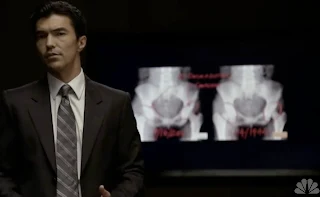
Here's the scene in the second episode that shows us what the US government knows about the aliens' biology:


Agent Lee:  Well, as you can see, outwardly they look very much like us, which could indicate a common ancestor, or even a parallel evolutionary process. But there are differences.

Now, initially, scientists were only able to detect small variations in their circulatory systems and blood composition. But over time it became clear that they age at a much slower rate that we do. Meaning that there had to be substantial differences we couldn't detect and that we didn't understand.

Now recent advances in DNA sequencing are starting to change that. We now know their DNA varies from ours by slightly less than 1%.

President Martinez: 1%? So they're people.

Blake Sterling: They're absolutely not. 1% is actually quite significant genetically. A chimpanzee's DNA differs from ours by only 2%, for example.
When I first saw that scene, my first reaction was "Wow, they are closely related to humans", followed by a puzzled "How are they not people?"   I suppose it all comes down to your definition of a "person.

It's true that a difference in genomic DNA sequence of even "slightly less than 1%" is significant.  It would definitely make the aliens a different species than Homo sapiens. They are not modern humans. But while they aren't human, they are more genetically similar to us than our close primate cousins the chimpanzees.

Reconstructed Neandertal family.  People?
Depending on the method you use to calculate similarity, human and chimp genomes differ anywhere from 1% to 6%.  That means you can't really compare the information thrown out in The Event. But the method of genome comparison that shows a 1.2% genomic difference between humans and chimps, shows a difference between the human and Neandertal genomes of 0.3%.

The ancestors of humans and chimps diverged roughly 6.5 millions years ago.  The ancestors of humans and Neandertals diverged between 500,000 and 800,000 years ago.  
I'd put the difference between the DNA of humans and the aliens of The Event somewhere between chimpanzees and Neandertals.  That means the ancestors the "aliens" would have split off from our human ancestors a couple of million years ago.

So what does that mean for the evolutionary origins of the aliens? 

Based on the similarity of their genome to humans, I'd say it would be extraordinarily unlikely that the aliens (or "aliens") originated anywhere other than Earth.  To produce intelligent humanoids more genetically similar to humans than other Earthly primates, evolution would have had to progress identically on Earth and on an alien world for many millions of years. That just couldn't happen – at least not without some sort of supernatural or superhuman intervention.

Where have the "aliens" been all this time? Perhaps they were moved from the Earth to another planet by more technologically advanced aliens.  Or maybe they've been living in an isolated enclave right here on Earth for a million years.  If it turns out they had been living all those millennia on a plateau in the South American jungle, on a tropical island in the Pacific, or in a valley high in the Himalayas, that would be a nice reference to the science fictiony "lost civilization" stories of the early 20th century.

I'm hoping that the origins of the "aliens" turns out to be both interesting and not entirely inconsistent with biology. Of course depictions of evolution in Hollywood unfortunately tend to be really bad, so I'm not going to be too surprised if the story ends up disappointingly silly.

So terrestrial origin or no, that leaves the question of whether the aliens are "people".

Maybe I've watched and read too much science fiction, but I consider any humanoid sentient being to be a "person". The Event's aliens are more similar to humans than Klingons or Vulcans or Minbari or Centauri or Gallifreyans - of course they are people!

Whether they turn out to be "people" with friendly intentions towards Homo sapiens remains to be seen.

---

Watch episodes of The Event on Hulu. (available only in the US, and only for a limited time)

Further technical reading on human evolution:
• Cohen J. Relative Differences: The Myth of 1%.  Science 316: 1836 (2007)(pdf)).
• Green RE et al. A Draft Sequence of the Neandertal Genome. Science 328:710-722. (2010) (pdf))
• Smithsonian National Museum of Natural History: What does it mean to be human? 

Top image: Still from The Event episode "To Keep Us Safe". Agent Lee points out key features of the alien anatomy he knows so well.

Bottom image: Reconstruction of a Neandertal group. © Johannes Krause.  Source: Neandertal Genome Project Press Kit.


1. There is also a plot line with a computer programming genius trying to rescue his sexy fiance  (apparently a scientist of some sort), who has been kidnapped by a homicidal group whose origins and plans are unclear.  Their story line isn't nearly as interesting as the interactions between Sophia and the President Martinez.  Hopefully that will change.

Thursday, August 12, 2010

Great FSM! Futurama Mocks Attacks on Evolution!

Tonight's episode of Futurama - "A Clockwork Origin" - spoofed creationist attacks on evolution.
Subtle it was not, but funny it was.

The appearance of the  Flying Spaghetti Monster suggests that at least one of the show's writers is hip to the internet version of the the evolution vs. creationism "debate".

Watch a clip.
FuturamaThursdays 10pm / 9c
Preview - Evolution Under Attack
www.comedycentral.com
Futurama New EpisodesRoast of David HasselhoffIt's Always Sunny in Philadelphia

The episode's robot evolution theme made me think of the finale of Battlestar Galactica, particularly when Bender finds "evidence" of ancient robots  (a spring) at Olduvai Gorge. Yes it's silly, but the ending of BG was pretty silly too.

For a more serious SF take on human evolution, you could read Mike Resnick's "Seven Views of Olduvai Gorge" at Subterranean Press.

For factual information about evolutionary biology, I recommend:
And if you are interested in one of the real recent controversies in primate evolution, check out Brian Switek's  article "Ancestor or Adapiform? Darwinius and the Search for Our Early Primate Ancestors" in the most recent issue of Evolution, Education and Outreach.

Thursday, January 21, 2010

More Pandoran Biology

Now that Avatar has won the Golden Globe Award for Best Picture and there is buzz that it could take top honors at the Oscars, I figured a round up of links about Pandoran biology would be timely:

• Darren Naish has written up the Tet Zoo Guide to the Creatures of Avatar
A lot of thought and time obviously went into the design of Pandora's ecosystem and creatures. In part, I'd say that this was a success: a lot of people (even many not that interested in the natural world) have been very much taken in by the movie's xenobiology - if only this inspired them to become interested in, and passionate about, the biology and ecology of the real world.
 Read his spoilery speculations on the biology of Avatar's creatures.

• io9 interviewed some of the designers who worked on Avatar

Read how the movie's Bio-Lab was inspired by a visit to biotech company AmGen, why the plant life was green instead of cyan, and how human "drivers" might control their avatars from a distance.

• Production designer Rick Carter explained the inspiration for Pandora's bioluminescent wildlife.
Cameron's inspiration for that, Carter believes, came from his deep-sea diving experiences. "The whole idea of (that) bioluminescent world at night is something he'd actually witnessed when he was down at the bottom of the ocean during his 'Titanic' time," Carter says. "That bioluminescence is almost like a nervous system of the planet, and that's what's at stake in the movie, as you start to get past the initial foray into the Na'vi culture and seeing the drama start to emerge between the military-industrial complex that wants to exploit the world."

• At The Intersection Sheril Kirshenbaum shares what she enjoyed about the movie's science
Sigourney Weaver’s portrayal of a research scientist was uncharacteristically good. Instead of the typical caricature we see in Hollywood, she wasn’t socially inept (i.e. typical Rick Moranis roles) or out to destroy everything (i.e. Dr. Evil). Instead, Grace conveyed the natural curiosity about the world that I observe so often in colleagues. Also noteworthy, she was funded by a program with corporate interests, but really using the opportunity to pursue her own research. Sound familiar to anyone?
• Peter Watts commented a bit on Pandora's biology in his review of the movie
 Someone put a lot of thought into Pandora’s wildlife; it was beautiful to behold, it was amazingly diverse, it even seemed (for the most part) phylogenetically consistent. Across a wide range of species, everything from nostril placement to jaw structure was nicely suggestive of common ancestry. Except for the Na’vi, which are ridiculously anthropomorphic: tetrapod bipeds where everything else on the planet seems to have six limbs; binocular vision on a world where four eyes is the vertebrate norm.
 Read the post for the rest of his (spoilery) comments.

• Astrobiology Magazine: Avatar's Moon Pandora Could be Real
So far, planet searches have spotted hundreds of Jupiter-sized objects in a range of orbits. Gas giants, while easier to detect, could not serve as homes for life as we know it. However, scientists have speculated whether a rocky moon orbiting a gas giant could be life-friendly, if that planet orbited within the star’s habitable zone (the region warm enough for liquid water to exist).
The gist of the article is that moon with life could exist, and if it does, astronomers should be able to detect it.

And if that's not enough, you could order a copy of the official Pandora field guide: Avatar: A Confidential Report on the Biological and Social History of Pandora


Related Biology in Science Fiction posts:

Tuesday, January 12, 2010

Science Fiction as Adam's Apple


The Human Words of God speak of the Creation in terms that could be understood by the men of old. There is no talk of galaxies or genes, for such terms would have confused them greatly! But must we therefore take as scientific fact the story that the world was created in six days, thus making a nonsense of observable data? God cannot be held to the narrowness of literal and materialistic interpretations, nor measured by Human measurements, for His days are eons, and a thousand ages of our time are like an evening to Him. Unlike some other religions, we have never felt it served a higher purpose to lie to children about geology.


~ Of the Creation, And of the Naming of the Animals. Spoken by Adam One, founder and leader of God's Gardeners. (The Year of the Flood: A Novel by Margaret Atwood, 2009)

Over the past week an ignorant attack on science fiction by David Cloud of the Fundamental Baptist Information Service has been making its way across the SF blogosphere. I started to write a detailed post about what was wrong with Cloud's reasoning, but once you get past the major underlying problem - that he rejects post-18th century science while claiming that he doesn't -  the rest is mostly trivia.

For example, the 5 dead authors Cloud lists (Asimov, Clarke, Heinlein, Vonegut, Sagan, Roddenberry) do not represent all science fiction authors, who come from many different religious backgrounds and sometimes write religious-themed science fiction.   There's even a whole blog devoted to religion in science fiction which is a great resource for people who are actually interested in the subject.

Cloud also puzzlingly calls astronomer and science popularizer Carl Sagan a "prominent evolutionary scientist".  I suspect that Cloud is using the term "evolution" to mean "science that conflicts with my world view" (i.e., all modern science),  which then makes a certain kind of sense to consider an astronomer an "evolutionary scientist" and to claim that science fiction is all based on an "evolutionary worldview".  Perhaps that's common usage among Cloud's target audience, and he simply doesn't care that it makes it appear that he is too lazy to look up basic facts to the rest of us. Or he really thinks that all science is evolution (??). 

Anyway, beyond my amusement that someone out there seems to believe that most science fiction arose from and is based on evolutionary biology, I actually find myself agreeing with Cloud's basic premise. No, not that evolution is false. Rather that science fiction often gives the appearance of simple entertainment while insidiously promoting a scientific world view.

In most science fictional universes it's assumed that the Earth and the stars are billions of years old, that species - including man - can change over time and be changed by scientists, that our exploration of astronomy and physics and chemistry will eventually carry us to the stars,  that there are other wolds that also carry life. Even when the science in SF is inaccurate or scientists are portrayed as evil or immoral, the underlying assumption is that science works.  I can well imagine science fiction inspiring in a curious reader (or watcher) a lifelong interest in the natural world or even lead to a career as a scientist.

Add to the mix of entertaining stories and scientific worldview the irreligiousness (or non-Christian religious beliefs) of many SF characters, and it's easy to imagine science fiction leading impressionable minds astray from Cloud's version of Christianity.

And that's not a bad thing at all.

(link via Steven Gould)

Image: Church of the Flying Spaghetti Monster propaganda
Tags:,

Friday, December 18, 2009

Holiday Free Fiction: The Christmas Count


The sky over the river is already light and I’m still six miles from his house -- ten more minutes. Provided I don’t get caught at the tracks by some goddamned, two-hundred-car freight train. Ron will have his audio equipment out, but it won’t do us any good. Not this late. Once the sun’s up, even a set-up as good as Ron’s is pretty much useless for calling in owls. Great-horned, screech, barred; usually Ron and I can call in at least two out of the three. Not this year. Maybe someone else in the McCarron count circle will have owls on their list, but it won’t be us. Two years ago the count had none at all, and Clover County beat us by two species. Two lousy species.
For over a century the Audubon society has sponsored a Christmas Bird Count, in which ordinary people help take a census of birds throughout the Americas. In the not so near future biotechnology may allow Christmas counters to spot birds that haven't been seen in decades . . .

Read "The Christmas Count" by David B. Coe.

Image: Passenger Pigeon, Ectopistes migratorius, from Orthogenetic Evolution in the Pigeons, 1920 (from Wikimedia Commons)

Tags:,

Tuesday, December 08, 2009

Censoring Darwin

At the Science and Entertainment Exchange blog, geneticist and Lecturer in Science Communication Studies David A. Kirby has a very interesting post about "Creation, Darwin, and Movie Censorship". It's mostly about the difficulty the Darwin-biopic Creation has had finding a U.S. distributor, but Kirby also takes a look at the general depiction of evolution in the movies, particularly the "mad evolutionists" in the post-Scopes trial horror movies of the 1920s and 1930s. Surprisingly, even the negative depiction of evolutionary biologists in those films wasn't good enough for them to escape censorship:

For example, filmmakers had to remove any reference to Darwin from the horror film Dr. Renault’s Secret to avoid offending religious people. The [Production Code Administration’s] judgment on the film reads: “The story is based on theories of human origin in such a way that, if presented to the public, will undoubtedly offend the sensibilities of large groups of religious people of different faiths, and accordingly, could not be approved under the provisions of the code.” Of course, such a judgment would have killed the film’s commercial value so after consultation with the executive producers and the studio executives: “It was agreed to eliminate any reference to Darwin or to his theory, and to establish the ape as a throwback."
Those currently fighting to keep religion out of the science classroom should take small comfort in the fact that at least Darwin and evolutionary theory is no longer considered to be too shocking to even be mentioned on screen.

But what if Darwin's opponents had succeeded in quashing the inclusion of evolutionary theory into the framework of the biological sciences? It's a bit hard for me to imagine, since the modern synthesis of genetics and evolution is so fundamental to our current understanding of biology.

But imagining bioscience without Darwin is what SF author Ted Kosmatka - a self-described "laboratory research drone" - has done in his novelette "The Prophet of Flores".

"Carlson, can you tell us in what year Darwin wrote On the Origin of Species?"
"1867", Paul siad
"Yes, and in what year did Darwin's theory finaly lose the confidence of the larger scientific community?"
"That was 1932," Anticipating this net question, Paul continued, "When Kohlhorster inventerd potassium-argon dating. The new dating method prove the earth wasn't as old as the evolutionists though."
"And in what year was the theory of evolution fianlly debuned completely?"
"1954, when Willard F. Libby invented carbon-14 dating at the University of Chicago. He won the Nobel prize in 1960 when he uswed carbon dating to prove, once and for all, that the Earth was 5,800 years old."
Now, in our world, Willard F. Libby did indeed win the 1960 Nobel Prize in Chemistry for his development of carbon-14 dating, but despite the arguments of the creationists, it did not prove the earth was young.

Also as in our world, the remains of tiny humans were discovered on the the Indonesian island of Flores. Study of Flores man - popularly nicknamed "Hobbits" - indicate that they are a new hominin species, Homo floresiensis. In the context of evolutionary theory, they are an interesting branch on the human family tree. In the absence of the framework of evolution they instead provoke a crisis of faith. It's an excellent story, well worth reading (or listening to).

Listen to "The Prophet of Flores" on StarShipSofa.

You can learn more about Homo floresiensis by watching the Nova program "Alien From Earth" (free online) or, if you are interested in more technical details, Nature's Flores man special issue (videos are free, most of the rest subscription only).

You can also read the first part of Kosmatka's zoological short story "Blood Dauber", written with Michael Poore and published in the October/November 2009 issue of Asimov's Science Fiction. (You'll have to get a dead tree copy to read the ending.)

Top Image: Artist Pure Evil's image of Charles Darwin made up of little monkeys (via Don't Panic Online).
Bottom Image: University of Wollongong scientists with a life-sized portrait of Homo floresiensis.

Tags:,

Tuesday, November 24, 2009

The Botany of Pandora

James Cameron's soon-to-be-released movie Avatar is about immersion in an alien environment:
We enter the alien world through the eyes of Jake Sully, a former Marine confined to a wheelchair. [. . . ] He is recruited to travel light years to the human outpost of Pandora, where corporations are mining a rare mineral that is key to solving Earth's energy crisis. Because the atmosphere of Pandora is toxic [to humans], they have created the Avatar Program, in which human "drivers" have their consciousness linked to an avatar, a remotely-controlled biological body that can survive in the lethal air. These avatars are genetically engineered hybrids of of human DNA mixed with DNA from the natives of Pandora... the Na'vi.
The visuals of Pandora - mostly CGI - look stunning. This video featurette gives a bit of background on how it was created.


Pandora is a lush tropical-looking world, a "garden of Eden with teeth and claws" in the words of Cameron.

To help create the lush backdrop for both the movie and the Avatar game, Cameron consulted with Jodie S. Holt, a Professor of Plant Physiology and Chair of the Department of Botany & Plant Sciences at UC Riverside. She also provided some pointers for Sigourney Weaver's botanist character. As Holt explains:
In 2007, I was asked to consult with an A-list actress who plays a botanist in the movie. She turned out to be Sigourney Weaver. My role was to advise her on how a botanist might dress and act. I met with her in her trailer in a sound studio in Playa del Rey in Los Angeles, and we had a long conversation. A set designer was also present during this meeting. I gave Weaver advice on topics like how a botanist would approach a plant and take samples. With the set designer, I later engaged in an email communication in which I advised him on the sets and equipment that Sigourney Weaver could use in her work as a botanist. I also shared information with him about plant physiology and plant sampling. For a period of months, we exchanged a number of images about equipment a botanist might use to study plants, and I wrote him short lectures on the plants.

Then, in the fall of 2008, I was told that James Cameron was developing a whole suite of game products. I was asked if I would help out by developing content around the plants that appear in the games. I agreed. So in December 2008 I met with Cameron and Jon Landau, the co-producer, in the sound studio, and agreed to develop wikipedia-type entries for the plants. In the game products, players can pause near a plant of interest and read up about it by clicking open an entry about that plant. I provided the content for these entries. Cameron and Landau were looking for credible botanical information for all these fantastic-looking plants. My challenge was to come up with explanations for why Pandora’s environment would select for the kinds of plants the game products have. Some of these plants are fluorescent, some can move, some can fire things off. Clearly, we’re not in Kansas anymore!

Watch a short video of Holt talking about her involvement with Avatar.

Watch a short video of Weaver talking about making Avatar.

Avatar will be released on December 18th.
Avatar the game is due to ship December 1. (It can be preordered through Amazon.com)

Top Image: Sigourney Weaver in her avatar body, via MarketSaw.
Bottom Image: Official Avatar movie still
Note: Links to Amazon.com are affiliate links. As an Amazon Associate I earn from qualifying purchases.