Showing posts with label ecology. Show all posts

Monday, November 19, 2012

At SIMF: Room needed on the Ark, for creatures great and small


I have a new post up over at Science in My Fiction - "Room Needed on the Ark" - that considers the following scenario: if Earth were in imminent danger of destruction and we had a space ark that could carry humans, animals, and plants to safety, how would we decide which animals to rescue? and how many individuals of each species we'd need to bring along?

Part of the answer depends, of course, on what the goal would be. Setting up a human colony on another planet might have different requirements than if the goal was to restore life on a ravaged Earth. To set up brand new self-sustaining ecosystems would likely require a wide range of animals and plants, whereas a self-contained and highly technological settlement might not.

And I think there is a bigger picture to look at. If we want to be able to save species from going extinct, or to have a repository to maintain genetic variety in crop plants, we need to be collecting samples and genetic material now (which is being done). So if we want to keep our precious gene banks from danger, do we spread them out in multiple countries? or do we build a DNA library on the moon?

So many questions! Read "Room Needed on the Ark" and share what you think.

Image: Startling Stories, November 1939

Friday, September 07, 2012

Free Friday Flick: Denmark: Throwing off the Balance of Nature

This week's free flick is the 2010 short film "Denmark", a joint project of Daniel Fickle of Two Penguins Productions and the Portland Cello Project.  The film has won a number of awards on the film festival circuit.


The film uses a lovely combination of puppetry and rich cello music to tell the touching story of Pily, a resourceful crustacean who crafts a space ship to escape pollution poisoning his home in the Willamette River outside Portland, Oregon.


In an interview about the project (and in a comment on the video page) director Fickle talks about being inspired by the recording of "Denmark" to develop the film's story. The song was composed by cellist Gideon Freudmann, who wrote it to honor his wife after she died of cancer. Fickle expands the themes of sorrow and loss to changes in the environment.  As he explains it:
Since I used a more environmental vehicle to express the story, the ending could also be interoperated to be about displacement of species. Because of human pollution, it's causing various species to attempt to move to a better place. Sometimes it works, but usually it throws off the balance of nature.
And while that message is indeed specifically relevant to the long-polluted Willamette River, I think it can be interpreted more broadly, especially in light of ongoing climate change that threatens to displace species around the globe. Pretty heavy for a story featuring a puppet, right?

But it's not all serious. You can find out what happened to Pily after the movie in this interview where he talks about his upcoming projects:

Catching Up With Pily from Two Penguins on Vimeo.

Watch "Denmark" at Vimeo or YouTube.

Wednesday, February 29, 2012

Could the Solar System be Rife with Life?

Big Picture Science is a radio program produced by the SETI Institute's radio studio in Mountain View, California. SETI stand for earch for extra-terrestrial intelligence, but the Institute also is interested in the original and nature of life in the universe in general.

This week's radio show "Rife with Life" explored whether there could be life in our solar system somewhere other than Earth.

The discussion panel included planetary scientists Cynthia Phillips, Alexander Hayes, Rachel Mastrapa, Robert Lillis, who discuss the environmental conditions on the various bodies in our solar system that might support extraterrestrial life.

Joining them was science fiction writer Robert J. Sawyer, who talked about the appearance of aliens from around our solar system in fiction.

The tour of the solar system begins, naturally, on Mars.  It all started with HG Wells' War of the Worlds, in which a dying civilization on Mars invades Earth.  But Sawyer points out that it's not until Stanley Weinbaum's "A Martian Odyssey" that we get science fictional Martians who seem well adapted to the dry desert-like surface conditions on Mars.

But over the years it has become apparent that it's unlikely that there is any life (currently) on Mars, and so it has become less popular as a setting for alien cultures.  Kim Stanley Robinson's Mars trilogy, for example, assumes that Mars is essentially sterile when humans settle there and begin the terraforming process.

Sawyer predicts that there is going to be a renaissance of Mars-based science fiction in the near future. Not coincidentally, he's currently working on his own novel set on Mars, tentatively titled The Great Martian Fossil Rush.

After leaving Mars, the tour moves on to Jupiter and its moon Europa, Saturn's moons Titan and Enceladus, and even the Sun.   All of them have been used as the home of fictional aliens except Enceladus, so that's something to keep in mind if you are looking for an unusual setting for your next novel.

I recommend listening to the whole Big Picture Science episode "Rife with Life" for an interesting discussion of both the science and science fiction of possible extraterrestrial life in our solar system. Maybe we'll find life out there yet.

All of the stories discussed in the show are listed on the Big Picture Science blog. If you'd like to get a copy, you can find them here (links to Amazon.com are affiliate links):

Friday, February 25, 2011

Breaking Waves: Helping Fishermen in the Gulf

Nearly a year ago, BP's Deepwater Horizon oil rig in the Gulf of Mexico exploded, resulting in more than 200 million gallons of oil plus methane and other hydrocarbons spilling into the Gulf. Marine and wildlife ecosystems were terribly damaged, and the fishing and coastal tourism industries have been devastated.

At last week's AAAS meeting in Washington DC, microbial geochemist Samantha Joye reported that the seafloor and its inhabitants had not nearly recovered when they made a dive last December:
Usually, there is a tremendous diversity of infaunal organisms on the bottom. Then, we began to see dead organisms like brittle stars. I noticed there were no holothurians (sea cucumbers) and these organisms are tremendously abundant at seeps. So, it was a grim view. We saw a few crabs but they did not look healthy and we saw oiled and dead corals.
There are some expedition photos on Joye's blog.

And it's not just the ocean depths that are affected. Frances Beinecke - president of the Natural Resources Defense Council and commissioner on the National Commission on the BP Deepwater Horizon Oil Spill and Offshore Drilling - wrote in January:
Eight months have passed since the BP blowout, and still the damage and devastation continue. Tar balls continue to wash up along Gulf shores. Oil sheen trails in the wake of fishing boats. Wetlands marsh grass remains dying and fouled. Toxic crude lies offshore in deep water and in fine silts and sands onshore.

It's not clear how long it will take for the Gulf to recover - and it may never recover completely.

In the face of all that bleak news, I was pleased to discover that that the members of the Book View Cafe  have contributed to the recovery effort by creating the anthology Breaking Waves. The book is a collection of poetry, essays and fiction from award-winning science fiction and fantasy writers in support of the Gulf Coast Oil Spill Fund.  The Fund focuses on helping fishermen and their families in the Louisiana Parishes most affected by the massive oil spill there.

The table of contents:
I've linked to a few of the entries you can read online to get a sense of the contents.

You can purchase a copy of the DRM-free e-book at the Book View Cafe, or the Kindle edition at Amazon.com (affiliate link). Proceeds go to the Gulf Coast Oil Spill Fund.

Monday, October 04, 2010

SIMF: Night and Day

Excitement, enticement, shrilling from the sun-side of the world. I come! … The sun is changing again too. Sun is walking in the night! Sun is walking back to Summer in the warming of the light! … Warm is Me-Moggadeet Myself. Forget the bad-time winter. 

~"Love is the Plan, the Plan is Death", James Tiptree, Jr.

I have a new post up at Science in My Fiction that looks at how changes in the number of hours of light and darkness might affect biology on other planets.

Read "Night and Day".

Some of my other recent posts at SIMF:

Thursday, September 02, 2010

Paolo Bacigalupi: Science fiction that makes us look at the world through a different lens

In May Paolo Bacigalupi gave a talk at the Google offices in San Francisco, not long after winning the Nebula Award for his novel The Windup Girl

He talked about how science fiction can "stretch the normal" like a rubber band, that eventually snaps back and makes people look at the present differently (quoted from the transcript:

So the thing I like about science fiction is the opportunity to take what looks normal and then to twist it, to- to take an idea and stretch it out into some unreasonable place where you think the world is going to be safe and stable, and then to rip the floor out from underneath you and drop you into something else. Ideally that process is a bit like stretching a rubber band. You pull somebody out into a different world, and then you let the rubber band snap. And when people come back to this world they're going to look at our place now, the present, with a different lens as well. And that's really the thing that excites me about science fiction.
Bacigalupi also talks about using science fiction to make people environmental issues that might otherwise be ignored:
"[to] look at drought or look at how chemicals might disrupt our endocrine systems and turn us all into stupid people. Or how agricultural companies with their IP and their terminator genes might actually really change the way that we interact with food. [. . .] And maybe interact with in a more tangible, visceral way than we would otherwise.


[. . . ] Yes, I want my characters to be interesting. Yes I want my stories to be fascinating and gripping.  And yes, I actually am this evangelist banging on my pulpit trying to get people to pay attention to some things that are pretty interesting and fundamental. And that we mostly spend our time not looking at. And that we prefer not to.

He also reads from his disturbing short story "Pop Squad" and his all-too-plausible tale of drought "The Tamarisk Hunter"

Watch the video:


A few samples of Bacigalupi's short fiction with biological themes you can read for free:

Thursday, August 12, 2010

Humanity Dies, Earth Abides

There is an interesting article by Kenneth Brower in the Summer issue of California Magazine (the UC Berkeley Alumni Magazine) about re-reading the work of George R. Stewart, with a particular focus on Stewart's famous post-apocalyptic novel Earth Abides. 


Earth Abides starts with a quote from from Nobel-prize winning biochemist and virologist Wendell M. Stanley.
If a killing type of virus strain should suddenly arise by mutation . . . it could, because of the rapid transportation in which we indulge nowadays, be carried to the far corners of the earth and cause the deaths of millions of people 
~ WM Stanley in Chemical and Engineering News, Dec. 22, 1947
That's the premise that sets the story in motion: a "super measles" plague breaks out that kills almost every living human, (not to mention our close biological cousins the apes). UC Berkeley graduate student Isherwood Williams - Ish - happens to hiking in the mountains, working on his graduate thesis The Ecology of the Black Creek Area.  Ish is bitten by a rattlesnake, which lays him up for days in an empty cabin. It isn't until he returns towards the Bay Area that he realizes that amazoeveryone - or almost everyone is dead.

After driving across the United States and back1, he returns to his home - a thinly disguised Berkeley. He checks that the great University library is intact, and keeps that knowledge to himself as a sort of thin link to the civilization that died. He meets a few other survivors and the form a Tribe.

Meanwhile nature begins to take back the spaces that humanity used to fill. Cats and dogs and cattle go wild, and plants begin to overgrow the buildings.
As with the dogs and cats, so also with the grasses and flowers which man had long nourished. The clover and the blue-grass withered on the lawns, and the dandelions grew tall. In the flowerbed the water-loving asters wilted and drooped, and the weeds flourished. Deep within the camellias, the sap failed; they would bear no buds next spring. The leaves curled on the tips of the wisteria vines and the rose bushes, as they set themselves against the long drought. Foot by foot the wild cucumbers quickly sent their long vines across lawn and flowerbed and terrace. As once, when the armies of the empire were shattered and the strong barbarians poured in upon the soft provincials, so now the fierce weeds pressed in to destroy the pampered nurslings of man. 
There is a plague of ants, which lasts until the ant population crashes. That's followed by plagues of rats and grasshoppers and even cattle.  Mountain lions prowl the campus and dogs run in menacing packs. The message is that it takes time for the ecosystems of the depopulated Earth to become rebalanced in the absence of humans.

The Berkeley setting isn't particularly surprising, given that Stewart was a UC Berkeley Professor of English.  In his article, Brower notes that it's likely Stewart's ideas were influenced by his fellow faculty members (in addition to Wendell Stanley, quoted above):
The writer Ernest Callenbach (who himself owes a debt to Stewart for his California-of-the-future novel Ecotopia) supposes that Stewart's sensibilities must have been shaped at Faculty Club lunches with brilliant Berkeley scholars like the paleontologist Charles Camp, the geographer Carl Sauer, the wildlife biologist Starker Leopold, and the anthropologist Alfred Kroeber. (The Kroeber connection seems especially likely. "Ish" is doubtless a nod to Dr. Kroeber's friend and subject, Ishi, the California Yahi, last of his tribe and the final "wild" Indian in North America.)

Geographer Sauer, for example, rejected environmental determinism - the idea that the physical environment determines culture - and instead focused on the effect of humans on their environment, drawing some of his ideas from the work of Kroeber. As mentioned above, Kroeber is best known for his work with Ishi2, the last member of his tribe, much the same way Ish is one of the last of his kind.

Despite all that, the science in Earth Abides mostly appears as asides to the main story.  The novel is about Ish, his life after the Great Disaster and his death. I think that's one of the reasons the novel doesn't appeal that much to me.

Ish is a loner at heart, both before and after the Great Disaster. He is unable to effectively interest his fellow survivors (and later their children) with his book-based knowledge, and he and his Tribe spend decades living off canned food scrounged from supermarkets and the water still running through the municipal water pipes rather than setting up a sustainable system to feed themselves.  I want Ish to do more, to care more, to get some form of civilization up and running. I suppose I want intellectualism to be important to survival, not an affectation of no particular use for survival.

And another thing I've noticed on recently re-reading Earth Abides, is how much is a book for men. The women who survive the plague spend their time having babies and keeping house and being "given" to the men as partners. A depressing future.

Earth Abides was the first winner of the International Fantasy Award, and influenced many post-apocalyptic novels that followed, including Steven King's The Stand.

While the novel isn't one of my favorites, I think it's final message is true: whatever happens to humanity, the Earth and its other inhabitants will continue on without us.

Read "Natural Affinities: Reading George Stewart in Antarctica" by Kenneth Brower.
Earth Abides at Amazon.com (affiliate link)

1. Earth Abides was first published in 1949, before the creation of the interstate highway system. I found it amusing that when Ish starts driving across the desert and really lets the car fly he's only traveling at 80 miles per hour.

2. Of course in science fiction circles Alfred Kroeber is probably best know as the father of Ursula Le Guin. His work clearly influenced Le Guins own fiction.


Top Image: Ruined Church © Copyright Jonathan Wilkins and licensed for reuse under this Creative Commons Licence
Bottom Image: Berlin Ghost Town by Snowfalcon

Sunday, January 24, 2010

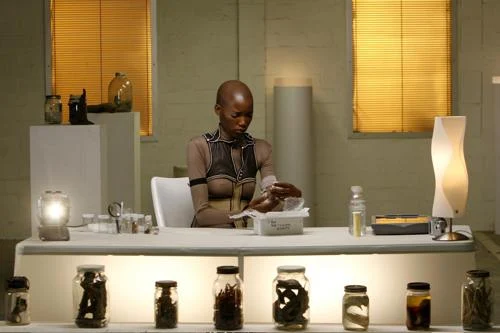
Pumzi : African Science Fiction


Pumzi is a 20 minute science fiction film by Kenyan director Wanuri Kahiu which had its US premier at the Sundance Film Festival this week. The movie takes place 35 years after World War III, the "Water War":
Nature is extinct. The outside is dead. Asha lives and works as a museum curator in one of the indoor communities set up by the Maitu Council [in East Africa]. When she receives a box in the mail containing soil, she plants an old seed in it and the seed starts to germinate instantly. Asha appeals to the Council to grant her permission to investigate the possibility of life on the outside but the Council denies her exit visa. Asha breaks out of the inside community to go into the dead and derelict outside to plant the growing seedling and possibly find life on the outside.

Watch the trailer:


Kahiu's last movie, the 2008 drama From a Whisper, depicted the aftermath of the 1998 US Embassy in Nairobi and won 5 African Movie Academy Awards.  

Kahiu has expressed some frustration in her blog about reporters questioning her decision to make make a science fiction film:

Yesterday, I did an interview and the reporter asked if Science Fiction is new to Africa. Mmmmm… yes and no. If you listen to the stories that have been told for generations, elements of fantasy, science fiction have always existed within them. [. . . ] I am just a new generation of storyteller, using cinema as my tool. The genre means less to me than the story. PUMZI chose to be Sci-Fi. The story dictated the genre.

[. . .]


Another interview I did a while back in South Africa asked why I would chose to do a Sci-Fi film when there were so many other stories to tell. What? How does that make sense? First, the genre does not dictate the story. Second, (I can feel myself getting hot at the memory) who decides the limitations of imagination? What story am I supposed to tell? Is there a formula that I have to follow because I was born in Kenya? Really? Really????? Aurghhhhhhhhhhh…
 I find the idea that some stories are meant to be told through science fiction to be a compelling one.  It's not just that science fiction allows exploration of "what if" ideas, it's that SF settings can be used to tell stories that transcend present-day social and political boundaries.  As Kahiu notes:
PUMZI is based on a futuristic Africa where borders cease to exist and the people who own the resources control the communities.  Familiar, no?

According to  the Wired Underwire blog, Kahiu hopes to offer Pumzi online, and plans to eventually expand the story into a feature length film.
 
(via SF Signal)

Tags:,

Sunday, December 27, 2009

@ The Reef Tank: Arthur C. Clarke and the Grand Banks

I have a new guest post up at The Reef Tank blog: Arthur C. Clarke and The Grand Banks, which takes a look at how Arthur C. Clarke's scuba diving adventures off the coast of Australia and Sri Lanka influenced some of his fiction.

Tags:,

Monday, May 25, 2009

Do you know where your towel is?

It is an important and popular fact thatthings are not alwasys what they seem. For instance, on the planet Earth, many had always asumed that he was mor intelligent than dolphins because he had achieved so much - the wheel, New York, wars and so on - while all the dolphins had ever done was much about in the water having a good time. But conversely, the dolphins had always believed that they were far more intelligent than man - for precisely the same reasons.
~ The Hitchhiker's Guide to the Galaxy by Douglas Adams (1979)
If you happen to see someone walking down the street this afternoon wearing nothing but a towel, Don't Panic! She's probably just celebrating Towel Day in tribute to the late Douglas Adams. Click the link for pictures, posts and related information. If you upload your own towelish photo to Flickr and you could win a cool Sony e-reader.

Adams was not only the author of the Hitchhikers Guide the Galaxy and many other humorous science fictiony novels. He was also deeply interested in wildlife conservation. In the mid-1980s Adams and biologist Mark Carwardine traveled around the world to search for nearly extinct species, including the aye-aye in Madagascar, white rhinos in Zaire and the Yangtze River Dolphin in China. Those excursions were parlayed into a book,Last Chance to See, as well as a BBC radio series (UK listeners only, alas). And despite Adams' premature death in 2001, his legacy is living on in a new Last Chance to See TV series hosted by comedian Stephen Fry. It will be shown on BBC 2 beginning in August.

If you are in the UK, you can watch Fry and Carwardine discussing the original series and Douglas Adams' legacy here:


You can get the latest information about the series and related information on the unofficial Another Chance to See blog.

Image: Thumbs Up by kreg.steppe on Flickr.
Tags:, ,

Saturday, April 04, 2009

Biology in Science Fiction Mega Link Roundup: April 4 Edition

I've slowly - oh so slowly - been going through the links I collected for "future reading" over the past few months. I also had a link roundup post meant to be published in January that somehow never made it out of draft form. The result? A mega maxi link roundup!

General SF Rumination

Gerry Canavan presented a talk on "Science Fiction and Ecological Futurity" (via SF Signal)

Mike Brotherton: Why Science Fiction Rules the World (but not enough!!!)
More and more often these things are aspects of our modern reality that have no precendence in human history. Somehow history gets respect and people say it “repeats itself” even though that is not true. Science fiction isn’t exactly great at prediction, but the process is very useful for meeting the future with open eyes.
Jason Stoddard suggested that the burden of the modern science fiction writer is keeping up with scientific progress. In response, Jeremiah Tolbert explained why Stoddard is wrong. The central issue seems to be how important "realism" in science is to science fiction (via Futurismic).

Meanwhile, Megan at Teen Ink magazine is teaching teenagers how to research science before writing science fiction. (via io9)

BBC talked to Ken MacLeod, Paul Cornell, Iain Banks, and Ian Watson about whether science fiction needs to stay up to date with scientific breakthroughs to be relevant.

Arvind Mishra has a more detailed look at the First National Discussion on science fiction in India.

The Consumerist reports on a study showing people rate harder-to-pronounce words as "riskier". It's true for food additives and rolloer coasters - maybe it's true for alien names too?

Written Word

Vice Magazine interviewed Ursula Le Guin (via SF Signal):
Some sf writers decided a while ago that true sf can only be based on the so-called hard sciences—astronomy, physics, chemistry, engineering, computer science, and so on. The word “hard” brings some gender luggage along with it. And sure enough, these guys find stories based on the “soft,” or social, sciences to be a debased and squashy form of the genre. They see it as chick lit for geeks. So, OK. If anybody wants to build a ghetto inside the ghetto and live there, fine with me. But I wish this sectarianism hadn’t infected Wikipedia. If they want to call my stuff social science fiction, that’s fair enough. But so much of what I write isn’t sf at all.
Graham Sleight at Locus online: Yesterday's Tomorrows: Ursula K. Le Guin
[Left Hand of Darkness] traces a slow process of discovery — of Winter and its inhabitants. In that respect, in that it's about finding out, it's a perfectly science-fictional work. (The later Ace edition carries a provocative introduction by Le Guin, in which she administers a few well-judged kicks to the idea of sf as narrowly extrapolative or predictive.) We find out, for instance, via Chapter 7 how and why the Gethenian biology was created. This chapter is an ethnologist's report on the planet — what would, in other circumstances, be considered an "infodump." But Le Guin is so thoughtful a writer, the implications of her thought-experiments so thoroughly and deeply felt, that you find yourself wanting to hear this information, even if it is couched in as dry a form as this.


Mur Lafferty at Tor.com reviews Scott Sigler's Contagious.

Peter Watts reports that his novel Blindsight is "going to be a required text for a Biological Psychology course at the University of Miami"

Brian Switek at Laelaps rants about Monster, a creationist anthropology thriller:
Peretti also mentions that his favorite author (and chief writing influence) was Michael Crichton, and this makes sense. Not only does the book have an anti-science bent, but it reads as a sort of mash-up between Jurassic Park, Congo, and Icons of Evolution. Even though it is a monster story, the author makes it clear that the real monsters are the immoral evolutionists who will stop at almost nothing to uphold their crumbling intellectual doctrine.
Jeff Carlson writes about the background behind his novel Plague Year

Nancy Kress reviews Kazuo Ishiguro's Never Let Me Go and talks about "cloning-for-organ-donation" in SF in general.

Kress also looks at genetically modified mosquitos, as they appeared in her biothriller Stinger, and in real life.

Jo Walton writes at Tor.com about Octavia Butler's Survivor, a novel Butler repudiated and refused to be a allowed to be reprinted. Part of her problem is the simple interbreeding of humans and aliens, and the way the novel depicts race and color (literally).

Jo Walton also looks at aliens and sapience in H. Beam Piper's Fuzzy novels

Annalee Newitz at io9.com: The Rise of Science Among Insects in Greg Egan's Incandescence

NK Jemisin reviewed Naomi Novik's Temeraire novel Victory of Eagles last August for Fantasy Magazine and the discussion touched on alternative evolution.

Peter Watts posts a proposal for a new novel, Dumbspeech.

DamienBarret has a great Flickr set of his visit to Alan Dean Foster's house. He got to see Foster's awards and decorations including a "fossilized critter" that "might help ADF with his depictions of the Thranx or other insectile cratures in his books."


Television

The Oyster's Garter takes a look at what the Earth was really like 150,000 years ago, when the Battlestar Galactica folks landed in Africa.

James F. McGrath at Exploring Our Matrix writes about John the robot in Sarah Connor Chronicles who questions why God didn't make humans with more ball socket joints and uses to talk about evolutionand "the image of God" (via io9)

Science Not Fiction talks about the real science of Sanctuary's abnormals, gives the lowdown on Sanctuary's Bad Bad Prions, and looks at the series' gene therapy

Charlie Jane Anders at io9: Kyle XY: How Not To Do a TV Series Finale

Science Not Fiction: Battlestar Galactica, Self-Repairing Material and biofilms

Movies

ScienceOnline: Alexis Gambis brings science and film together to create a new genre of science fiction (ScienceOnline is a project of NYU's Science, Health and Environmental Reporting Program)

George Dvorsky posts about young filmmaker Jason Silva's short film "The Immortalists", which is "a love letter to science and philosophy that explores the idea of engineered radical life extension and biological immortality"

T. Ryan Gregory at Genomicron: Would you act as a consultant on a scifi movie? And more importantly, would you accept compensation if you did?

Jonathan Fahey at Forbes.com writes about The Science Behind 'Watchmen' and the teaming of Hollywood with scientists

John Scalzi @ SciFi Scanner on Video Game Movies:
In point of fact, the average gamer is nearly thirty, not dumb, and while he may enjoy bombs, blood and babes, I'm willing to bet he'd happily see a movie that doesn't assume he's stupid. When I watched Doom, the scene where a scientist explained that a certain percentage of the human genome has never been mapped (and the part that hasn't, well, that's your soul, you see) made me want to throw a rock through my TV -- which is ironic, as the film stars The Rock.
SciFi Scanner looks at directors that include some real science in their science fiction. Included are Andrew Niccol, director of Gattaca and Steven Spielberg, director of Jurassic Park (and lots of other movies, of course).

Matthe Nisbet at Framing Science: "What about the "Gattaca" Effect on Perceptions of Medical Cloning?"

James Sanford takes another look at GATTACA, plucked from Rotten Tomatoes' list of "Ten Sci-Fi Flicks for the Thinking Man... or Woman".

At Nature Jascha Hoffman reviews films about science at the Sundance Film Festival (subscription required). LabLit.com points out that "it seems a lot of this was more medical than scientific, with tales of mental breakdown, bipolar disorder, autism and psychopathology."

Scientific American 60-Second Science: Science at the Oscars

Ain't it Cool News reports that Ronald D. Moore's prequel to The Thing will be directed by Matthijs Van Heijningen, who is an experienced director of commercials. Hopefully he can make the transition from the 15 second to 90 minute storytelling. In any case, it's supposedly heavily based on John W. Campbell's 1938 novella "Who Goes There?", which I'd think makes it a remake of John Carpenter's 1982 The Thing, which itself was a remake of the 1951 move The Thing From Another World, rather than a prequel. Don't moviemakers realize there are SF stories out there that have never been made into movies? But what do I know.

Darren Naish at Tetrapod Zoology reports on the whereabouts of the Krayt dragon skeleton from Star Wars Episode IV: A New Hope.

BoingBoinger Xeni Jardin reviews her favorite B-Movie - The Food of the Goods - for Fancast.

Repo! The Genetic Opera is coming to DVD. Genevieve Valentine at Tor.com rounds up the special features. BloodyDisguisting.com has an exclusive peek at the DVD's "Sing-Along" feature.

io9 has a nice clip of Vegan Horror, Sheep Punching, and a Lot of Fart Jokes (with a clip from Black Sheep)

Miscellaneous

Torsten Reil gave a TED talk on how he studies biology to make realistic animation.

John Holbo at Crooked Timber points out that Jack Kirby's comic books are really bad on evolution and Norm Doering has more on creationist misconceptions about evolution that seem to be based on comic book science.

An article in the January 2009 issue of Scientific American looked at the depiction of evolution in the game Spore.

NotCot visited Alien Fresh Jerky in Baker - a small town out in the California desert between Barstow and Las Vegas. Despite the name, they don't sell jerky made from aliens, which might or might not be tasty. No, what they sell is beef jerky made from abducted cows and other alien-related products. Sounds awesome.

Correlation vs. causation: There are fewer babies and fewer storks - is it pollution? or space aliens?

Tags:,

Monday, March 16, 2009

The Family Tree

Sorry for my absence, dear readers. My dad passed away on February 28th, and I'm still getting myself back up to speed. If you are interested, you can follow the link to see some photos and some of my memories. I miss him very much.

I've spent more time in my childhood bedroom in the past few months than I have in many years. While most of my junk precious possessions were moved out long ago, I did find a variety of paperbacks - some I recognize as mine, others not so much. There was a really bad SF novel1 that I'm sure my brother purchased (I refuse to take any responsibility for it, anyway).

I also came across my copy of Sheri Tepper's novel The Family Tree. It's actually one of the first SF novels I selected specifically because of its biological themes. There are actually two parallel plots: in a world very much like our present day, police officer Dora Henry investigates the murder of several geneticists, tries to figure out why rapidly growing trees and weeds seem to be taking over, while recovering from the breakup of her loveless marriage. The second plot takes place in a fantasy-like world, with royal families, limited technology, working magic, and sentient trees. There an unlikely band of travelers finds themselves on a quest that they believe will save the world. As you would expect, the two seemingly separate tales eventually become one.
"Dr. Winston was always getting himself in trouble with the boss, but he used to say every time he isolated a particular combination of genetic instructions and saw what the effect was, he'd filled in a bit of knowledge. [...] Winnie really opened our eyes to the possibilities. He was working on clusters, you see. Discrete genetic items that added up to more than the sum of the parts. One change in skull structure plus one change in hormonal tissue, plus or minus some other odds and ends, gave us horns on a pig. [...] Some brain modifications, other change in skull structure to make it curved instead of flat, and a change in throat and tongue structure should theoretically give us a sheepdog that could talk to the shepherd."
~ The Family Tree, Sheri S. Tepper, 1998
I have mixed feelings about the story. I found the fantasy part of the novel a bit too cute for my tastes, and the message - that man is destroying the environment and that genetic engineering may have long term consequences - a bit heavy handed.

If you've read Tepper's other novels, that environmental message shouldn't come as any surprise, since it's a recurring theme in her novels. As she told Locus in 1998:
''I happen to be obsessed by some subjects. There's the whole card of environmental issues, the extinction of species after species. To my mind, the expression of divinity is in variety, and the more variable the creation, the more variable the creatures that surround us, botanical and zoological, the more chance we have to learn and to see into life itself, nature itself. If we were just human beings, living in a spaceship, with an algae farm to give us food, we would not be moved to learn nearly as many things as we are moved by living on a world, surrounded by all kinds of variety. And when I see that variety being first decimated, and then halved – and I imagine in another hundred years it may be down by 90% and there'll be only 10% of what we had when I was a child – that makes me very sad, and very despairing, because we need variety. We came from that, we were born from that, it's our world, the world in which we became what we have become."
The science isn't described in much detail and I don't think it's particularly plausible. All that having been said, I did find most of it entertaining, an the way she brought the two story lines together was clever. It was definitely worth rereading.

1. The author writes in the postscript that the novel was rejected many times, and that it wasn't until he was famous that he found a publisher for it. I'm not at all surprised.

Tags:,

Thursday, December 18, 2008

Living in a Pocket Biosphere

Mstislav, our most dedicated gardener now that Sledge rarely emerges from the Attic, has been tinkering with the carbon-dioxide balance, a dangerous but crucial sport. At six or seven hundred parts per million, the air in here is dreadful but sustains life. Regular jiggering of organic functions is needed to keep the ratio from ballooning to something deadly. To make a long story short, after an alarmingly high reading Mstislav discovered a mound of rotting mangrove fronds under a seemingly healthy hillock of wheatgrass—a camouflaged nightmare of poison-leaching compost. Endgame for us could be that simple, that foolish.
~ "Lostronaut" by Jonathan Lethem
Half of the oxygen in the air we breathe is produced by phytoplankton, tiny plants living in Earth's oceans. The plant life is crucial to maintaining the proper balance of gases in Earth's biosphere. It's only natural, then, that NASA has been trying to develop efficient bioregenerative life support systems that incorporate plants and bacteria for long term space settlements and space stations.

It's not an easy problem, though, either scientifically or politically, as NASA scientists pointed out back in 1997.
"If the current [funding] level is maintained, I would not expect to see a functional ground-based regenerative system for 10-15 years, or a space-rated system for 15-20 years," Finger said. "If a long-duration manned mission becomes a reality, then I would expect the budget to increase significantly for all aspects of life support research."

In addition to the reality of funding, doubts about the reliability of biological systems remain fixed in many people’s minds. Can a closed system recycle waste material quickly enough to renew vital resources? Will the reduced gravity environment of space affect the biological system in ways we cannot assess on Earth? What back-up life support must lunar or planetary colonies have if a plant-based system should fail? Above all, is the concept truly feasible?

"The challenges of designing a working bioregenerative life support system are gargantuan," Morris admitted. He noted that investigators will need to find ways to make such a system extraordinarily compact and energy-efficient. Physicochemical back-up systems add a slew of weight and energy requirements.

Browsing through the NASA web site, it doesn't look like there has been too much progress in the past ten years. The International Space Station (ISS) has a Plant Research Unit is being used to study the effects of microgravity on plant growth and reproduction . It's important research to determine the best plant strains and growth conditions for low gravity environments, but it's just one of the first steps in developing a self-sustaining environment. Science not Fiction has more about NASA's plant research.

But science fiction steps in where science has yet to go. Jonathan Letham's short story "Lostronaut", published in the November 17th issue of The New Yorker, is set on a space station orbiting Earth. The Chinese have planted mines below the station's orbit, preventing the astronauts from leaving the station or supplies from being delivered. They are completely dependent on the the slowly deteriorating systems, including the plant beds that provide them with oxygen and absorb excess carbon dioxide. Letham doesn't provide a lot of scientific details, but does give us a moving story of memory and love and death and life.

Read Jonathan Lethem's "Lostronaut"

For more technical information about plant research on the International Space Station, see "Factors Affecting the Utilization of the International Space Station for Research in the Biological and Physical Sciences" (2003)

Top Image: 39-inch closed glass Ecosphere in the Rose Center for Earth and Space, American Museum of Natural History. The sphere is a closed ecosystem containing small shrimp, bacteria and algae in salt water. Credit: me.

Bottom Image: Corn growing under red LED grow lights, which would be efficient for growing plants in space. Source: NASA.


Tags:, ,

Tuesday, December 16, 2008

2008 Holiday Gift Guide: Science Fiction Novels With A Bit of Biology

Tis the season and all that, so if you haven't finished your holiday gift shopping I thought I'd make a few suggestions.

I don't think it should surprise any of you that books are at the top of my list, both for giving and receiving. Here are a few recent science fiction novels with a bit of biology that I blogged about this year (note: all Amazon.com links are affiliate links):


Infected: A Novel by Scott Sigler (read the original post). Sigler's follow-up novel, Contagious, will be released in hardcover on December 30th.
Unwelcome Bodies ,a short story collection by Jennifer Pelland (read the original post).
Dr. Franklin's Island, a young adult novel by Ann Halam (read the original post).
Ratha's Courage is another young adult novel (read the original post). It's the long-awaited fifth book in Clare Bell's "The Named" series.
Dogs by Nancy Kress is (read the original post) is a biological warfare thriller.
Seeds of Change is an anthology featuring short stories by Tobias Buckell, Ken MacLeod, Nnedi Okorafor-Mbachu, KD Wentworth, Jeremiah Tolbert, Jay Lake, Ted Kosmatka, Blake Charlton, Mark Budz and John Joseph Adams. (Read the original post)
Neuropath by R. Scott Bakker and Blindsight by Peter Watts may represent a new SF movement: neuropunk. (Read the original post)

Riders of the Storm is the latest novel set in Julie Czerneda's Clan Chronicles universe. (read the original post)
Paul McAuley's The Quiet War features engineering of both people and ecosystems.(Read the original post)
Invertebrata Enigmatica: Giant Spiders, Dangerous Insects, and Other Strange Invertebrates in Classic Science Fiction and Fantasy, edited by Chad Arment is a collection of SF short stories "involving strange invertebrates". I haven't read it - or blogged about it - but it sounds like fun.

And if none of those sound interesting, you might check out the Biology in Science Fiction bookstore, assembled by yours truly.

There are 2 days left to order from Amazon.com with free shipping and still have the package delivered by Christmas - three days if you are ordering from Amazon.co.uk - so you can even shop from the comfort of your own home. All Amazon.com links are affiliate links.
Note: Links to Amazon.com are affiliate links. As an Amazon Associate I earn from qualifying purchases.