Showing posts with label written word: short fiction. Show all posts

Saturday, November 03, 2012

OMNI Magazine free!

More than 200 scanned issues of OMNI magazine, originally published between 1978 and 1995, are now available for download at the Internet Archive. Totally free and presumably legal! (can you tell I'm excited?) While the science may be looking a bit dated now - and some of the UFO and "fringe" science was never very plausible to begin with - the short science fiction was and is fantastic.

I had a subscription to OMNI through high school and college, and up until that point most of my SF reading had been much older stories, like the Heinlein juveniles and the old Asimov robot stories. Maybe William Gibson's "Johnny Mnemonic" and "Burning Chrome" don't seem cutting edge today, but 30 years ago they weren't like any science fiction I'd previously read.

If you are looking for someplace to start, I'd suggest Best of OMNI Science Fiction #1 (1980). It includes GRR Martin's "Sandkings", Orson Scott Card's "Unaccompanied Sonata", plus stories by Isaac Asimov, Alfred Bester, Harlan Ellison, Robert Sheckley, Ben Bova, Roger Zelazny, Joe Haldeman and more.

Check out the fan-created Complete OMNI Index to find your favorites.

Image: Pierre Lacombe's cover of Best of OMNI #1.

Friday, February 25, 2011

Breaking Waves: Helping Fishermen in the Gulf

Nearly a year ago, BP's Deepwater Horizon oil rig in the Gulf of Mexico exploded, resulting in more than 200 million gallons of oil plus methane and other hydrocarbons spilling into the Gulf. Marine and wildlife ecosystems were terribly damaged, and the fishing and coastal tourism industries have been devastated.

At last week's AAAS meeting in Washington DC, microbial geochemist Samantha Joye reported that the seafloor and its inhabitants had not nearly recovered when they made a dive last December:
Usually, there is a tremendous diversity of infaunal organisms on the bottom. Then, we began to see dead organisms like brittle stars. I noticed there were no holothurians (sea cucumbers) and these organisms are tremendously abundant at seeps. So, it was a grim view. We saw a few crabs but they did not look healthy and we saw oiled and dead corals.
There are some expedition photos on Joye's blog.

And it's not just the ocean depths that are affected. Frances Beinecke - president of the Natural Resources Defense Council and commissioner on the National Commission on the BP Deepwater Horizon Oil Spill and Offshore Drilling - wrote in January:
Eight months have passed since the BP blowout, and still the damage and devastation continue. Tar balls continue to wash up along Gulf shores. Oil sheen trails in the wake of fishing boats. Wetlands marsh grass remains dying and fouled. Toxic crude lies offshore in deep water and in fine silts and sands onshore.

It's not clear how long it will take for the Gulf to recover - and it may never recover completely.

In the face of all that bleak news, I was pleased to discover that that the members of the Book View Cafe  have contributed to the recovery effort by creating the anthology Breaking Waves. The book is a collection of poetry, essays and fiction from award-winning science fiction and fantasy writers in support of the Gulf Coast Oil Spill Fund.  The Fund focuses on helping fishermen and their families in the Louisiana Parishes most affected by the massive oil spill there.

The table of contents:
I've linked to a few of the entries you can read online to get a sense of the contents.

You can purchase a copy of the DRM-free e-book at the Book View Cafe, or the Kindle edition at Amazon.com (affiliate link). Proceeds go to the Gulf Coast Oil Spill Fund.

Saturday, February 12, 2011

Just in time for Darwin Day: The Tangled Bank: Love, Wonder and Evolution

It is interesting to contemplate a tangled bank, clothed with many plants of many kinds, with birds singing on the bushes, with various insects flitting about, and with worms crawling through the damp earth, and to reflect that these elaborately constructed forms, so different from each other, and dependent upon each other in so complex a manner, have all been produced by laws acting around us. These laws, taken in the largest sense, being Growth with reproduction; Inheritance which is almost implied by reproduction; Variability from the indirect and direct action of the conditions of life, and from use and disuse; a Ratio of Increase so high as to lead to a Struggle for Life, and as a consequence to Natural Selection, entailing Divergence of Character and the Extinction of less improved forms. Thus, from the war of nature, from famine and death, the most exalted object which we are capable of conceiving, namely, the production of the higher animals, directly follows. There is grandeur in this view of life, with its several powers, having been originally breathed by the Creator into a few forms or into one; and that, whilst this planet has gone circling on according to the fixed law of gravity, from so simple a beginning endless forms most beautiful and most wonderful have been, and are being evolved.
~ On the Origin of Species, Charles Darwin (1876 Edition)

Today - February 12th - marks the 202th anniversary of the birth of Charles Darwin. Just in time to celebrate, the print version of  The Tangled Bank: Love, Wonder, and Evolution - an anthology of evolution-related fiction from Tangled Bank Press - has just been released in print. 

Originally released as an e-book, editor Chris Lynch has collected contributions by a number of speculative fiction  authors and poets:
[. . . ] The Tangled Bank: Love, Wonder, and Evolution is bursting with stories, poetry, and full-page artwork about the meaning of evolution. From science fiction and fantasy, to comedy and horror, to fairy tales and literary fiction, this anthology has something for everyone. An international lineup of more than 40 contributors includes Sean Williams, Brian Stableford, Patricia Russo, Carlos Hernandez, Jetse de Vries, Christopher Green, Bruce Boston, and Emily Ballou. Dark, whimsical, and shot through with wonder, The Tangled Bank explores the universe Charles Darwin revealed.
Chris Lynch has generously sent me a copy of the e-book, and I'm looking forward to reading it. The bits I've sampled so far have been both interesting and entertaining. It's also beautifully illustrated with drawings by Ernst Haeckel.

If you'd like a sample,  you can read Christopher Green's short story Darwin's Daughter for free.

You can also read a couple of contributor Anne Bryan's Darwin-related sonnets on her web site, and listen to poet Emily Ballou read from her collection The Darwin Poems

Print, e-book and EPUB editions of The Tangled Bank are available for purchase through Lulu.com

Friday, December 10, 2010

Life Force

The few minutes I had to spend in the Institute’s waiting room were my least favorite part of coming up to visit my mother. It felt more like a dialysis room, the visitors sunk into the overly-soft couches and not speaking, just drinking orange juice and recovering. There were no magazines and no television, just cold air blowing from the vents and generic music flowing with it. I’d finished my juice and was beginning to brood on my dislike for overly air-conditioned buildings when my mother arrived attended by a nurse.


I kissed and hugged her, automatically asking how she was, mouthing the answer she always gave as she gave it again.


“I’m fine, same as always.”


It wasn’t strictly true, but true enough.

~ "Élan Vital" by K. Tempest Bradford

Last week Escape Pod republished K. Tempest Bradford's short story "Élan Vital".

The science part is handwavy, but I don't think that takes away from the story at all. The first time I read it, it was only a few months after my dad had passed away and it really hit home.

What would you be willing to give to keep someone you love alive?

Listen to and read "Élan Vital" at Escape Pod

Read "Élan Vital" by K. Tempest Bradford at Sybil's Garage


Image: "Free Souls Embrace" by D Sharon Pruitt on Flickr.  Shared under a Creative Commons Attribution 2.0 Generic license.

Friday, December 03, 2010

Medical aid on distant worlds


The colony sat at the edge of a river, under an evening sky of breathable air set with three brilliant, fast-moving moons. Beds of glorious flowers dotted the settlement, somewhere in size between a large town and a small city. The buildings of foamcast embedded with glittering native stone were graceful, well-proportioned rooms set around open atria. Minimal furniture, as graceful as the buildings; even the machines blended unobtrusively into the lovely landscape. The colonists had taste and restraint and a sense of beauty. They were all dead.

~ "Ej-Es" by Nancy Kress
The November issue of Lightspeed Magazine republishes Nancy Kress's 2003 short story "Ej-Es". The tale follows a member of a team of "medicians" that lands on a colony planet where the inhabitants have been wiped out by an unknown disease.

In an interview with Lightspeed, Kress explains the inspiration for the medical team:
The Corps is based on USAMRIID, the United States Army Medical Research Institute for Infectious Diseases. This group has joined (and sometimes waged turf wars with) the CDC in fighting epidemics in third-world countries; they also have shared jurisdiction, with FEMA and the CDC, for any bioterrorist attacks here (potential turf wars).
Of course USAMRIID's web site makes it sound like they are quite chummy with the CDC. It's true, though, that the vaccines, antivirals and antitoxins developed by USAMRIID have been used to help people around the world.

I like the idea that when humanity does spread through space, there will be a medical organization equipped to help identify and fight the unexpected diseases we are likely to encounter.  I think it unlikely that viruses or microbes evolved on alien worlds to infect the local life forms would find humans to be good hosts, but who knows? That's why we'd need medical experts ready for the unexpected.

The other scientific aspect of "Ej-Es" is that the infections seem to have induced conversations with invisible companions.  In an accompanying article, neuroscientist The Evil Monkey takes a look at the science of how a brain malfunctions and seizures could lead to visions. He writes:
How is it possible for a sane, sober, rational human to see things that aren’t there, and that maybe don’t even exist? Because your mind is your reality, that’s how. And your mind only exists because your brain exists. And your reality only reflects REALITYTM inasmuch as the information your brain processes accurately represents the world. Which, of course, then begs the question: what happens to us sane, sober, rational humans when our brains misfire?
Read the article to learn how our brain affects our perception of the outside world.

Read "Ej-Es" by Nancy Kress

Wednesday, October 13, 2010

Tall Girls Represent!

If you browse through the science fiction bookshelf at Project Gutenberg, you can find a number of complete issues of Astounding Stories of Super-Science from its first year of publication.  I've spent some time browsing through the stories from those collections, but until I saw this post at Marooned, I hadn't realized that I was missing something awesome: the letters to the editor*.

Readers provided feedback about the stories, discussed the fictional science and technology, and provided suggestions as to how the pulp magazine's format could be improved (14-year-old Forrest J Ackerman thought it should be larger). It's interesting to see that the same discussions have been going on for generations.

But what really made me smile were the letters from the girls.  Even eighty years ago science fiction wasn't just for boys.

In the May 1930 issue, Ruth Miller of Cleveland wrote:
Saw your new magazine at the newsstand and bought it at once. I like the following stories in this issue: "The Beetle Horde," "Phantoms of Reality," "The Stolen Mind." I did not care much for the others, and least of all for "Tanks."

I believe that readers, like myself, who are interested in scientific fantasies, prefer stories of interplanetary travels and fourth dimensional stories, and variations of these themes. Such as various space-ships and vibration machines for visiting other planets and traveling backward and forward in time. Stories of lost continents and of strange races of people living in unknown places on our own Earth are interesting also.

A magazine of this kind has unlimited possibilities for stories of the aforementioned types, and I believe that readers who buy magazines of these subjects expect to find therein really Astounding Stories.
Hard to argue with that.

Sue O'Bara's letter in the September 1930 issue was give the headline "From the Other Sex":
You'll be surprised to hear from a girl, as I notice only boys wrote to praise your new magazine. I tried reading some of the Science Fiction magazines my brother buys every month but I'd start reading a story only to leave it unfinished. But your magazine is different. When I picked it up to read it I thought I'd soon throw it down and read something else, but the moment I started to read one of the stories of your new magazine I read it to the finish. I never read such vivid and exciting stories. Even my brother who loves all kinds of Science Fiction magazines couldn't stop praising your new magazine. He said Astounding Stories beats them all.
[. . .]
Will recommend your new magazine to all my friends.
I wonder if Sue convinced her friends to become Astounding readers?

The next month, in a letter published in the October 1930 issue, Josephine Frankhouser of Philadelphia shared her interest in both science and science fiction:

I am only a young girl sixteen years of age but am greatly interested in science. I have no master mind by any means, but have worked out many a difficult problem in school for my science prof. Your magazine is a wiz. I haven't missed an instalment since it started. Give us more stories like "Monsters of Moyen," and "The Beetle Horde."
The Beetle Horde - a story about giant beetles trying to take over the world - seems to have been quite popular.  It sounds like the precursor to SyFy's "big critters gone bad" movies.

But it's 18-year-old Gertrude Hemken of Chicago who really won my heart with her letter in the March 1931 issue. She's responding to a previous letter by a Mr. Johnston, who complains that the science in the stories is so bad that only "a young child or a moron" could "read and enjoy such futile nonsense". Gertrude takes him to task:
And if Mr. Johnston of Newark believes us who like [Astounding Stories] to be morons, why let's be morons! for when ignorance is bliss, 'tis folly to be wise. I'd like to inform this highly intelligent person that our mag is dealing with pure Science Fiction, and why should any author go into detail describing how cities are made to float and why invisible cloaks are invisible? Why, if every paragraph were broken off to let us know how this or that is possible, I'm sure we'd all be yawning and nodding over the magazine, and finally discard it entirely in search of something more to our liking!
Why waste your time, Mr. Johnston, telling us you don't like A. S.? Just don't purchase it, if it isn't to your liking. We're satisfied with what we have.
What if the stories are like fairy tales? Isn't all fiction more or less of a fairy tale? I want Mr. Johnston to get this point: what we want is fiction, pure Science Fiction and not instructions. We read A. S. as a pleasure. We do not have to be scientists just because we are interested in science!
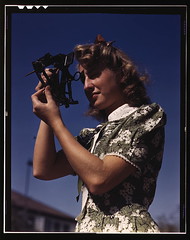
Learning how to determine latitude by using a sextant is Senta Osoling, student at Polytechnic High School, Los Angeles, Calif. Navigation classes are part of the school's program for training its students for specific contributions to the war effort (LOC
A great response to a cranky-pants like Mr. Johnston.  I may complain about the science (or lack thereof) in SF stories, but I nevertheless am entertained - I wouldn't bother to read or watch otherwise.

After detailing the stories she's enjoyed, Gertrude makes plea for some female characters who aren't sweet little things:
Another word to ye Authors: Please do not always have the girls in your stories such sweet little bundles of humanity. Aren't there any tall girls in your imaginations? Please give us tall girls a break once in a while. It makes me feel better. Thanks.
Amen to that!

I wonder if the Ruths and Sues and Gertrudes who were science fiction fans 80 years ago continued reading the pulps into adulthood, or if they gave them up along with the other trappings of their youth. I like to imagine that they continued to enjoy a space fantasy story now and then, and eventually passed on the love of science fiction to their daughters or nieces or students.

* I also like the ads. Where else could you find answers to burning questions like "Why is Listerine to be found in the offices of a majority of American business men? Why do they use it at the noon hour? Why do they sometimes halt important meetings, to gargle with it?", while ordering "French Love Drops" and "Learning to Play Hawaiian Guitar Like the Hawaiians!"

 (Post at Marooned via SF Signal)

Thursday, August 05, 2010

How OMNI Ruined Me for Analog

I just got home from a nice stay at my mom's and it's put me in a reminiscing mood.


I have a confession to make.

Despite being a voracious reader of science fiction (among other genres), I never picked up a copy of one of the "big three" science fiction magazines - Asimov's, Fantasy & Science Fiction, Analog - until I was in my early 20s. And when I did finally start picking up the occasional copy of Asimov's or Analog, I often felt like they fell a bit short of my expectations.

Part of the problem, I suspect, was that much of my short story reading had been in anthologies, which highlights an author's or magazine's best stories.

But it's also almost certainly because the magazine with science fiction I did read regularly was OMNI.  It was the first grown-up magazine I had a subscription to and it was awesome.  The magazine had science articles - in retrospect often pretty "fringy" or pseudoscience-based, yet always interesting - and original short science fiction stories, all in a glossy colorful package.

 Just look at the short stories OMNI published - during my subscription that spanned from 1980ish to 1987ish the list included William Gibson, Pat Cadigan, Robert Silverberg, Harlan Ellison, Greg Bear and many others edited by the Ellen Datlow. These were the short stories of my teenage years and they came in a shiny sciency wrapper.

OMNI eventually ceased publication in the late 1990s, but it lives on at the OMNI Online tribute site (from which I borrowed the cover images) and some pages of the web-only version of the magazine that were archived by the Internet Archive.

To my 20-year-old self Analog and Asimov's seemed dull in comparison. And honestly, they still seem a bit dull me as a 40-something. It's not just the lack of pretty pictures, but the magazines' stiff "attitude" (for want of a better word) and old-fashioned feel.  To my mind the spirit of OMNI is closer to current personal science blogs than any print magazine.


And sure, the "big three" still publish good short fiction. But there is strong competition from other mags like Strange HorizonsClarkesworld Magazine, and Subterranean Magazine, to name a few. It's not a surprise to me that the circulation numbers for the big three has been declining.

I don't know what science & SF-loving teenagers are reading these days, but I hope whatever it is provides as much entertainment to them as OMNI did to me.

(See also Frederick Pohl's recent post about writing about the July 1991 solar eclipse for OMNI.)

Tuesday, February 23, 2010

He shoots! He scores!

I'm not much of a winter sports fan, but when the Winter Olympics rolls around, I find myself watching speed skating and ski cross and skeleton and figure skating. And that's how I found myself watching the exciting USA-Canada hockey game on Sunday.

What does this have to do with science fiction? It an excuse to post a link to Steven Popkes' 2002 story "The Ice".   

Phil Berger is a young hockey star who learns that he is actually a clone of Canadian hockey great  Gordie Howe
 The lead article, by Frank Hammett and Carl Weatherspoon, is about the "Gordie Howe Clone." The article continues, occupying most of the flimsy with a host of associated links. There are several pictures of DNA chromatographs and chromosomes, documenting the similarities between the Howe genotype and that of Phil Berger.
Phil feels as if the world has entered into some long, horrible tunnel. He shakes his head and stares at the pictures. This is his life on display without his permission. No. It’s more than that. He feels naked before strangers. He feels shame without knowing why.

The story isn't so much about hockey,  as it is about a young man trying to figure out who he really is and what he wants to do with his life.

Read "The Ice" by Steven Popkes

(I wonder what Mr. Howe thinks of the story.)
((Also, Go Team USA!))

Tags:, ,

Tuesday, December 22, 2009

Holiday Free Fiction: Visions of Gingerbread

At this year's party, as usual, everyone from my executive VP to the mail clerk steered clear of me. An hour into the evening, as conversations buzzed in every other part of the room, I found myself standing alone, eggnog in hand, looking at the Christmas tree. It was as if I had never seen one before. There was something about the shape of the tree, about its deep green shadows and its smell, that spoke to me. It said, forest. It said, everything is alive. It said, this is the perfect moment. And at that perfect moment, I felt as if I were a key sliding into its lock. The universe and I, we fit.
Sometimes feelings of love, peace and joy need just a bit of chemical assistance.

Read "Visions of Gingerbread" by Bruce Holland Rogers.

Sunday, December 20, 2009

Holiday Free Fiction: R3

Damn right we're Christmas—a holiday all about the foolish belief in the impossible. Flying reindeer are perfect for impossible. Doubters said you couldn't make flying reindeer, and they were right: We're not really reindeer; we're more like a whole new animal on a reindeer chassis.
R3 isn't really a reindeer, and he's had a rough life, but he brings Christmas all the same.

Read Read "R3", by Dennis Danvers.

And for a slightly different take on Reindeer physiology, see Robert Billing's Nature Futures short "Harnessing the brane-deer" (pdf).

Image: Image from the Bell Mobility animated reindeer commercial

Tags:, ,

Friday, December 18, 2009

Holiday Free Fiction: The Christmas Count


The sky over the river is already light and I’m still six miles from his house -- ten more minutes. Provided I don’t get caught at the tracks by some goddamned, two-hundred-car freight train. Ron will have his audio equipment out, but it won’t do us any good. Not this late. Once the sun’s up, even a set-up as good as Ron’s is pretty much useless for calling in owls. Great-horned, screech, barred; usually Ron and I can call in at least two out of the three. Not this year. Maybe someone else in the McCarron count circle will have owls on their list, but it won’t be us. Two years ago the count had none at all, and Clover County beat us by two species. Two lousy species.
For over a century the Audubon society has sponsored a Christmas Bird Count, in which ordinary people help take a census of birds throughout the Americas. In the not so near future biotechnology may allow Christmas counters to spot birds that haven't been seen in decades . . .

Read "The Christmas Count" by David B. Coe.

Image: Passenger Pigeon, Ectopistes migratorius, from Orthogenetic Evolution in the Pigeons, 1920 (from Wikimedia Commons)

Tags:,

Saturday, November 28, 2009

Silurian Tales


"Here about the beach I wander,
Nourishing a youth sublime
With the fairy tales of science,
And the long results of time."
- Alfred Tennyson

The Silurian Period of the Paleozoic Era featured coral reefs in shallow seas, and abundant life - jawless fish, sea scorpions, nautiloid cephalopods, trilobites and other creatures - inhabited the oceans. Plants - mostly mosses - were just emerging onto dry land. What would it be like if we could travel back to that time?

Steven Utley has written a series of time travel stories featuring scientists exploring the Silurian era. As he explained in an interview:
The stories in Silurian Tales span 25 to 40 years in the lives of a number of recurring characters, scientists and other visitors to mid-Paleozoic time, who are trying to do the work that is important to them while coping — or failing to cope — with isolation, boredom, privation, their own and one another’s shortcomings, and the implications of so-called time travel in accordance with the many-universes hypothesis advanced by quantum physicists. It is, in short, a book of stories about folks trying to be happy.
Over the years Utley has read extensively to provide background for his stories:
The last time Utley calculated the number of books and magazine articles he’s consulted for the series, it was over a hundred. "Including the Atlas of the Prehistoric World, Wildlife of Gondwana, John G. Maisey’s Discovering Fossil Fishes, works by David Attenborough, John McPhee, books about plate tectonics and oceanography, back numbers of National Geographic," Utley said. "I got off into astronomy and quantum physics, too. Everything became grist for the mill. Will Durant’s Story of Philosophy proved useful in writing some of the stories, so, too, Darwin’s Voyage of the Beagle, and throughout you’ll catch me paying homage, consciously or otherwise, to all sorts of authors besides Wharton — Jane Austen, Edmond Hamilton, H. P. Lovecraft, Conrad, Borges, Proust. Zane Grey, of all people: his description of a canyon in Riders of the Purple Sage or Heritage of the Desert somehow informs my sense of a Paleozoic landscape. [...]

While an anthology is supposedly in the works, it doesn't appear to have been published yet. Fortunately, several of Utley's Silurian tales are free to read online:
Image: Asaphus species (Trilobite) from the Ordovician-age strata near St. Petersburg, Russia.
Tags:,

Thursday, November 05, 2009

Empire of the Ants


In a few miles of this forest there must be more ants than there are men in the whole world! This seemed to Holroyd a perfectly new idea. In a few thousand years men had emerged from barbarism to a stage of civilisation that made them feel lords of the future and masters of the earth! But what was to prevent the ants evolving also? Such ants as one knew lived in little communities of a few thousand individuals, made no concerted efforts against the greater world. But they had a language, they had an intelligence! Why should things stop at that any more than men had stopped at the barbaric stage? Suppose presently the ants began to store knowledge, just as men had done by means of books and records, use weapons, form great empires, sustain a planned and organised war?
~ "Empire of the Ants", HG Wells (1911)
Sometimes an ant is more than just an ant.

University of Kent senior lecturer in the history of science Dr. Charlotte Sleigh has been known as "the ant woman" for her research into the way that society has shaped the way scientists have looked at ants. In her 2003 book Ant she discusses how ants came to represent "Europeans' fears about the complicity of savage insects and humans" and how that was "part of a larger anxiety about "degeneration".
This has been well documented by historians; predictions that the sun was going to die, that hte comforts of civilization would cause evolution to run backwards, that the working classes were out-breeding the rest, and that the white man could not survive the tropics all contributed to the sense that things were going downhill around the turn of the twentieth century.
This is, of course, the period when H. G. Wells wrote most of his novels, and it is no coincidence that many of his monsters were quite ant-like. And, of course, in Wells's short story "Empire of the Ants" the monstrous creatures truly are ants. Sleigh points out:
Although they are large as ants go, they are still too small to be shot, and little enough to swarm and surge like Ewers' black carpet. The ants also seem to have evolved greater intelligence than normal. The Portuguese captain turns out to be incompetent; he sends the lieutenant to his death on an infested ship of human corpses. He futilely fires his cannon at the ants' ranks - ranks that simply scatter and recondense like so many droplets of black water. No wonder, then, that the mission fails. The ship turns around and sails away with all haste, leaving the ants to their new-found mastery of the continent.
What gives the story its bite is its title. The tale goes beyond the fantastic and taps into contemporary fears about the tenability of European empires.
[. . . ]
Wells could not resist pushing anxieties about the limits of progress and the fragility of European superiority to their furthest extreme.
That brought to mind another ant short story, Carl Stephenson's "Leiningen Versus the Ants", originally published in Esquire in 1938. The story is about a "scrappy, no-nonsense" settler in the Brazilian wilderness who battles to save his plantation from being overrun by ants. Even though he's the hero, when I read the story I ended up quite disliking Leiningen (who is racist, sexist, and arrogant) and was rooting for the ants to win. But, alas, he does. Apparently Europeans can conquer the savage wilderness if he is of strong enough character and willing to do anything to succeed.

You can read "Empire of the Ants" in the HG Wells collection The Country of the Blind, and Other Stories at Project Gutenberg. (The collection also includes the story "Valley of Spiders", which may or may not symbolize something beyond icky eight-legged creatures. ) Aternatively, you can download the pdf of just "Empire of the Ants" from Horrormasters.com

Read "Leiningen Versus the Ants" at Classic Short Stories.

You can purchase Ant and Sleigh's follow-up book Six Legs Better: A Cultural History of Myrmecologyat Amazon.com (affiliate links):

Top Photo: Ant Pile by Thirteen of Clubs. http://www.flickr.com/photos/thirteenofclubs/ / CC BY-SA 2.0
Bottom Photo: Salivating Ant by NeilPhotography. http://www.flickr.com/photos/neilspicys/ / CC BY 2.0


Tags:, ,

Thursday, October 29, 2009

When it Changed - Science Into Fiction


UK publisher Comma Press has just released When it Changed, a cool-sounding new anthology where writers and scientists have teamed up to produce something that incorporates both their specialities. From their book's web site:
When It Changed is an attempt to put authors and scientists back in touch with each other, to re-introduce research ideas with literary concerns, and to re-forge the alloy that once made SF great. Composed collaboratively – through a series of visits and conversations between leading authors and practicing scientists – it offers fictionalised glimpses into the far corners of current research fields, be they in nanotechnology, invertebrate physiology, particle physics, or software archaeology. From Planck's Length (the smallest indivisible distance) to Plankton (potential saviours of the Earth's ecosystem), from virtual encounters between Witgenstein and Turing, to future civilisations torn asunder by different readings of the Standard Model, together these stories represent a literary 'experiment' in the true sense of the word, and endeavour to isolate a whole new strain of the SF bug.
Edited by award-winning author Geoff Ryman, the scientists involved include two biologists and a bioethicist:
  • Dr. Jennifer Rowntree, post-doctoral researcher, Faculty of Life Science, University of Manchester. Rowntree is a plant evolutionary ecologist whose reseach includes "genetics of plant-plant and plant-animal interactions and the value of genetic diversity in plant communities."
  • Dr. Matthew Cobb, Programme Director Biology, the University of Manchester. Cobb and his laboratory study how genes and environment shape animal behavior and communication. Most of his research has focused on pheromones and olfaction in fruit flies. Cobb was paired with writer Simon Ings, who wrote the story "Zoology" for the anthology.
  • Professor Steve Williams, Williams develops and uses magnetic resonance imaging techniques to study appetite regulation and gut-brain interctions.
  • Professor John Harris, Lord Alliance Professor of Bioethics, and Director of the Institute for Science, Ethics and Innovation, University of Manchester. He has written a number of books, including Enhancing Evolution: The Ethical Case for Making Better People and On Cloning.
When it Changed had it's UK debut at an apparent joint event of the overlapping Manchester Literature Festival and Manchester Science Festival (which runs through the weekend -TThere's a lecture on "Exploring neuroscience through literature" on Sunday, Nov. 1, which is right up Bio in SF's alley). You can read all about the October 24th panel on the Manchester Literature Festival Blog.

When it Changed will be released in the US in April 2010.

(via io9)

Tags:, ,

Monday, October 12, 2009

ALL THESE WORLDS ARE YOURS, EXCEPT...


" . . . relay this information to Earth. Tsien destroyed three hours ago. I'm only survivor. Using my suit radio – no idea if it has enough range, but it's the only chance. Please listen carefully. THERE IS LIFE ON EUROPA. I repeat: THERE IS LIFE ON EUROPA. . . "
~ 2010: Odyssey Two by Arthur C. Clarke
Europa, one of the Jupiter's large moons, holds a special place in the minds of science fiction writers and astrobiologists alike. What sets Europa apart from the other planets and moons in our solar system is that it is covered with a fairly smooth surface layer of frozen water, and its interior is much hotter than its surface, suggesting that there could be a zone of liquid water under that protective layer of ice where life might exist. That easily accessible source of water on its surface could also make Europa a handy refueling stop for space ships exploring the outer solar system – assuming there isn't the sort of life that destroyed the ill-fated spaceship Tsien in Clarke's 2010.

In the afterword to 2010, Arthur C. Clarke says his Europans were inspired in part by a 1980 article by Richard C. Hoagland – "The Europa Enigma" – which describes his "quite brilliant concept" that there might be life on Europa. Since then, NASA's Galileo exploration mission to Jupiter and its moons has provided more detailed information about the moon's surface:

Prior to the Galileo mission, scientists' knowledge of Europa was simply a small ice- covered moon with an exceptionally bright surface covered by faint curved and linear markings. Now, scientists see evidence of a young and thin, cracked and ruptured ice shell, probably moving slowly over the surface of a briny ocean that is 100 kilometers (62 miles) or more deep.
University of Arizona Professor of Planetary Sciences Richard J. Greenberg, a member of the Galileo Imaging Team, believes that Europa might even be able to support fairly complex life forms, as Discovery News reported last week:
Judging by how quickly Europa's surface ice is replenished, Richard Greenberg estimates that enough oxygen reaches the subterranean ocean to sustain "macrofauna" -- more complex, animal-like organisms. Assuming Europa life forms would need as much oxygen as Earth-like fish, Greenberg estimates the moon's ocean has enough oxygen to support 6.6 billion pounds of macrofauna.
Unconstrained by the limitations of biology, futurist/physicist Freeman Dyson has speculated a bit more wildly, suggesting that we should be looking for flowers on Europa's surface:
Life could be visible from orbiting spacecraft, however, if it made a home in cracks in Europa's shell that connect the surface to the interior, Dyson said.
Such life might take the form of flowers with a parabolic shape that focuses the dim sunlight falling on Europa on the interior of the plant. Flowers with such shapes [...] are found in Arctic climes on Earth, where the plants have evolved to maximise solar energy.
Europa flowers could be detectable through a phenomenon called retroreflection, in which light gets reflected back to its source, Dyson said. This optical effect is seen in light reflected from animals' eyes, and was used in the design of road signs and mirrors left behind on the moon by Apollo astronauts.
My first thought was that Dyson had wandered off into Larry Niven's Known Space, but on further consideration I think it's an interesting idea – assuming that Dyson was referring to life forms with a superficial resemblance to flowers, rather than actual Earth-type plants. Or as University of Washington astrobiologist John Baross explained:
As for Dyson's flower suggestion, he says it is "a very radical" idea. "On Earth, flowering plants evolved during the Cretaceous and became diverse by co-evolving with insects. . . . I would not include flowering plants to my list of life-forms to look for."
"Any photosynthetic system on Europa would have to live at a depth removed from the high radiation bombarding the ice surface and still get light," Baross says. "Having said this, it would be worthwhile to make more comprehensive observations and analysis of some of the surface features, including the deeply coloured ridges [...]," he says. "One might find evidence for biosignatures or very interesting chemistry."
More likely than surface flowers are organisms similar to those found around the deep sea hydrothermal vents on Earth. Frank Carsey and his colleagues at the Jet Propulsion Laboratory are designing robotic vehicles that will be able to cut through ice and explore the watery world beneath, initially in Antarctica, but with the hope of eventually exploring Europa's depths. Until we are able to send exploratory probes, the possibility of life on Europa is little more than educated speculation.


Free Short Fiction:
Further Background Reading:

Top Image: The Conamara Chaos. "a view of a small region of the thin, disrupted ice crust in the Conamara region of Jupiter's moon Europa showing the interplay of surface colors with ice structures." From NASA's Galileo Image Gallery. More details.
Middle Image: Europa and the Thrace Region. This image shows an image of the cracked surface of Europa. From NASA's Galileo Image Gallery.
Middle Image:"Metal Flower" http://www.flickr.com/photos/quepollo/ / CC BY 2.0
Bottom Image: Artist's concept of a cryobot and hydrobot that can melt through ice and then explore the water beneath. From "The Search for A Planetary Ocean on Europa" at JPL.
Tags:, ,

Wednesday, October 07, 2009

Science Fictional Ribosomes

small subunit of the Thermus thermophilus ribosome"What you want is to add and subtract lengths of input DNA easily, and the feedback enzyme arrangement does this. When the feedback arrangement is in place, the molecule will open itself up for transcription much more easily, and more rapidly. Your program will be transcribed onto two strings of RNA. One of the RNA strings will go to a reader - a ribosome - for translation into a protein. Initially, the first RNA will carry a simple start-up code ––

~ Blood Music
by Greg Bear, 1985
This year's Nobel Prize in Chemistry went to three scientists - Venkatraman Ramakrishnan, Thomas Steitz, and Ada Yonath - for their study of the structure and function of the ribosome", the organelle assembles proteins from amino acids based on nucleic acid sequences. Since ribosomes are essential part of the cellular machinery, it's no surprise that writers who incorporate genetics and biotechnology into their fiction include it in their fiction. They even provided the name for the bioscience-based science fiction subgenre called "ribofunk".

This classic 1971 human reenactment of protein synthesis, made by the Department of Chemistry at Stanford, can give you a pretty good idea of how ribosomes work1. (Click for bigger video)
The much abbreviated version:
  • DNA sequences that encode proteins are used as a template for the transcription of messenger RNA (mRNA)
  • a ribosome attaches to the mRNA
  • protein synthesis begins at a specific sequence of three nucleotides - the AUG start codon - within the mRNA
  • a transfer RNA (tRNA) that has a sequence complementary to the start codon sequence (the anticodon) carries the amino acid methonine to the ribosome.
  • a tRNA with an anticodon complementary to the next three nucleotides in the mRNA - the next codon - also binds the ribosome, and the amino acid it carries added to the initial methionine
  • this process continues along the length of the mRNA until a stop codon is reached and the newly synthesized protein is released from the ribosome
Greg Bear's mention of ribosomes in Blood Music gets the process right. Other science fiction writers have used ribosomes much more fancifully in their stories. Take, for example, the 2003 short story "Junk DNA" by Rudy Rucker and Bruce Sterling:
"You’re about to tell me that Alan Turing anticipated the notion of DNA as a program tape that’s read by ribosomes. And I’m not gonna be surprised."

"One step further," coaxed Veruschka. "Since the human body uses one kind of ribosome, why not replace that with another? The Universal Ribosome–it reads in its program as well as its data before it begins to act. All from that good junk DNA, yes Janna? And what is junk? Your bottom drawer? My garbage can? Your capitalist attic, and my start-up garage!"

"Normal ribosomes skip right over the junk DNA," said Janna. "It’s supposed to be meaningless to the modern genome. Junk DNA is just scribbled-over things. Like the crossed-out numbers in an address book. A palimpsest. Junk DNA is the half-erased traces of the original codes–from long before humanity."
While they use lots of sciency terminology, the description of ribosome function doesn't make much sense. Of course ribosomes skip over "junk DNA" - they don't interact with DNA at all. And while some "junk DNA" may be transcribed into "junk mRNA", it appears that those sequences are degraded before they can be used to encode protein. I'm just not grokking how "junk DNA" that is primarily made up degenerate coding sequences2, could be translated into proteins that do anything more than muck up cells, even given an Universal Ribosome Turing-like machine.3

And I should say that "Junk DNA" is an entertaining story if you can gloss over the nonsensical biology details - read it for yourself for free at Asimov's Science Fiction.

I'm hoping that science fiction writers will embrace recent research exploring complex biochemistry of our cells to come up with some interesting variations on life as we know it. I just wish they would get their terms straight (of course, that's probably just me).

Oh, and if you know other SF that uses ribosomes as a plot device, mention them in the comments. I know there is an episode of Star Trek:TNG that does, but I couldn't come up with any other examples.

1. Note that the ribosomal components are not depicted to scale. They are also a bit more colorfully dressed than you find in your typical cell.

2. What most biologists call "junk DNA" is primarily made up of repetitive DNA sequences from transposable elements, not interesteringly "scribbled over" ancient genes.

3. While DNA-based Turing machines have been proposed (and even shown to work in rudimentary form), the "computations" are not performed by protein synthesis, which is the function of ribosomes I don't think that's the case, anyway. My understanding of Turing machines is a little fuzzy. Mark Chu-Carroll has posts about them here and here and here that I'm still thinking about.

My related posts:

Animation: "Animation of the small subunit of the Thermus thermophilus ribosome. RNA shown in orange, protein in blue." Taken from PDB 1FKA and animated by David S. Goodsell
Tags:,

Monday, August 10, 2009

Hugo Award Winner: Bear's Shoggoths in Bloom

The sea-swept rocks of the remote Maine coast are habitat to a panoply of colorful creatures. It's an opportunity, a little-studied maritime ecosystem. This is in part due to difficulty of access and in part due to the perils inherent in close contact with its rarest and most spectacular denizen: Oracupoda horibilis, the common surf shoggoth.
This year's Hugo for best novelette went to Elizabeth Bear for her WWII-era alternate natural history tale "Shoggoths in Bloom". As the title suggests the story features shoggoths, creatures from HP Lovecraft's Cthulhu Mythos, but with a slightly different twist.

Read Shoggoths in Bloom

Image: Shoggoth by pahko @ wikimedia commons. Also see pahko at DeviantArt.
Tags:, , ,

Hugo Award Winner: Chiang's Exhalation

It has long been said that air (which others call argon) is the source of life. This is not in fact the case, and I engrave these words to describe how I came to understand the true source of life and, as a corollary, the means by which life will one day end.
Ted Chiang's excellent short story "Exhalation" won a Hugo last night. The setting is an alien world where an argon-breathing metal scientist seeks to understand his world and himself. Admittedly, it technically isn't about biology - at least not carbon-based life - but if you read it for yourself I think you'll see the similarities.


Read Exhalation
Listen to a podcast of "Exhalation" @ Escape Pod or @ Starship Sofa


Tags:, , ,

Hugo Award Winner: Kress's Erdmann Nexus

Nancy Kress's novella "The Erdmann Nexus" won a Hugo yesterday. It's basis is a combination of the philosophical and scientific concept of emergence in complex systems along with a bit of neuroscience. In particular she uses the fact that activity in the brain changes when people go into deep meditative states as an indication that humanity could develop a group mind that goes beyond basic human consciousness. It's not a new science fictional idea, and not surprisingly the story has significant religious and mystical themes. I didn't find the story that interesting, other than Kress's inclusion of some recent science.

Read The Erdmann Nexus.

Image: fMRI data for expert meditators. From Brefczynski-Lewis JA et al. "Neural correlates of attentional expertise in long-term meditation practitioners". Proc Natl Acad Sci USA (2007) 104: 11483–8. doi: 10.1073/pnas.0606552104
Tags:, , ,

Wednesday, August 05, 2009

Hugo Nominee: Pride and Prometheus

Mary Shelly's 1831 classic, Frankenstein; or, the Modern Prometheus, is considered by many to have been one of the earliest science fiction novels. It is, of course, dear to me because of it's basis in biology, particularly the contemporary experiments on the effect of electricity on "reanimating" corpses.

Shelley's work is revisited in John Kessel's "Pride and Prometheus", a nominee for this year's best novelette Hugo Award. Kessel has Dr. Victor Frankenstein meeting a young Miss Mary Bennet, Elizabeth Bennet's bookish younger sister in Jane Austen's Pride and Prejudice. Mary is a Natural History enthusiast, and her meeting with Frankenstein changes her life . . .

Read "Pride and Prometheus" at Fantasy & Science Fiction

Download John Kessel's The Baum Plan For Financial Independence and Other Stories
(including "Pride and Prometheus") at Small Beer Press

Image: Illustration from the 1831 Edition of Mary Shelley's Frankenstein
Tags:, , ,
Note: Links to Amazon.com are affiliate links. As an Amazon Associate I earn from qualifying purchases.