Showing posts with label paleontology. Show all posts

Wednesday, November 07, 2012

Science & SF Tidbits: intelligent dinosaurs, printed meat, extreme voting

Some recent links:

• Extreme Voting: How Astronauts Cast Ballots from Space »
If you are in the US, did you vote in yesterday's election? The American astronauts on the International Space Station did, submitting their absentee ballots electronically.

Dinosauroids revisited, revisited | Tetrapod Zoology
If dinosaurs had evolved intelligence, rather than going extinct, what might they look like? Would they be like the Silurians on Doctor Who, essentially human shaped? or would they be clever as crows and appear more bird-like? It seems like most of the science fictional and speculative science depictions assume the former model: intelligent "dinosauroids" would look much like us humans, only scalier. Paleozoologist Darren Nash takes a look at the biological plausibility of the different models of intelligent dinos that have been proposed and takes a slightly different view. Read the article for more!

Image: Dinosauroid, Dinosaur Museum, Dorchester. Photograph by By Jim Linwood on Flickr. Shared under a CC by 2.0 license.

Primeval: New World >> Create a Fan Video
Primeval: New World is a Canadian spin-off of the UK paleo-science fiction series Primeval. The basic premise is that there are "anomalies" that appear that are essentially doorways to other times. If an anomaly opens between the Cretaceous and our own time, a bunch of velociraptors might just end up running down the street. So every week a team of specialists needs to catch any creatures that have come through the portal and fix any damage done.

As you might expect, both series rely heavily on CGI dinosaurs and other beasts. Primeval: New World has an interesting offer - they provide special effects and animated dinosaurs, you create the video and upload it to YouTube and they may feature it on their site (like this video). If you want to create your own dino movie, there is more information here.

First tasting of Printed Meat « NextNature.net »
University of Missouri biological physicist Gabor Forgacs uses 3-D bioprinting devices to "print" organs made of cells on extracellular matrix biogel scaffolds. But there may be other uses. As part of a TEDMed presentation, Forgac cooked and ate a printed piece of meat. Forgac's company, Modern Meadow, is working on developing lab-grown meat and leather products that could eventually be mass produced and sold.

What's not clear to me is whether this is really necessary. If industrial farming is the problem (and it is), why not use artificial leather and promote meatless meals, rather than growing likely expensive versions in the lab? I'm not sold.

Saturday, October 13, 2012

Science and SF Tidbits: October 13, 2012: Nobel Prizes, Bringing Back Dinosaurs, Martian Biorhythms

Have you watched my live interview with artist Brian Kolm yet? We talk about his design of the Biology in Science Fiction logo, teaching art, and socializing with other artists. Be sure to check it out!

From around the web:

• G Protein-Coupled Receptors (GPCRs) win 2012 Nobel Prize in Chemistry | The Curious Wavefunction, Scientific American Blog Network
On Thursday the 2012 Nobel Prize in Chemistry went to two biochemists: Brian Kobilka (Stanford) and Robert Lefkowitz (Duke). Their work helped explain how a signal on the outside of the cell (such as a neurotransmitter, hormone or even light) is translated into physiological changes inside the cell and altered gene expression. Their research focused on a particular class of receptors in cell membranes that are associated with "G protein" signalling molecules inside the cell. The article linked above is a pretty good overview of how they function.

• An Interview with Sir John Gurdon winner of the 2012 Nobel Prize Winner in Physiology or Medicine
I recommend this Cambridge University video interview with John Gurdon. He talks about his original work on frog cloning in the early 60s, the relevance of his work today, and how his parents helped him pursue studies in science after his teacher made him out to be a failure in the subject.

• DNA has a 521-year half-life :: Nature News
After 6.8 million years nearly every bond in a DNA molecule would be broken. That means no Jurassic Part-style cloning of extinct dinosaurs will be possible. Sad news for those of us wishing for a cute cloned Sciurumimus as a pet. It also brings into question reports of extracting DNA from very ancient amber.

• Weird Things » Blog Archive » Who Needs DNA to Bring Back the T-Rex?
Perhaps dinosaurs could be reconstructed even without their DNA. The trick is to use what we know about T. rex anatomy and modern animal biology and fake the rest:
"The blueprint for this creature will be everything we know about the T-Rex. We can design bone structure, ligature and a thousand other tiny details we’ve learned from the fossil records. Although we may never find DNA, we have found cells inside T-Rex fossils, resembling the same kind in ovulating birds. Cells, protein and other kinds of information can help us build a replica that’s perhaps 95% accurate"
• Ridley Scott Explains Prometheus, Is Lovably Insane | Tor.com
Ryan Britt summarizes Ridley Scott's commentary from the DVD release of Prometheus. Sounds either quite brilliant or a bit unhinged, or maybe both.  I may have to watch the movie with commentary myself to see what he says about the dumbest biologist in the galaxy (ooh, the goo in this alien building full of dead bodies is unexpectedly turning into a snake-like creature - let me pet it!)

• Fossil of Ancient Spider Attack - only one of its type discovered
About 100 million years ago a young spider was about to start munching on a wasp caught in his web. But before he could commence munching, tree resin flowed over spider, wasp and web and they were trapped in amber.  Click here to see the fantastic large image.

• How Blue Light And Caffeine Will Help Humans Move To Mars
Mars days are 24.6 hours long, which means we humans with Earthly 24-hour internal clocks can find it hard to adjust. It turns out the key is carefully timed blue light, caffeine, and a comfortable sleeping environment. Tests on members of the Mars Phoenix mission suggests it works, even for folks here on Earth.

• Science In My Fiction » Mind-Control and Instant Skill
Optogenetics combines advanced genetic engineering of neural tissue in the brain and implanted fiber optics to allow external control of behavior and learning in mice. It has even been shown to work to some extent in monkeys. And simply stimulating the brain with electrical current and speed up learning in humans.  Not surprisingly, the military is at he forefront of this sort of research. But it's still in it's early stages - there won't be human "mind control" using this technology any time soon. But if it did work, would you allow your brain cells to be manipulated if it would give you instant skills?

• Report: Ukraine Trains Dolphins With Friggin' Pistols on Their Heads | Danger Room | Wired.com
Pistols attached to dolphins may be far fetched, but it's already the case that navies (including the United States) use dolphins for mine clearing and other underwater operations. The US also apparently uses sea lions "equipped with a spring-loaded clamp that can be attached to a diver’s legs. The sea lion then swims back to its handlers, who can reel the enemy diver in like a snagged fish."  But if you want to make dolphins really lethal, give them mechanical arms and hands. Not only will they be able to kill, before you know it they'll be piloting starships!

Image: Courtesy of Brian Kolm at Atomic Bear Press. Used with permission.

Wednesday, September 19, 2012

Dinosaurs on a Spaceship: Not enough feathers!

A couple of weeks ago the Doctor Who episode "Dinosaurs on a Spaceship" delivered just what the episode title promised: dinosaurs, on a spaceship. Of course there was much more to the story than that, and the episode had a mix of the silly (the Doctor and his companions riding a triceratops and goofy robots) and the dark (the Doctor hastening the death of the pirate trader who had taken over the ship and killed most if its inhabitants.). But for me the dinosaurs stole the show.


Why were Earthly dinosaurs on the spaceship? Because, in the Whoverse the Earth hosts another humanoid race besides Homo sapiens. There is also a lizard-like race called the Silurians or Homo reptilia, currently hibernating deep underground. But millions of years ago the Silurians had a technologically advanced society among the dinosaurs. When the asteroid that caused the extinction of the dinosaurs was on a collision course with Earth, the Silurians filled a spaceship with dinosaurs and plants to rescue them. Thus dinosaurs on a spaceship.

Of course I don't watch Doctor Who for serious science, so it's no surprise when scientific inaccuracies appear. But Brain Switek has pointed out that the dinosaur designers for the episode missed an opportunity to make the deadly raptors that stalk the TARDIS crew more colorful. As he put it:
... the unidentified “raptors” suffered the curse of the bunny hands and insufficient feathery coats. Filmmakers seem reluctant to drape feathers over dromaeosaurids, but, for any effects artists who may be reading, we know that these dinosaurs had exquisite plumage covering almost their entire body. If you’re going to have raptors, they should be intricately feathery. [...] You may want to laugh at a Deinonychus all puffed up, but that will be the last sound you ever make before it starts to eat you.
I would go further than that.  It was recently found that a distant cousin of Tyrannosaurus rex  called Yutyrannus huali was covered with a downy coat of 6-8 inch long feathers over most of its body. That has lead to speculation that T. rex might have been feathered as well.

Analysis of the fossilized feathers of the much smaller Sinosauropteryx lead to the discovery that the more than 120 million year old feathers contain melanosome cells that store either red or black pigments. The pattern of those pigment cells in the fossils suggest that Sinosauropteryx may have been striped, at least along its tail.

So I'd propose putting those two findings together with a bit of artistic license, giving even the great T. rex on the spaceship colorfully patterned plumage. I think that would have looked awesome and have had the right mix of terror wrapped in whimsy to suit a Doctor Who episode.

It also makes me think about how quickly science fiction stories can become outdated, even when they are set in the past. I'd guess that most of us have read or watched older science fiction stories where the "future" technology became obsolete long ago. The recent discoveries about dinosaur appearance are an example of how scientific progress can change how we view the past. Perhaps plain gray dinosaurs should go the way of telephone booths and horse-drawn carriages in SF.

Apparently the idea of feathered dinosaurs apparently is quite upsetting to young-earth creationists, who don't like the way it supports the hypothesis that modern birds evolved from dinosaurs. Fiction that depicts prehistoric animals based on the most up-to-date fossil evidence not only has cool-looking creatures, but also helps promote science in general.

More feathered dinosaurs please!
----

Get Dinosaurs on a Spaceship at Amazon.com (affiliate link)


Top image:  Sinocalliopteryx gigas as a stealth hunter feeding on the dromaeosaur SinornithosaurusIllustration by Cheung Chungtat.  From Xing L, Bell PR, Persons WS IV, Ji S, Miyashita T, et al. (2012) Abdominal Contents from Two Large Early Cretaceous Compsognathids (Dinosauria: Theropoda) Demonstrate Feeding on Confuciusornithids and Dromaeosaurids. PLoS ONE 7(8): e44012. doi:10.1371/journal.pone.0044012.g008. This file is licensed under the Creative Commons Attribution 2.5 Generic license.

Bottom image: Cover of Analog Science Fact & Fiction February 1961. It illustrates "The Weakling" by Everett B. Cole, in which there are great "saurians" used as pack animals, meat and pets on an alternate (or future?) Earth. The story is heavily dependent on "psionics" and mind control as a plot device, if you like that sort of thing. The cover and story are available through Project Gutenburg, and are out of copyright.

Monday, October 18, 2010

Are Homo sapiens the only people?

Alien Anatomy
I've been watching the new NBC series The Event. So far it's hasn't been tell-all-your-friends awesome, but I've been finding interesting enough to keep watching.

The premise is that in 1944 a plane carrying aliens crashed in Alaska. While many of the aliens escaped, those who were injured  - and their leader, "Sophia Maguire" - were captured and interred in the secret Inostranka military base.1 In the present day, there have been a series of strange events seemingly precipitated by the aliens who avoided capture.

Unlike the other recent "aliens are among us" series, V, the US government in The Event is more realistically suspicious of the aliens motives.  And unlike V's lizard-like aliens in beautiful human skins,  the aliens of The Event are primates like us.
While the series probably won't reveal the aliens' origins and purpose on Earth for some time, I think the possibilities are intriguing.

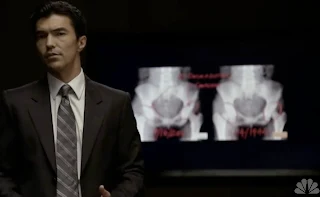
Here's the scene in the second episode that shows us what the US government knows about the aliens' biology:


Agent Lee:  Well, as you can see, outwardly they look very much like us, which could indicate a common ancestor, or even a parallel evolutionary process. But there are differences.

Now, initially, scientists were only able to detect small variations in their circulatory systems and blood composition. But over time it became clear that they age at a much slower rate that we do. Meaning that there had to be substantial differences we couldn't detect and that we didn't understand.

Now recent advances in DNA sequencing are starting to change that. We now know their DNA varies from ours by slightly less than 1%.

President Martinez: 1%? So they're people.

Blake Sterling: They're absolutely not. 1% is actually quite significant genetically. A chimpanzee's DNA differs from ours by only 2%, for example.
When I first saw that scene, my first reaction was "Wow, they are closely related to humans", followed by a puzzled "How are they not people?"   I suppose it all comes down to your definition of a "person.

It's true that a difference in genomic DNA sequence of even "slightly less than 1%" is significant.  It would definitely make the aliens a different species than Homo sapiens. They are not modern humans. But while they aren't human, they are more genetically similar to us than our close primate cousins the chimpanzees.

Reconstructed Neandertal family.  People?
Depending on the method you use to calculate similarity, human and chimp genomes differ anywhere from 1% to 6%.  That means you can't really compare the information thrown out in The Event. But the method of genome comparison that shows a 1.2% genomic difference between humans and chimps, shows a difference between the human and Neandertal genomes of 0.3%.

The ancestors of humans and chimps diverged roughly 6.5 millions years ago.  The ancestors of humans and Neandertals diverged between 500,000 and 800,000 years ago.  
I'd put the difference between the DNA of humans and the aliens of The Event somewhere between chimpanzees and Neandertals.  That means the ancestors the "aliens" would have split off from our human ancestors a couple of million years ago.

So what does that mean for the evolutionary origins of the aliens? 

Based on the similarity of their genome to humans, I'd say it would be extraordinarily unlikely that the aliens (or "aliens") originated anywhere other than Earth.  To produce intelligent humanoids more genetically similar to humans than other Earthly primates, evolution would have had to progress identically on Earth and on an alien world for many millions of years. That just couldn't happen – at least not without some sort of supernatural or superhuman intervention.

Where have the "aliens" been all this time? Perhaps they were moved from the Earth to another planet by more technologically advanced aliens.  Or maybe they've been living in an isolated enclave right here on Earth for a million years.  If it turns out they had been living all those millennia on a plateau in the South American jungle, on a tropical island in the Pacific, or in a valley high in the Himalayas, that would be a nice reference to the science fictiony "lost civilization" stories of the early 20th century.

I'm hoping that the origins of the "aliens" turns out to be both interesting and not entirely inconsistent with biology. Of course depictions of evolution in Hollywood unfortunately tend to be really bad, so I'm not going to be too surprised if the story ends up disappointingly silly.

So terrestrial origin or no, that leaves the question of whether the aliens are "people".

Maybe I've watched and read too much science fiction, but I consider any humanoid sentient being to be a "person". The Event's aliens are more similar to humans than Klingons or Vulcans or Minbari or Centauri or Gallifreyans - of course they are people!

Whether they turn out to be "people" with friendly intentions towards Homo sapiens remains to be seen.

---

Watch episodes of The Event on Hulu. (available only in the US, and only for a limited time)

Further technical reading on human evolution:
• Cohen J. Relative Differences: The Myth of 1%.  Science 316: 1836 (2007)(pdf)).
Green RE et al. A Draft Sequence of the Neandertal Genome. Science 328:710-722. (2010) (pdf))
Smithsonian National Museum of Natural History: What does it mean to be human? 

Top image: Still from The Event episode "To Keep Us Safe". Agent Lee points out key features of the alien anatomy he knows so well.

Bottom image: Reconstruction of a Neandertal group. © Johannes Krause.  Source: Neandertal Genome Project Press Kit.


1. There is also a plot line with a computer programming genius trying to rescue his sexy fiance  (apparently a scientist of some sort), who has been kidnapped by a homicidal group whose origins and plans are unclear.  Their story line isn't nearly as interesting as the interactions between Sophia and the President Martinez.  Hopefully that will change.

Sunday, January 10, 2010

Not Your Father's Pterodactyls


According to Pterosaur.net, unlike many other prehistoric beasts*, pterosaurs don't seem to get a fair representation on the big screen:
While dinosaurs of all kinds abound (Tyrannosaurs, Diplodocus, Triceratops, Stegosaurus and now Velociraptor seem to make it into every film), the only pterosaurs we ever see are Pteranodon and the occasional Rhamphorhynchus. To make matters worse (for me anyway) the reconstructions are often very poor and rely on outdated ideas about pterosaurs. One can hardly complain about the early films and books, but dinosaurs on the big screen especially have changed dramatically several times over the years reflecting the latest (well relatively recent) ideas in palaeontology, yet the pterosaurs stay the same. Pterosaur research has been no less intense that that on the dinosaurs and our ideas about how they lived have changed as we discover new fossils and new ways of analysing them, but we are left with tooth-y Pteranodons, ‘pterodactyls’, and 5 meter wing-span rhamphorhyncoids!
Paleontologist David Hone then goes on to take a look at pterosaurs in the movies, books and in the BBC TV series Primeval. While the going into such detail probably strikes some people as nit-picky, I think it's actually a great resource for people who see or read about such critters and want to know what the real facts are.

Hone sums up my own feelings about inaccuracies in science-in-fiction pretty well:
Believe it or not, I don’t mind too much about ‘dramatic license’ for fiction. My problem is when it is dressed up as scientific accuracy. 
And happily for geeks like me,  "not minding too much" isn't at all the same thing as "not interested in explaining what the science should be".  That way I get to enjoy the fiction and learn about the science too.

Check out Pterosaurs in Popular Culture and the related page Myths and Misconceptions about Pterosaur

* I almost called them dinosaurs, but now I know better.

(via Metafilter)

Image: "The Vultures Sing", by paleontologist and pterosaur.net contributor Mark Witten on Flickr.  From the description . "A pair of Quetzalcoatlus nothropi raid the nest of Tyrannosaurus rex in what will eventually become the Hell Creek Formation of Montana in 65 million years time. The idea here is that the animal on the right is the more striking male, whilst the drab pterosaur behind him is a female."  Go read the whole description, which is a lot more like a blog post than an image caption.
http://www.flickr.com/photos/markwitton/ / CC BY-NC-SA 2.0

Tags:,

Saturday, November 28, 2009

Silurian Tales


"Here about the beach I wander,
Nourishing a youth sublime
With the fairy tales of science,
And the long results of time."
- Alfred Tennyson

The Silurian Period of the Paleozoic Era featured coral reefs in shallow seas, and abundant life - jawless fish, sea scorpions, nautiloid cephalopods, trilobites and other creatures - inhabited the oceans. Plants - mostly mosses - were just emerging onto dry land. What would it be like if we could travel back to that time?

Steven Utley has written a series of time travel stories featuring scientists exploring the Silurian era. As he explained in an interview:
The stories in Silurian Tales span 25 to 40 years in the lives of a number of recurring characters, scientists and other visitors to mid-Paleozoic time, who are trying to do the work that is important to them while coping — or failing to cope — with isolation, boredom, privation, their own and one another’s shortcomings, and the implications of so-called time travel in accordance with the many-universes hypothesis advanced by quantum physicists. It is, in short, a book of stories about folks trying to be happy.
Over the years Utley has read extensively to provide background for his stories:
The last time Utley calculated the number of books and magazine articles he’s consulted for the series, it was over a hundred. "Including the Atlas of the Prehistoric World, Wildlife of Gondwana, John G. Maisey’s Discovering Fossil Fishes, works by David Attenborough, John McPhee, books about plate tectonics and oceanography, back numbers of National Geographic," Utley said. "I got off into astronomy and quantum physics, too. Everything became grist for the mill. Will Durant’s Story of Philosophy proved useful in writing some of the stories, so, too, Darwin’s Voyage of the Beagle, and throughout you’ll catch me paying homage, consciously or otherwise, to all sorts of authors besides Wharton — Jane Austen, Edmond Hamilton, H. P. Lovecraft, Conrad, Borges, Proust. Zane Grey, of all people: his description of a canyon in Riders of the Purple Sage or Heritage of the Desert somehow informs my sense of a Paleozoic landscape. [...]

While an anthology is supposedly in the works, it doesn't appear to have been published yet. Fortunately, several of Utley's Silurian tales are free to read online:
Image: Asaphus species (Trilobite) from the Ordovician-age strata near St. Petersburg, Russia.
Tags:,

Wednesday, September 30, 2009

And there were giants in those days . . .

Imagine that at some point in the near future explorers on the moon discovered a dead space suit-clad body. Imagine further that examination of the body - nicknamed "Charlie" turned out to be 50,000 years old - and fully human. That's the premise of James P. Hogan's 1977 novel Inherit the Stars.
Now, Charlie's kind, Hunt told himself, must have evolved to their human form somewhere. That this "somewhere" was either Earth or not Earth was fairly obvious, the rules of basic logic admitting no other possibility. He traced back over what he could recall of the conventional account of the evolution of terrestrial life forms and wondered if, despite the generations of painstaking effort and research that had been devoted to the subject, there might after all be more to the story than had up until then been so confidently supposed. Several thousands of millions of years was a long time by anybody's standards; was it so totally inconceivable that somewhere in all those gulfs of uncertainty, there could be enough room to lose an advanced line of human descent which had flourished and died out long before modern man began his own ascent?
Now the novel itself isn't very good, as novels go. There is no character development and little plot beyond scientists lecturing about "Charlie's" origin. The only female character that appears in more than one paragraph is introduced via the "proud thrust of her behind under her thin skirt", provides a clue to translating Charlie's alien-language documents not through any particular expertise, but because she is familiar with the format of a diary, then spends the rest of the book pouting and winking. There is no conflict or personal relationships any of the other usual things that drive a story.

The novel provides the convenient discovery of additional artifacts to help the scientists with their analysis, including a 25 million year old spaceship with the skeleton of a non-human giant and preserved samples of Earthly flora and fauna. There's never really any question that the mystery of Charlie's life fully will be understood by the final chapter.

In the end, it's just a good old-fashioned "what if" story, and one that I found fairly interesting.(Yes I'm easy.) There aren't many science fiction novels that speculate about evolution, so that makes it fairly unique. Could technologically-advanced humans have existed on Earth 50,000 years ago? Could Charlie be the product of convergent evolution on another planet? If completely alien species were successfully introduced into a planet's ecosystem and survived (and evolved) for millions of years, how would that look to evolutionary biologists?

Now this being fiction, the scientists are able to extract a lot more information from poor Charlie's ancient freeze-dried body than you might expect, such as precise enough metabolic information to infer the composition of the atmosphere where he lived. But, very oddly from a modern perspective, there is no DNA sequence data or detailed molecular phylogenetics. That's not too surprising, since back when the novel was written DNA sequencing was in its infancy. since Sanger, Gilbert, and Berg didn't receive their Nobel Prize for their contributions towards recombinant DNA technology and sequencing until 1980, and the human genome project wasn't even a twinkle in Wally Gilbert's eye in the mid-1970s.
Professor Danchekker, the novel's chief biologist and paleontologist, is of the adaptationist school of evolutionary thought - he assumes that all of Charlie's apparent traits are due to adaptions to his environment. He also doesn't have that great a grasp on evolutionary theory, at least it seems that way when he is lecturing about it:
"The point you are overlooking here, I think, is that the evolutionary process is fundamentally made up of random events. Every living organism that exists today is the product of a chain of successive mutations that has continued over millions of years. The most important fact to grasp is that each discrete mutation is in itself a purely random event, brought about by aberrations in genetic coding and the mixing of the sex cells from different parents. The environment into which the mutant is born dictates whether it will survive to reproduce its kind or whether it will die out. Thus, some new characteristics are selected for further improvement, while others are promptly eradicated and still others are diluted away by interbreeding.

and later

"But this is typical of the way in which evolution works. The forces of natural selection will always operate in such a way as to bend and shape a new mutation, and to preserve a variation of it that offers the best prospects of survival for the species as a whole. [...]"

Evolution does not happen merely by random chance as he suggests, and he seems to be ignorant of the role that genetic drift plays alongside natural selection. And then there is his belief that humans are oh so very special:

"Have you ever stopped to think what it is that makes man so different from all the other animals on Earth? I know that we have larger brains, more versatile hands, and so forth; what I am referring to is something else. Most animals, when in a hopeless situation will resign themselves to fate and perish in ignominy. Man, on the other hand, does not know how to give in. He is capable of summoning up reserves of stubbornness and resilience that are without parallel on his planet. He is able to attack anything that threatens his survival, with an aggressiveness the like of which the Earth has never seen otherwise. It is this that has enabled him to sweep all before him, made him lord of all the beasts, helped him tame the winds, the rivers, the tides, and even the power of the Sun itself. [...]"

It seems he'd be a fan of the humanity test used by the Bene Gesserit in the Dune novels. As Reverend Mother Gaius Helen Mohiam tells Paul Atridies:

"You've heard of animals chewing off a leg to escape a trap? There's an animal kind of trick. A human would remain in the trap, endure he pain, feigning death that he might kill the trapper and remove a threat to his kind.
So it's a comforting notion that humanity's aggressiveness and ability to transcend suffering is both unique and an excellent survival trait, but I don't think there is any solid science to support that notion.

So the details of the evolutionary biology aren't at all perfect*. And yet, I still found myself entertained by the wild speculation and the final piecing-together of Charlie's life. Like I mentioned above, I'm easy. However, I probably won't be searching out the sequels - known as Hogan's "Giants Novels".

You can read Inherit the Stars for free at the Baen Free Library

If you do read it, you might be interested in some additional scientific background related to the story:

* Hogan is apparently a "skeptic" of the "I don't believe any modern science that touches a political issue" variety. His web site has positive links to books and sites about Intelligent Design, AIDS denialism and other pseudoscience. So his writing is likely not a good source for biology-based science fiction.

Tags:, ,

Wednesday, May 20, 2009

The Missing Link and other Science Fictions

"In South America there are, if my memory serves me—you will check the observation, Professor Summerlee—some thirty-six species of monkeys, but the anthropoid ape is unknown. It is clear, however, that he exists in this country, and that he is not the hairy, gorilla-like variety, which is never seen out of Africa or the East." (I was inclined to interpolate, as I looked at him, that I had seen his first cousin in Kensington.) "This is a whiskered and colorless type, the latter characteristic pointing to the fact that he spends his days in arboreal seclusion. The question which we have to face is whether he approaches more closely to the ape or the man. In the latter case, he may well approximate to what the vulgar have called the 'missing link.' The solution of this problem is our immediate duty."
~ The Lost World by Arthur Conan Doyle (1912)
If you've watched the news - or used Google today - you can't have missed all of the publicity about the well-preserved 47-million-year old primate fossil nicknamed "Ida" (or more technically, Darwinius masillae). She is both beautiful and important scientifically. As the authors summed up in their paper describing the find:
Darwinius masillae represents the most complete fossil primate ever found, including both skeleton, soft body outline and contents of the digestive tract. Study of all these features allows a fairly complete reconstruction of life history, locomotion, and diet. Any future study of Eocene-Oligocene primates should benefit from information preserved in the Darwinius holotype.
Ida is a prosimian in the family Adapidae - similar to present-day lemurs - and the type of primate that may have been ancestor to Anthropoidea - including present-day monkeys, apes and humans. The scientists studying Ida were careful not to claim that she was necessarily of a species ancestral to humans.
Note that Darwinius masillae, and adapoids contemporary with early tarsioids, could represent a stem group from which later anthropoid primates evolved, but we are not advocating this here, nor do we consider either Darwinius or adapoids to be anthropoids.
At least they were careful until they started talking to the press, where one author claimed Ida is "the closest thing we can get to a direct ancestor". The hype may have something to do with the History Channel special - "The Link" - featuring the discovery, which was announced alongside the paper. The program's web site has more hyperbolic quotes, my favorit being from the paper's lead author Jens Lorenz Franzen:
"When our results are published, it will be just like an asteroid hitting the Earth."
Presumably without all the death and destruction.

To add to the hype, many of the articles in the mainstream media have touted the find as "the missing link" - a non-sensical term, since every new fossil species is a new link in the evolutionary record. As the quote from The Lost World suggests, the phrase had already fallen out of favor by the beginning of the 20th century, so it's simply bad science journalism for news reports to be using it now.

And it's not just the media hype that's at issue. At Laelaps Brian Switek has raised some questions as to the quality of the paper's analysis of the fossil. I'm not well-versed enough in paleontology to give my opinion on that. However, I do find it troubling that the History channel's PR department and the scientists' own self-promotion are providing a false picture of the significance of this fossil find. I suspect that the over-the-top promotion will be a turnoff to many people who already assume that scientists routinely exaggerate their findings.

And I doubt Stephen Baxter will feel the need to add a chapter to Evolution.

For more coverage, Carl Zimmer has a nice post about the science and they hype and see Bora's roundup of related links at A Blog Around the Clock.

Images from Franzen JL et al. "Complete Primate Skeleton from the Middle Eocene of Messel in Germany: Morphology and Paleobiology" PLoS ONE 4(5): e5723. (2009) doi:10.1371/journal.pone.0005723
Tags:, , ,

Saturday, May 16, 2009

Biology in Science Fiction Roundup: May 16 Edition

Some miscellaneous biology-related science fiction links from around the web:

On SF

Charlie Jane Anders @ io9: Is "Sense of Wonder" Just a Code for Returning to Childhood? (my answer: no way!)

Nancy Kress: SF is Dead - Again

Ben Bova: Science is so important to us, yet so unappreciated

Written Word

Wired Science lists science fiction novels that feature memory alteration

SF Signal interviews CJ Cherryh about her new novel Regenesis.

Jo Walton @ Tor.com reviews Kazuo Ishiguro's Never Let Me Go

From A Sci-Fi Standpoint reviews James E. Gunn's 1962 novel, The Immortals.
Actually the Immortals appear very little in the book, primarily at the beginning, and play a relatively small role. As you read on, you find that the book is really all about issues relating to medicine and its role in society, and especially about its differential availability to those at various economic levels. Indeed, the hunt for the Immortals is really a metaphor of sorts for the privileged status of the ultra-rich who have access to the best, most cutting-edge medical care.

In a BBC interview, author Peter F. Hamilton (Night's Dawn) talked a bit about genetic engineering:

PFH: The genetic technology that hopefully will cure Spina Bifida one day could also be used to create viruses that could just wipe us out completely.

But does that mean you should stop researching genetics? We laugh, we hold politicians and the political process in contempt, but the societal structure of international law and order does actually hold that off.

Movies

What do you call a movie that is set in the very near future, explores biotechnology that is almost-but-not-quite-yet possible, but doesn't otherwise use any science fictional tropes? What if it's a bit too speculative to be considered true realism, but too realistic to quite be SF? I don't really have an answer (speculative bioethics?), but there are a couple of recent films that seem to fit the bill: My Sister's Keeper (watch the trailer at Genetics and Health) and The Baby Formula.

According to SciFi Wire, Warner plans to remake the BBC's Primeval as a big-screen movie.
Warner and Goldsman will transplant the action to the United States and ramp up the spectacle.
Because battling dinosaurs and other prehistoric creatures clearly just isn't actiony enough. BBC-America will show season 3 of Primeval beginning tonight, and SciFi is currently airing season 1 on Friday nights.

Center for the Study of Science Fiction has video of Forrest J. Ackerman on Mad Scientists in the Movies

Kazuo Ishiguro's Never Let Me Go is being made into a movie starring Keira Knightley, Carey Mulligan and Andrew Garfield. It is being filmed in the UK and there is no word on whether the spectacle is bing

At SciFi Scanner Christine Fall writes about Sleep Dealers and new technological advances that may help allow scientists to translate brain activity into images.

Miriam at The Oyster's Garter compares Vampire ecology in Twilight vs. Buffy the Vampire Slayer.

CHUD.com reviews The Gene Generation, recently released on DVD. Bottom line: be very glad you didn't pay to see this movie in the theater.

Live Science: Can You Have Bones Like Wolverine?

ComputerWorld asks "Do sci-fi films get advanced tech right?" including genetic engineering.

Television

Science Not Fiction has a series of posts reviewing the science of each Fringe episode.
Popular Mechanics also has a series of posts reviewing the science of Fringe.

Also at Popular Mechanics: Dollhouse's Memory Science Mixes Fact With Fiction
Annalee Newitz @ io9: Five Brain-Maanipulating Technologies That Prove Dollhouse Exists Right Now

If you are interested in the science of Eleventh Hour, check out the regular Eleventh Hour posts at Science Not Fiction and Genevieve Valentine's posts at Tor.com.
Also Åsa Karlström has an article about the depiction of biophysicist Dr. Jacob Hood at LabLit.com

Tags:,

Sunday, March 22, 2009

The Mother of Us All

Friday night's two-hour-plus Battlestar Galactica finale was an excellent ending to the series, from its action-packed beginning to the more contemplative ending that allowed us to say goodbye to the characters and tied up most of the loose ends. I wasn't particularly keen on the final message: that humanity's "brains outrun our hearts", and our development and increasing reliance on technology will ultimately lead to our downfall - and, at least in the Galatica universe, has ended up destroying civilization again and again.

In the first part of the finale, Admiral Adama leads a small human and cylon crew (including all the show's principal characters, natch') on a mission aboard the failing Galactica to rescue Hera Agathon - the only known human-cylon hybrid - from her cylon captors. It is only through a series of highly improbable events that our heroes escape - ending up on our very own Earth.

It's not really "our" Earth though, it's the Earth of 150,000 years ago. The few tens of thousands of survivors from the defeat of the 12 colonies land in the grasslands of East Africa, just about the time that Homo sapiens emerged as a separate species. And there are indeed already inhabitants there. We don't learn much about them, except that they carry long spears, travel in groups, and likely have no language. And in what appears to be a coincidence of supernatural proportions, their DNA is similar enough to that of the humans (or perhaps "humans") from the fleet so that they are genetically compatible. The improbability of populations evolving so similarly on planets that are millions of light years apart is even commented upon by Doc Cottle, so it's no careless mistake by the writers. That the refugee and Earth populations will be able blend together seems to be part of the divine plan that is influencing the characters' fates1.

That plan involves more than just humans, though. Young Hera Agathon's father Helo is human, and her mother Sharon is a humanoid cylon. The humanoid cylon models had tried unsuccessfully to reproduce for many years, and their experiments attempting to breed human-cylon hybrids also ended in failure. It's not clear to them - or us - why that is the case. They are anatomically identical to humans down to the "cellular level", and presumably pass standard fertility and genetic tests (otherwise why would they think reproduction was possible at all). With all of their resurrection ships destroyed the need to find a solution becomes urgent to the remaining humanoid cylons. They see Hera as the key to their own survival.

I always thought their hope in Hera holding the secret to cylon reproduction was probably unfounded. Would she be any more fertile than a mule? It turns out that I was totally wrong.

In the closing scenes to the finale we see the divine (or otherwise supernatural) versions of Baltar and Number Six in present-day New York City. They look at a magazine in a science article that claims that scientists had discovered the fossilized bones of "Mitochondrial Eve" and they note that she had a cylon mother and human father. Sounds like Hera!

But who exactly is Mitochondrial Eve? I always thought the name was a bit unfortunate, because the Biblican Adam and Eve story has so much cultural baggage. Just to be clear she was not the first female human, and she lived roughly 100,000 years before the similarly poorly-named "Y-Chromosome Adam". To understand what geneticists mean by the term, the first thing you have to know is how mitochondria are inherited. Mitochondria are energy generating organelles found inside our cells. Importantly, they carry their own DNA. Unlike the chromosomal DNA which we inherit equally from both parents, our mitochondria are inherited only from our mothers. That means that geneticists can use the sequence of our mitochondrial DNA to follow maternal inheritance2. They followed this back for many many generations, until they arrived at the most recent woman who is the ancestor of all presently living humans. She is "Mitochondrial Eve" and she lived roughly 150,000 - 200,000 years ago.

If you are having trouble imagining how that works, Krishna Kunchithapadam has a pretty good explanation at Talk.Origins:
Consider all the humans alive today on Earth. Put them into a set S.
Next, consider the set of all those women who were the mothers of the people in the set S. Call this set S'. A few observations about this new set S'. It consists of only women (while set S consists of both men and women)---this is because we chose to follow only the mother-of relationship in going from set S to set S'. Also note that not every member of set S' needs to be in set S---set S consists of all people living today, while some of the mothers of living people could have died, they would be in set S' but not in set S. Third, the size of set S' is never larger than the size of set S. Why? This is because of the simple fact that each of us has only one mother. It is however overwhelmingly more likely that the size of set S' is much smaller than that of set S---this is because each woman usually has more than one child.

Repeat the process of following the mother-of relationship with set S' to generate a new set S''. This set will consist of only women, and will be no larger (and very likely smaller) than set S'.

Continue this process. There will come a point when the set will consist of smaller and smaller number of women, until we finally come to a single woman who is related to all members in our original set via the transitive-closure of the mother-of relation.
Well, it makes it clearer to me, anyway. She's not our most recent common ancestor or even our only common ancestor. She's not the only woman who was living at the time. She may not be the our common ancestor for chromosome 1 or 7 or 20.

And because the way mitochondrial inheritance works, in the Battlestar Galactica universe our mitochondria - passed down to us from Hera who inherited them from her number eight model mother - are entirely cylon.

That makes the series' suggestion that humanity is caught in an ever repeating cycle of technological development that ultimately leads to our destruction that much more circular because we are are inherently a part of that very technology.

We are them.

Related posts:

Read the original Mitochondrial Eve-related publication: Cann RL et al. "Mitochondrial DNA and human evolution"
Nature 325, 31 - 36 (01 January 1987); doi:10.1038/325031a0 (free pdf or text version)

1. I think the scenario presented in the finale brings up a lot of issues of ethics and race that are beyond the scope of my post. One question that I have Racefail to thank: Is it problematic that the technologically advanced and mostly white members of the fleet are shown arriving on Earth and either breeding with or supplanting the native African population so that they became our ancestors? I think so, but I haven't been able to put my thoughts clearly into words. I'm hoping others will post on that subject.

2. In the 1980s, geneticist Mary-Claire King used mitochondrial genetics help identify children who had been taken away from their imprisoned mothers during Argentina's so-called "dirty-war". Since then she's worked with human rights organizations to help identify missing personas all over the world. It's not science fiction, but her work is an important demonstration of using science to support human rights.

Tags:, , ,

Friday, March 20, 2009

ART Evoloved

While I'm on the topic of paleontology, I'll point you to ART Evolved, a new Palaeo-Art community.Founder Peter Bond writes:
Craig and I started ART Evolved for one reason. To share art and technique about recreating dinosaurs and other prehistoric animals, plants and ancient landscapes. As someone who loves art of extinct life, I found that there really wasn't a community of amateur palaeo-artists on the net. ART Evolved aims to bring together everyone who shares our love for art from Earth's history.
They are open to contributions, so be sure to check it out if you'd like to share your own paleontology-inspired art.

While the art on the site is more science than fiction, contributor Glendon Mellow's work is a bit of both worlds. I especially like his alien looking Life As Trilobite (at left) and Sara Chasm.

(Thanks to artist and writer Sean Craven for the tip.)

Image (top right): Psittacosaur Fleshed Out by Sean Craven
Image (bottom left): Life as Trilobite by Glendon Mellow

Tags:,

Thursday, March 19, 2009

Alternative Evolution on Ratha's Island

Clare Bell is exploring a bit of alternative evolution set in the prehistoric world of Ratha, an intelligent self-aware cats. Her new novellette ". . . sends Ratha to a large island where evolution has taken a different course than on the mainland."

* SPOILER * The evolutionary twist is that the vertebrates on the island evolved from a fish that "walks on three pairs of fins." As you might imagine, that gives the island's creatures a bit of a leg up on vertebrates descended from lobed-fin fish like the fossil Tiktaalik (pictured at right). * SPOILER *

The story is also a bit of experimental modern story-telling in that it's being published sentence-by-sentence on Twitter. I think it's interesting to see how the limit of 140 characters for each sentence affects the flow of storytelling. It reads a bit choppy to me so far, but that may change as the story develops. I'm looking forward to the appearance of the alternatively evolved critters.

You can follow the story's progress on Twitter (RSS feed), or read the regularly updated log post at The Scratching Log. The blog post also has links to information about the paleontology behind the various animals in her story.

Bell's twitter feed also points to two interesting related sites: the Speculative Evolution forum and The World We Don't Live In blog.

Clare Bell's short story, "Bonechewer's Legacy" was recently published in Firebirds Soaring: An Anthology of Original Speculative Fiction. The fifth book her "Named" series, Ratha's Courage, was released last October.

Related Post: Ratha's Creatures


Image: Tiktaalik rosae drawing by ArthurWeasley on Wikipedia
Tags:, , , ,

Saturday, December 13, 2008

Biology in Science Fiction Roundup: December 13 edition

It's been a while since I did a round up, so there are lots of links!

General SF

SF Signal has video of a 1997 discussion between Harlan Ellison, J. Michael Straczynski, Herb Solow and Yvonne Fern about the meaning of the terms "science fiction" and "SciFi". Be sure to read the comments too.

Livemint.com has an extensive article about the state of science fiction in India with a number of video interviews with Indian SF writers, including Indian Science Fiction Writers Association secretary (and frequent commenter here) Arvind Mishra, Mohan Sanjeevan, Nellai Muthu, YH Deshpande, and GS Unnikrishnan.

John Scalzi points out that Technology Changes, People Not So Much

Ursula LeGuin and George RR Martin appeared on the public radio show To The Best of Our Knowlege, and discussed the future of science fiction and the genre boundaries between fantasy and science fiction (via io9)

Written Word

There's a great post at Metafilter about John Wyndham (author of Day of the Triffids), including links to the BBC Four documentary "The Invisible Man of Science Fiction".

The 2009 One Book - One Edinburgh reading campaign will feature Sir Arthur Conan Doyle's The Lost World.

In 2009 it will also be 200 years ago that Charles Darwin was born, who also has ties to our city. It was during his study at the University of Edinburgh that he developed a keen interest in natural history, and it was here and around the Forth that the foundations for his theory of evolution were developed.

To mark this double celebration, it seems only natural that the 2009 reading campaign - The Lost World Read 2009 - will focus on Conan Doyle's classic adventure story, The Lost World, in which a group of explorers set out on an expedition to South America to prove that deep in the jungle there is a forgotten world where dinosaurs and other prehistoric animals still survive.

They will be distributing thousands of free copies of The Lost World with a special cover by Aardman Animations, as well as a comic book biography of the life of Charles Darwin.

Moira Gunn at ITConversations has posted her 2003 interview with Michael Crichton about his novel Prey.


Movies

Annalee Newitz at io9 has a detailed review of The Day The Earth Stood Still

BioethicsBytes has a discussion of the 2004 DeNiro cloning movie Godsend.

Chris Mooney writes about the new science-Hollywood venture, The Science and Entertainment Exchange.

At io9 Lauren Davis rounds up Science Fiction's Deadliest Plants

There will not, as rumored, be a sequel to I Am Legend, but plans for a prequel apparently are real.


Rich Handley has recently published Timeline of the Planet of the Apes: The Definitive Chronology. It sounds like it provides the background information on how the apes came into power on Earth, including a bunch of biology:
  • How the apes acquired sentience and the power of speech—while man descended into mute savagery
  • Where the plague that ravaged the planet originated, and the effects it had not only on man and ape, but on other creatures
  • The many unique simian and human cultures that spawned around the globe in the aftermath of a nuclear holocaust—and how the Statue of Liberty ended up in pieces on a desolate beach
Television

Science Not Fiction looks at the Stargate Atlantis episode "Remnants" and speculates on colonizing the galaxy by sending out pods with our DNA.

Science Not Fiction also discusses Skynet's bioweapon in this week's episode of Terminator: The Sarah Connor Chronicles.

Armchair Commentary has an interview with Primeval cast members Hannah Spearritt and Andrew Lee Potts.

About Eleventh Hour:
About Fringe:
Cool Bioscience

Mike Brotherton explains how to build a giant monster

Seed Magazine profiles Mac Cowell, the cofounder of DIYbio and "the biohacking hobbyist"

Invitrogen is sponsoring a new ScienceBlogs biotech blog, "What's new in life science research". A few interesting recent posts: "Genetically Modified Humans? No Thanks." and "Bizarre cloners and serious questions" by Marcy Darnovsky; "10 Things You Should Know About Cloning" by Hsien-Hsien Lei; and "Short, Euphonious, and Different: Clone is Born, 1903" by Alexandra Stern.

Japanese scientists were able to create clones from the nuclei of cells isolated from dead mice that had been frozen for 16 years. What made this particular experiment unique is that the mice had not been frozen using chemicals to protect cells from damage. That suggests that extinct animals for which frozen samples exist could be resurrected by cloning.

A virus carrying the DNA encoding a light-sensitive protein was introduced into the spinal chord of nerve-damaged rats. The infected cells produced the protein which allowed the scientists to restore the function of the neurons by pulsing them with light.

Jonah Lehrer at The Frontal Cortex explains that "Hell is a Perfect Memory"

Scientific American has an in-depth article about Peptide Nucleic Acids (PNAs), which "combines the information-storage properties of DNA with the chemical stability of a proteinlike backbone"

"The Big Picture" at Boston.com has a fantastic collection of micrograph images. The very very small is like an alien world. (via Hoyden About Town)

WebEcoist has pictures of 20 Strange and Exotic Endangered Species (via BoingBoing)

Zooillogix has video of spiders spinning webs in the microgravity environment of the space shuttle.

Ask Metafilter tackles the question of whether virulent microbes can survive in crypts.

Sequencing of the Neanderthal genome is about 50% complete, and the first draft should be completed "by year's end" the NewScientist reports. So far there is no evidence that prehistoric European humans regularly interbred with Neanderthals. Meanwhile,William Saletan at Slate asks "Should we resurrect the Neanderthals?"

The J. Craig Venter Institute has made the news again. This time they successfully manufactured the first synthetic yeast organism in a single step. Meanwhile, scientists have created a virus from scratch based on SARS.

Virginia Hughes posts about "Genes & Jazz", a collaboration between virologist Harold Varmus and his musician son Jacob.

A new type of giant squid with "elbows" has been caught on video.

The IRAM radio telescope has discovered a sugar molecule - glycolaldehyde - in a star-forming region of space where planets that can support life as we know it might exist.

Wired Science has the Top 10 Amazing Biology Videos

io9 looks at the winners of the International Genetically Engineered Machine (iGEM) competition

Tags:,
Note: Links to Amazon.com are affiliate links. As an Amazon Associate I earn from qualifying purchases.