Showing posts with label art. Show all posts

Wednesday, October 17, 2012

Dance your PhD: Viruses in Space and Muscle Demons

I'm a big fan of work at the intersection of science and art, so I quite enjoy watching the entries in the annual "Dance Your PhD" contest. Anyone who has completed a PhD in a science-related field can submit a dance video, with the only requirements being that the PhD has to participate in the dance and the video needs to convey something essential about the research.

This year's overall winner is from the chemistry category. Titled "A super-alloy is born: The romantic revolution of Lightness and Strength", University of Australia materials science PhD student Peter Liddicoat's entry includes several interludes, with a big dance number, alongside juggling, and a bit of clowning.

A couple of this year's biology entries seemed to have a speculative fictional flare that I think deserves a closer look.

The first video that caught my eye was the winner of the Biology category: "The Fable of the Agonist, the Antagonist, the Force and the Demon". Physiology PhD student Maria Vinti turned her thesis research into a surreal dance. Patients affected by stroke sometimes have difficulty moving their limbs because they cannot control the agonist and antagonist muscle groups. Injection of botulinum toxin (a powerful neurotoxin also known as "Botox") into overactive muscles can help ease this condition. Here's the science in dance form:


The Fable of the Agonist, the Antagonist, the Force and the Demon from Maria VINTI on Vimeo.

The second University of Texas graduate student Alaina Brinley's video is the only one to include a rocket and dancing astronauts. She turned her dissertation on "Epstein-Barr virus Reactivation During Spaceflight" into a ballet. Her research seems a bit worrying: 90% of the population carries the Epstein-Barr virus (EBV), which can cause mononucleosis and is associated with some cancers. Spaceflight seems to "wake up" the virus, and cells infected with EBV don't die, even when they are seriously damaged, potentially making cancer serious health risk for astronauts on long-duration space missions.
Watch the dance version of her research:

Brinley:Dance your Dissertation from Alaina Brinley on Vimeo.

It's fun to watch these scientists share their passion for their research through dance. And if some of us viewers learn something new in the process, that's even better!

Friday, March 20, 2009

ART Evoloved

While I'm on the topic of paleontology, I'll point you to ART Evolved, a new Palaeo-Art community.Founder Peter Bond writes:
Craig and I started ART Evolved for one reason. To share art and technique about recreating dinosaurs and other prehistoric animals, plants and ancient landscapes. As someone who loves art of extinct life, I found that there really wasn't a community of amateur palaeo-artists on the net. ART Evolved aims to bring together everyone who shares our love for art from Earth's history.
They are open to contributions, so be sure to check it out if you'd like to share your own paleontology-inspired art.

While the art on the site is more science than fiction, contributor Glendon Mellow's work is a bit of both worlds. I especially like his alien looking Life As Trilobite (at left) and Sara Chasm.

(Thanks to artist and writer Sean Craven for the tip.)

Image (top right): Psittacosaur Fleshed Out by Sean Craven
Image (bottom left): Life as Trilobite by Glendon Mellow

Tags:,

Monday, December 15, 2008

Imagining Science Exhibit

Imagining Science is an art exhibition assembled for the Edmonton Festival of Ideas, which celebrates the Centenary of the University of Alberta. It's meant to bring together a number of different perspectives on biotechnology:
Organized by Professors Tim Caulfield and Sean Caulfield, Canada Research Chairs in the fields of Health Law and Policy, and Printmaking respectively, in conjunction with Catherine Crowston at the Art Gallery of Alberta, the exhibition addresses the impact of the rapidly changing world of genetics, bio-technologies and human engineering, and the many significant breakthroughs, challenges and controversies that have arisen in the last decade with advancements made in new life science technologies: stem cell research, cloning, genetic testing. The works in the exhibition explore the complex and interrelated legal, ethical and social issues associated with advancements made in the life sciences over the past 100 years.
The exhibit, which is sponsored in part by Genome Alberta, features works by ten artists or teams of artists:There is also a related blog, Imagining Science: Genes and Art. It was apparently meant to be an active forum for discussion of the project, but so far there is only one post. It asks for discussion of the following issue:
Should genes be used as an artistic medium? What responsibility do artists and scientists have towards the new organisms that they create through genetic modification?
If you have an opinion on the topic, you should head over there a leave a comment.

There are also several upcoming public events at the Alberta Gallery of Art meant to foster discussion about biological art and bioethics.
  • December 18:
    Art for Lunch "Seeing Science: Exploring the Intersections of Art and Science" with Catherine Crowston, AGA Deputy Director/Chief Curator.
  • December 18 and January 15:
    Imagining Science Idea Exchange with a representative from the Health Law Institute, Law Centre, U of A. "The Health Law Institute provides public legal education and undertakes research on current issues in health law. The institute was intimately involved in the Imagining Science project from the start."
  • January 15:
    Imagining Science Artists Forum. "Edmonton artists who were part of Imagining Science reflect on some of the ideas and trends presented in the exhibition."
  • January 22:
    Imagining Science Idea Exchange with Mike Spear, Director of Communications, Genome Alberta.
  • January 29:
    Imagining Science Idea Exchange with Dr. Willi Braun, Program Director, U of A, Religious Studies Program
The exhibit runs through February 1st.

(via The Filter)
Top Image: "Who's Afraid of Red, Yellow and Blue", 2008 Slide projection on Morpho Butterfly by Christine Davis
Bottom Image: Detail from "Endless Forms" Installation by Lyndal Osborne

Tags:, ,

Tuesday, October 28, 2008

Gene Genies Worldwide

I was doing some sorting of old files, and I ran across a brochure for "Gene Genies Worldwide" my husband picked up about seven years ago on a trip to Pasadena. From what he remembers, there was a storefront with a large window. Inside there was a clean lab-like setup with Erlenmeyer flasks filled with colored liquid on the shelves*. It was late evening, so it was closed, but there were brochures outside the door. The text has an odd description of the Gene Genie Worldwide business, and he wasn't sure if it was strange, but serious, new-age woo or an art installation. You can see for yourself if you click the images below:


The founders, "internationally renown biodesigners" Karl Mihail and Tran T. Kim-Trang, offer a special service for people who want to change their personality:
Gene Geneies Worldwide's Dream Tools are the new genetic reality and, for our clients, the greatest shopping experience of all time. Finally, the best Personality that medical science can produce!

Our most prized line of Dream Tools are the Transgenic traits. For the first time in history we are no longer bound at the organism or species level. Now at the genetic level, manipulations can extend to cross-fertilization of species which are incapable of mating in the natural world. Imagine acquiring the personality traits of your favorite creatures in the animal kingdom (i.e. the cunning of a fox or feline intuition). Human to human and animal to human transgenic augmentations are our specialty. Gene Genes Worldwide has secured sole patents for our gene pool and hybrid genetic codes to ensure against biopiracy.
Who wouldn't want badger fierceness, canine loyalty, reptilian cool, otter playfulness, or internal firefly glow? Unfortunately, all but the firefly glow aren't likely to be easily transferred genetic traits. Most of the behaviors they list are pretty vague - are reptiles really "cool", or just lethargic when the temperature drops? That's not to say that our genes don't influence our behavior. There is, in fact, an ongoing project that uses purebred dogs to understand the behavioral genetics of behavioral issues such anxiety disorders and aggression. I suspect that "loyalty" is a bit harder to quantitate.

So what exactly is Gene Genies Worldwide? There's the old Gene Genies website, but it doesn't say much more than the brochure. A little Googling on the names of the "biodesigners", however, turns up page from the November 2002 LA Freewaves festival that provides the background for the project, which is indeed an art installation:
Gene Genies Worldwide?? is a collaboration between Tran, T. Kim-Trang and Karl Mihail. We are artists posing as scientists who aspire to be artists. As Gene Genies Worldwide?? we create work that addresses the conjunction of genetic engineering and consumer culture to provide a critical evaluation of biotechnology while serving to raise consciousness, foster civic dialogue on accountability, and ownership concerns. The project is a catalyst for action by imagining a possible future and challenging viewers to question that future.
The project made Tran and Mihail runners-up for the 2001 Leonardo New Horizons Awards. The award site gives a bit more background about the installation:
Tran T. Kim-Trang and Karl Mihail's public art installation Gene Genies Worldwide (1998) [...] created a seductive retail space for a fictitious company offering to custom design clients' genetic codes. Behind an immaculate red brick facade, Plexiglas display cases presented the various bio-related components of the installation with formality and great attention to aesthetics. One pristine display case contained a row of literary classics updated by the artists ("Eugenic America"; "Genetic Scarlet Letter"); a single text lay open to reveal grinning images of artists/providers peering into microscopes. [... ] Elsewhere, human and animal skulls were grouped against a satin backdrop --- and a mini DNA strand, a model of molecules, and a row of pristine test tubes completed the depiction of science as art and retail. The presentation, presided over by life-size images of the two scientist/artists, was an ironic evocation of a viable future scenario that raises provocative ethical, economic, and social issues.
They also claim to have been technical consultants for a number of movies featuring genetics and genetic engineering, including Race for the Double Helix, The Boys From Brazil, Jurassic Park, Gattaca, and The X-Files. Given the often silly ways that genetic engineering is portrayed by Hollywood, it wouldn't surprise me if that bit were true.

ETA: Gene Genies Worldwide doesn't have anything to do with the Gene Genie genetics blog carnival, despite the similar logos.

* He's actually not sure if he's accurately remembering the way it looked, but colored liquid in flasks sounds plausible.

Tags:,

Friday, July 18, 2008

Fantastic Contraption: The Interface Between Man and Machine

Device, an art gallery in La Jolla, opens a new show tomorrow: the Fantastic Contraption Group Exhibition, which explores the interface between animals and machines.

The exhibited artists include Ashley Wood, Christopher Conte, D. Hwang, Eduard Anikonov, Eric Joyner, Greg Brotherton, HR Giger, Joey Vaiasuso, John U Abrahamson, Kazuhiko Nakamura, Mike Libby, Nemo Gould, Stephane Halleux, Theo Kamecke, Viktor Koen, Wayne Martin Belger, William B Hand and Zoran Milivojevic. Even if you won't be able to visit the exhibition, it's worth spending some time browsing through the artists' web sites for some truly beautiful - and sometimes disturbing - works. I especially like Mike Libby's "Insect Lab", in which he combines gears and other machine parts with insects.

There's also a companion book (shown at right).
The opening reception is Saturday, July 19 from 6-9pm and the show runs through September 2.

(via Make)

Tags:,

Wednesday, May 28, 2008

GenPets: Bioengineered Pets Perfect For You

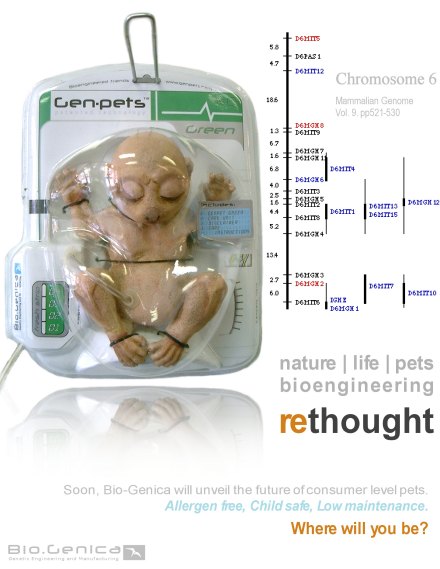
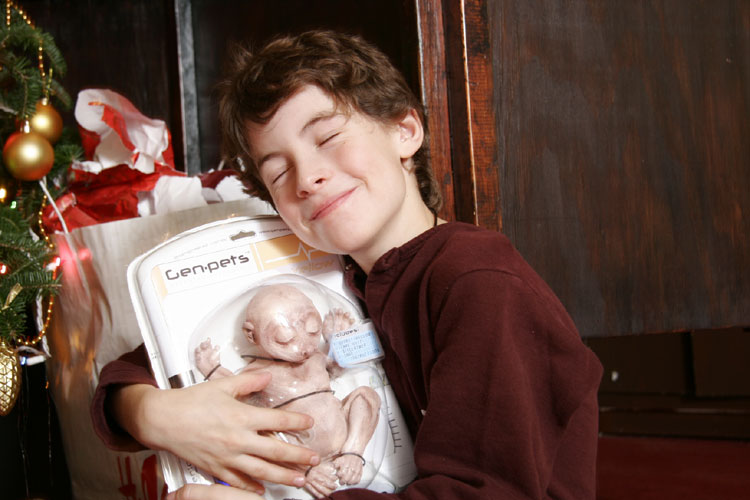
Have you ever wished you could get a pet with just a personality to match your own? Bio•Genica Genetic Engineering and Manufacturing company has developed several different types of "GenPets", so you can easily find the personality you are looking for:
Through extensive psychological testing done in the last century, certain behaviours and moods can be linked to specific colors and shades.We have taken the bioengineering of our Genpets one-step further, by altering and embedding certain personality characteristics into each type. Each personality type of the Genpets has been linked to its respective color, and that color is then used as a base for each package. For example, a child wanting a tougher, more aggressive Genpet™ would choose a red color coded one, rather than a more calm, green coded one.
GenPets were developed using well-established genetic engineering technology.
We use a process called "Zygote Micro Injection" which is quickly becoming a favourable method to combine DNA, or to insert certain proteins from different species. Most notably it was used in 1997 to splice mice with bioluminescent jellyfish (link) and has since been used to create glowing rabbits, pigs, fish, and monkeys (link). Since then, human DNA has been injected into rabbits, chimpanzees, spider DNA into sheep, and now, Genpets have arrived!
And no matter which type you chose, it will be an excellent pet.
Genpets™ learn and adapt. They are fully living pets, but better, modified to be as reliable, dependable and efficient as any other 'technology' we use in our busy lives.
Each package even comes with it's own fresh strip, so you can be sure the GenPet you take off the shelf is not past its expiration date. Check out the reseller catalog (pdf) for all the details.

GenPets are unfortunately not yet available to the general public. However, you can purchase Bio•Genica and GenPet-related merchandise from Cafe Press.

(via The Filter)

Images: GenPets by Bio•Genica. The right side of the image at top shows a segment of rat chromosome 6. (Brown et al. Mammalian Genome 9(7):521-530 (1998))

Tags:,

Tuesday, August 07, 2007

Creative Biotechnology

According to Alex Palazzo, one of the big ideas from this year's ScienceFOO "Camp"* was
biohacking - garage molecular biology is the future. Modularizing DNA functional components will help promote this technology. (Drew Endy) Will molecular biology be so simple that someday a disgruntled kid will construct some sort of lethal biological agent? (Greg Bear) Perhaps the shared knowledge between individuals will help prevent such a scenario? (Drew Endy) The greatest risk is not the biological agent, but the public's over-reaction. (many) [. . .]
Certainly Freeman Dyson (who was also at Science FOO - who wasn't there?) would agree.

While genetic-engineering-at-home kits aren't available at present, you might want to check out biotech artist Natalie Jeremijenko's Creative Biology: A User's Manual. Wired Science points out that Jeremijenko uses biotechnology to look at the world from a slightly different angle.

In the fifth chapter of Creative Biology: A User's Manual, Jeremijenko proposes a series of home mouse experiments that -- as is her specialty -- mix humor, cleverness, and a do-it-yourself ethos into a recipe for asking unexpectedly profound questions.

One experiment involves a musical composition that is played by mice snatching food from floor-mounted spoons and evolves as their tastes change. In another, people are encouraged to ask, "Will mice in Manhattan deliver (or take) food from a trapped mouse? That is to say, how different are mice geographically?" More recreationally-minded home labs can observe whether mice prefer water to vodka, gin & tonics, or antidepressant-laced beverages.

Or maybe Chapter 2 - culturing your own skin cells - is more your style. Just remember that it's not yet hobbies-as-usual to have petri dishes and tissue incubators in your home. As Jeremijenko discusses in the introduction, the projects are as much politics as it is science and art:
In the kits and explorations we have discussed, the one thing thatais absolutely unequivocally clear is that biotechnology is not something confined to well funded academic and corporate labs. The ideas and technologies of biotech effect us all. Biotechnology has far reaching effects on our health, on our environment and on our politics and many effects we cannot yet know or specify. It even effects our own sense of political agency in the world: are we predetermined by genetic predispositions, or by the environments in which we live. Biotech hobbyist emphasizes the later; this is where we can act, change and improve things.
It's interesting to speculate about a future in which we can change our own genes on whim and genetics is never destiny.

* Science FOO was an unstructured conference hosted by Google, O'Reilly and Nature that brought together scientists, science fiction writers and thinkers (not to mention Martha Stewart).

Tags:, ,

Wednesday, July 25, 2007

Bioscience News Roundup: 7-25-07

Here's an overview of some of the interesting bioscience news from the past week.

The Search For Alien Life

The Register takes a look at the National Research Council's report, The Limits of Organic Life in Our Solar System (by which I think they mean The Limits of Organic Life in Planetary Systems) It may not require water, and it may not be carbon based, so how can we look for extraterrestrial life?

Add to this the new complexity of looking for life that is unfamiliar, and the already formidable challenge becomes truly daunting. Burchell puts his finger on the problem: it is too complicated to test for life remotely, but you can't send an astronaut to do it because you would, in the best tradition of a twisty CSI plot, contaminate the scene.

This is where the cameras come in.

"A better alternative is to send a camera and look for changes. If you see a change, you can try to assign a reason for it. Are the seasons changing and frost melting, or have you observed something else, maybe a biological process," he says.

Astrobiology Magazine's take on the report is that space missions will have to make their tests for life as inclusive as possible.
Planned Mars missions, for example, should include instruments that detect components of light elements -- especially carbon, hydrogen, oxygen, phosphorous, and sulfur -- as well as simple organic functional groups and organic carbon.
Astrobiology interviewed the European Space Agency's Jorge Vago about the ExoMars program, scheduled to land on Mars in 2013. The goal is to search "for past and present life."
The idea is that we want to pick up where Viking left off, in terms of looking for life signatures, and try to answer once and for all if indeed there are oxidants there, if the oxidants are destroying the organics, if we see a relationship - or actually, I should say an anti-correlation - between the presence of oxidants and organics as we move down in the subsurface. And of course we also have instrumentation that will be able to answer other questions, more classical ones, related to mineralogy. To understand the possible biomarkers and interpret whether indeed they are biomarkers or not, we also need to know a bit about the geological context. So we have these other instruments with us that, even if we don’t find any organics, will provide good science.
Earthly Science

Art of the future? At Eye on DNA Hsien-Hsein Lei reports on the combination of genetics and art. Dr. Peter N. Gray creates sculptures and paintings that "reflect concepts from genetics, microbiology, and physics." Adam Zaretsky is a bit more offbeat: he runs a workshop called Hybrid DNA Isolation: A Hobbyist Workshop and an Exploration of the Unnamable.

The Beam Me Up blog reports on scientists who have engineered nematodes so that their muscles respond to colored light.
One possibility is that the technology, coupled with a method of getting light into the human skull, could create a Brave New World of neuro-modification in which conditions such as depression or Parkinson's disease are treated not with sledgehammer drugs or electrodes, but with delicate pinpricks of light.
That getting light into the skull might be a major stumbling blog to this approach, unless trepanation makes a comeback. For an overview of the technology, see the Nature News and Views "Controlling neural circuits with light." (pdf)

The complete mitochondrial genome of a 50,o00-130,000 year old mastodon ago has been sequenced. While a significant achievement, mitochondrial DNA is only about 16,500 base pairs, a mere fraction of the roughly 4 billion base pairs in a typical elephant genome. We're still a long way from Jurassic Park. You can read the paper in the open-access journal PLoS Biology.

The New Scientist article "Why 'junk DNA' may be useful after all" was given a thumbs up by University of Toronto biochemist Larry Moran. Read his post for background about the current scientific thought on "junk DNA" (which is not the same as "non-coding DNA").

New Scientist reports that new software
has been developed that can recognize dolphin species by their whistles. It's a far cry from real communication, of course. Hopefully the first dolphin message we understand is not "so long, and thanks for all the fish."

Finally, Posthuman Blues points to a report that concludes "Deadly germs may be more likely to be spread due to a biodefence lab accident than a biological attack by terrorists." For some reason I find the idea of accidental plague more frightening than a planned attack.

Tags:, , , , ,

Wednesday, July 11, 2007

Bioscience News Roundup: 7-11-07

Some of the interesting biology and biotechnology news stories from the past couple of weeks:

Scientists at MIT were able to reverse mental retardation caused by fragile X syndrome by blocking an enzyme involved in cellular development. As Scientific American (and lots of others ) point out, this is reminiscent of Daniel Keys' Flowers for Algernon in which surgery is used to boost the intelligence of the mouse Algernon and janitor Charlie Gordon. Hopefully the long term results are better in real life than in fiction.

Technology Review talks to Ari Patrinos, president of Synthetic Genomics, about engineering microbes to harvest oil. Craig Venter, founder of Synthetic Genomics, reported a major step in that direction; transferring an entire genome from one microbe to another. As Technology Review reports:
For Venter's team, the genome transplant is a step toward engineering microbial machines to efficiently produce fuel. The researchers are currently trying to stitch together a synthetic version of the genome of Mycoplasma genitalium, a bacterium found in the human genital tract, which Venter's group has been studying for more than a decade. By rearranging or deleting specific chunks of the synthetic genome and inserting it into a bacterial host, scientists should be able to figure out which genes are critical for the organism to function--in essence, the minimal genome. This minimal genome could then be modified to carry fuel-producing genes, and the entire string of DNA could be transplanted into a bacterial carrier.
You can listen to an interview with Venter on the June 29 Science Friday.

According to Technology Review, the Rothberg Institute will be initiating what it calls the Methuselah Project: sequencing the DNA of 100 people who are 100 years old, or older. They will only be looking at the DNA sequences that encode proteins. They apparently believe any genetic changes that increase lifespan will most likely affect protein sequences rather than the stretches of DNA that regulate when and in which cells those proteins are expressed.

TED Talks has video of a lecture by professor of surgery and chemical engineering Alan Russell on Why can't we grow new body parts?

The New Scientist Short Sharp Science blog reports on the recent report of a test of a memory erasing drug, Propranolol, on people who had experienced traumatic events.

Margaret Talbot writes for the New Yorker about using brain scans to uncover lies. It sounds like the technology currently lies on the boundary of pseudoscience.

The June 22 issue of Slate looks at "recombination of man and beast" - animals carrying human DNA - based on a report from the British Academy of Medical Sciences (pdf).
Last month, ethicists from Stanford University and the University of Wisconsin detailed a proposal by a Stanford scientist to substitute human brain stem cells for dying neurons in fetal mice. "The result would be a mouse brain, the neurons of which were mainly human in origin," they reported. The payoff, if the fetuses survived, would be "a laboratory animal that could be used for experiments on living, in vivo, human neurons." Imagine that: a humanoid brain network you can treat like a lab animal, because it is a lab animal.
Meanwhile the Roman Catholic Church has opined that human-animal hybrids should be considered to be human. (via Womens Bioethics Blog)
"The bishops, who believe that life begins at conception, said that they opposed the creation of any embryo solely for research, but they were also anxious to limit the destruction of such life once it had been brought into existence. In their submission to the committee, they said: 'At the very least, embryos with a preponderance of human genes should be assumed to be embryonic human beings, and should be treated accordingly.'"
On June 26, the New York Times devoted the science section to stories about evolution. The stories (you'll need a free account or bugmenot):

Michelle Wirth takes at takes a look at human pheromones for Scientific American Observations. She points out some of the problems with a recent study by Claire Wyart and colleagues that tested whether women responded to a chemical - androstadienone - in male sweat.

The inhabitat blog reports on wall insulation grown from a culture of mushrooms (via Beyond the Beyond)

Neurofuture reports on a collaboration between University of Calgary researchers and artists Dr. Morley Hollenberg, Alan Dunning and Paul Woodrow called the Shapes of Thought.
Participants were monitored by EEG, and EKG sensors and asked to recall traumatic events from their past. Participants agreed to undergo hypnosis and aid in the recollection and reliving of events in which they were deeply afflected by anger, fear, joy or other primary emotions.
The EEG data was translated into three dimensional images in real time.

Finally, Mind Hacks reports that the text book Neuropsychopharmacology: The Fifth Generation is now available online for free. It ". . . covers the cutting edge of pretty much everything we know about how drugs affect the mind and brain."

Tags:, , , , , ,

Wednesday, June 20, 2007

Biotech Art


Some of the coolest and weirdest uses of biotechnology are from artists' studios rather than scientists' labs. Amanda Schaffer at Slate has put together a slide show of biotech art, which ranges from green-glowing rabbits to images made with DNA.

For more biotech art, check out the web sites of some of the featured artists:
Tags:, , , , ,
Note: Links to Amazon.com are affiliate links. As an Amazon Associate I earn from qualifying purchases.