Showing posts with label writing tips. Show all posts

Tuesday, February 22, 2011

PD James: A Moral Fable

This is the last in my series of posts on science fiction author interviews in the Paris Review. Previously: Aldous Huxley, William S. Burroughs, Kurt Vonnegut, Ray Bradbury, Hortense Calisher, Doris Lessing.

I'm a fan of P.D. James. She's a master of her genre, which happens to be detective novels, rather than SF. However, I think her 1992 dystopian novel Children of Men should well be considered science fictional.

Children of Men opens in January of 2021, the last recorded birth on Earth - now 25 - has been killed in a bar fight. Our narrator describes how the declining birth rate and eventual universal infertility lead a world without children and a population sliding into despair and hopelessness.
The world didn't give up hope until the generation born in 1995 reached sexual maturity, But when the testing was complete and not one of them could produce fertile sperm we knew that this was indeed the end of Homo sapiens.   It was in that year, 2008, that the suicides increased.
It's a bleak picture she paints of future childless England - and very different from her realistic present-day crime novels.

In her 1995 Paris Review interview , James describes the science* that inspired her novel:


[. . . ] I don’t think of [Children of Men] as science fiction, as some have claimed. I didn’t set out to write a moral fable, but it came out that way. This time it was not a setting that inspired it, but the review of a scientific book drawing attention to a dramatic drop in the sperm count of Western men—fifty percent in as many years. I asked some scientists about this and they said that it was perhaps due to pollution. But the article drew attention to another factor: that of all the billions of life-forms that have inhabited this earth, most have already died out, that the natural end of man is to disappear too, and that the time our species has spent on this planet is a mere blink. So I wondered what England would be like, say, twenty-five years after the last baby was born and then for twenty-five years no one had heard the cry of a baby. I sat down and wrote it.
So she asked what kind of of future might arise from an extrapolation of present-day scientific findings. That definitely sounds like science fiction!

But the novel does feel very "English"  from my American point of view, much in the same way James' novels featuring the Scotland Yard detective Adam Dalgleish do.  I'm not sure if it's the realistic-seeming setting in the English countryside or the characters' mannerisms, but that aspect of Children of Men doesn't seem very science fictional. In that way it's much closer to Kazuo Ishiguro's Never Let Me Go, than "regular" science fiction.

Read the entire 1995 interview with P.D. James, in which she talks about being a feminist, writing about detectives, her belief in God and her preoccupation with death.

It's quite worth checking out all the Paris Review author interviews, since they cover a wide range of topics and, as Nicola Griffith pointed out, it's a  an excellent way for anyone interested in writing to "get an education, for free".
-------

* I think it's interesting that in the movie version of Children of Men, creator Alfonso Cuarón chose to twist the science underpinning the story 180 degrees by making women, rather than men, infertile. It isn't clear to me why that change was made. Cuarón has said the infertile women are a "metaphor for a fading sense of hope", but I don't why infertile men wouldn't play the same part - unless you think of male characters as individual humans, and female characters as symbols.


Monday, February 21, 2011

Doris Lessing: Sufism and Space Fiction

A continuation of my series of posts on science fiction author interviews in the Paris Review. Previously: Aldous Huxley, William S. Burroughs, Kurt Vonnegut, Ray Bradbury, Hortense Calisher.


Between 1979 and 1983 Nobel prize winning author Doris Lessing published five "space fiction" novels. The  Canopus in Argos series is influenced by Lessing's interest in the mystical and spiritual aspects of Sufism, and focuses on an advanced interstellar species accelerating the evolution of less advanced species.

The Canopus in Argos series was not Lessing's first dip in to science fiction.  Her 1969 novel The Four-Gated City  - sometimes called her most important work - begins in post-WWII Britain and follows the characters through a bloody future World War III at the close of the 20th century.

In her  interview published in the Spring 1988 edition of the Paris Review, Lessing talks about the role of the novelist in possible futures in fiction:

Lessing:  I know people say things like, “I regard you as rather a prophet.” But there’s nothing I’ve said that hasn’t been, for example, in the New Scientist for the last twenty years. Nothing! So why am I called a prophet, and they are not? 

Interviewer:  You write better. 

Lessing:  Well, I was going to say, I present it in a more interesting way. I do think that sometimes I hit a kind of wavelength—though I think a lot of writers do this—where I anticipate events. But I don’t think it’s very much, really. I think a writer’s job is to provoke questions. I like to think that if someone’s read a book of mine, they’ve had—I don’t know what—the literary equivalent of a shower. Something that would start them thinking in a slightly different way perhaps. That’s what I think writers are for. This is what our function is. We spend all our time thinking about how things work, why things happen, which means that we are more sensitive to what’s going on.


 I think that's an interesting take on the "predictions" that so many science fiction writers lay claim to - it's not so much a special knowledge of science or current events that allows authors to do that, but the habit of thinking about the way the world works that allows for plausible extrapolations to be imagined.

Even though Lessing doesn't think of her novels as science fiction, it's not because she disdains the genre. She raves about Stanislaw Lem's Solaris - and about being the guest of the 1987 Worldcon:

I’ve just read a book by the Solaris bloke, Stanislav Lem. Now that’s real classic science fiction . . . full of scientific ideas. Half of it, of course, is wasted on me because I don’t understand it. But what I do understand is fascinating. I’ve met quite a lot of young people—some not so young either, if it comes to that—who say “I’m very sorry, but I’ve got no time for realism” and I say “My God! But look at what you’re missing! This is prejudice.” But they don’t want to know about it. And I’m always meeting usually middle-aged people who say, “I’m very sorry. I can’t read your non-realistic writing.” I think it’s a great pity. This is why I’m pleased about being guest of honor at [the World Science Fiction Convention, in Brighton] , because it does show a breaking down [of compartmentalization of SF and non-SF].
In the interview, Lessing says she's going to publish a sixth Canopus in Argos novel, a sequel to  The Sentimental Agents. That novel apparently never materialized, and she moved away from writing "space fiction". The "goblin child" story she talks about writing is likely The Fifth Child, published in 1988, and since then she has published other speculative fiction works (although  fantasy or horror, rather than science fiction).


Read the entire interview with Doris Lessing, for more about living in Persia and Africa, involvement with Sufism,  her writing habits, the "Jane Somers" hoax and having one of her  SFnovels turned into an opera by Philip Glass.

Tomorrow: The series wraps up with an interview with PD James.

Saturday, February 19, 2011

Ray Bradbury: The fiction of ideas and giving the gift of books

A continuation of my series of posts on science fiction author interviews in the Paris Review. Previously: Aldous Huxley, William S. Burroughs, Kurt Vonnegut.

Ray Bradbury shouldn't need any introduction. His earliest stories were published in science fiction fanzines in the late 1930s. Since then, he has published hundreds of short stories and novellas;  a dozen novels, including The Martian Chronicles, Fahrenheit 451, and Something Wicked This Way Comes, plus plays and poetry.

The Paris Review's interview with Ray Bradbury is a composite of unpublished interviews from the late 1970s, supplemented with additional discussions not long before publication in early 2010.  In it, he talks about reading, writing and what science fiction means to him:
Science fiction is the fiction of ideas. Ideas excite me, and as soon as I get excited, the adrenaline gets going and the next thing I know I’m borrowing energy from the ideas themselves. Science fiction is any idea that occurs in the head and doesn’t exist yet, but soon will, and will change everything for everybody, and nothing will ever be the same again. As soon as you have an idea that changes some small part of the world you are writing science fiction. It is always the art of the possible, never the impossible.
That sounds like a solid definition. Of course what some people consider "impossible", others just consider "improbable", so, as ever, the boundary between fantasy and science fiction is a fuzzy one.

But whether fantasy or science fiction, Bradbury argues that books can inspire kids to become scientists or engineers or simply do something interesting with their lives.
That’s what we have to do for everyone, give the gift of life with our books. Say to a girl or boy at age ten, Hey, life is fun! Grow tall! I’ve talked to more biochemists and more astronomers and technologists in various fields, who, when they were ten years old, fell in love with John Carter and Tarzan and decided to become something romantic. [. . .] I find this in most fields. The need for romance is constant, and again, it’s pooh-poohed by intellectuals. As a result they’re going to stunt their kids. You can’t kill a dream. Social obligation has to come from living with some sense of style, high adventure, and romance.
Although kids today are more likely to read Harry Potter or The Hunger Games series than Tarzan, I think his basic premise is right. Fantastic fiction can help kids (and adults) set their imaginations free, and inspire dreams of progress and adventure. 


Bradbury also talks about writing pensées - evocative poetic prose - like the description of the dinosaur in his short story "A Sound of Thunder":

It came on great oiled, resilient, striding legs. It towered thirty feet above half of the trees, a great evil god, folding its delicate watchmaker’s claws close to its oily reptilian chest. Each lower leg was a piston, a thousand pounds of white bone, sunk in thick ropes of muscle, sheathed over in a gleam of pebbled skin like the mail of a terrible warrior. Each thigh was a ton of meat, ivory, and steel mesh. And from the great breathing cage of the upper body those two delicate arms dangled out front, arms with hands which might pick up and examine men like toys, while the snake neck coiled. And the head itself, a ton of sculptured stone, lifted easily upon the sky. [...]
He really can paint a picture with words, which is what I enjoy about Bradbury's writing.

Read the whole interview to find out about Bradbury's views on other writers, how he writes, and the stroke he suffered in 1999. Most of it is great, although I totally disagree with his opinion on the value of learning mathematics.

Tomorrow: Hortense Callisher

Friday, February 18, 2011

Kurt Vonnegut: War, Anthropology, and Atheism

This is a look at another SF authored who was interviewed by the Paris Review. The interviews with  Aldous Huxley and William S. Burroughs took place in the early 1960s. Now we jump ahead more than a decade to a 1977 interview with Kurt Vonnegut.

The Paris Review's interview with Kurt Vonnegut starts out with a discussion of Vonnegut's experiences as a infantry scout in during the Second World War.  His experience as a prisoner of war during the firebombing of Dresden formed the basis for his 1969 novel Slaughterhouse Five - at least for the parts that weren't set in a zoo on the planet Tralfamador.

Before the war Vonnegut studied chemistry at Cornell University for several years. When he enlisted in the Army, he was transferred to the Carnegie Institute of Technology where he studied mechanical engineering. His studies were interrupted by the war.

After the war was over, Vonnegut went back to school to study anthropology as a post-grad at the University of Chicago. As he describes it, anthropology influenced his opinion of religion and his own atheism:
After the war, I went to the University of Chicago, where I was pleased to study anthropology, a science that was mostly poetry, that involved almost no math at all.
[. . .] [Anthropology] confirmed my atheism, which was the faith of my fathers anyway. Religions were exhibited and studied as the Rube Goldberg inventions I’d always thought they were. We weren’t allowed to find one culture superior to any other. We caught hell if we mentioned races much. It was highly idealistic.

Those views would influence the depiction of the fictional island dictatorship of San Lorenzo in his Hugo-winning 1963 novel Cat's Cradle. The government of San Lorenzo promotes (by prohibiting) a made-up religion to control its population. 

Apparently a poor student, Vonnegut left the anthropology program without completing his degree.  Luckily one of the University of Chicago's deans was apparently a fan, and got Cat's Cradle accepted in lieu of Vonnegut's rejected thesis in 1971.  
Twenty years [after leaving the University of Chicago], I got a letter from a new dean at Chicago, who had been looking through my dossier. Under the rules of the university, he said, a published work of high quality could be substituted for a dissertation, so I was entitled to an M.A. He had shown Cat’s Cradle to the anthropology department, and they had said it was halfway decent anthropology, so they were mailing me my degree
According to Vonnegut it was a "piece of cake".

Several characters in Cat's Cradle were inspired by the scientists he met while working in the public relations department of General Electric in Schenectady, New York.  Even the idea for the novel's compound "ice-nine", supposedly came from Nobel-prize winning GE scientist Irving Langmuir.   The way Vonnegut tells it, he wasn't even the recipient of that suggestion:
[H.G.] Wells came to Schenectady, and Langmuir was told to be his host. Langmuir thought he might entertain Wells with an idea for a science-fiction story—about a form of ice that was stable at room temperature. Wells was uninterested, or at least never used the idea. And then Wells died, and then, finally, Langmuir died. I thought to myself: “Finders, keepers—the idea is mine.”
Even if Wells had used the idea in a story, I doubt it would have turned out anything like Vonnegut's version.

Read the whole interview for more of Vonnegut's reminiscences and thoughts on writers and writing.

Tomorrow: Ray Bradbury

Thursday, February 17, 2011

William S. Burroughs: Body Modification and Biologic Courts

This continues the series on interviews with SF writers in the Paris Review. Yesterday, I posted about the 1960 interview with Aldous Huxley. Today, I'll take a look at the 1965 interview with William S. Burroughs

William S. Burroughs was interviewed by the Paris Review in 1965. His weird and controversial novel Naked Lunch had been published in the United States in 1959. At the time this interview was published, its sale was still banned in Boston.

Burroughs was interviewed the year after publication of his Nebula award-winning novel Nova Express. Nova Express was the third book in his Nova Trilogy, and was assembled using the cut-up method, in which "existing texts ... cut into various pieces and put back together in random order." Definitely not what most people would think of a standard science fiction novel.

The plot summary for Nova Express makes it sound hallucinogenic:
The Nova Mob—Sammy the Butcher, Izzy the Push, The Subliminal Kid, and others—are viruses, "defined as the three-dimensional coordinate point of a controller."[...] "which invade the human body and in the process produce language." These Nova Criminals represent society, culture, and government, and have taken control. Inspector Lee and the rest of the Nova Police are left fighting for the rest of humanity in the power struggle. "The Nova Police can be compared to apomorphine, a regulating instance that need not continue and has no intention of continuing after its work is done."

The novel also apparently involves biologic police agents and legal battles between competing life forms are fought "Biologic Courts".

As Mac Tonnies described it, it's "the literary equivalent of downing a few vials of choice LSD".

In the Paris Review interview, Burroughs expands on the idea of that the future of the human race will involve genetic engineering and require some sort of "biologic law" and courts to mediate the changes.
Science eventually will be forced to establish courts of biologic mediation, because life-forms are going to become more incompatible with the conditions of existence as man penetrates further into space. Mankind will have to undergo biologic alterations ultimately, if we are to survive at all. This will require biologic law to decide what changes to make. We will simply have to use our intelligence to plan mutations, rather than letting them occur at random. Because many such mutations—look at the saber-toothed tiger—are bound to be very poor engineering designs. The future, decidedly, yes. I think there are innumerable possibilities, literally innumerable. The hope lies in the development of nonbody experience and eventually getting away from the body itself, away from three-dimensional coordinates and concomitant animal reactions of fear and flight, which lead inevitably to tribal feuds and dissension.  
I'm struck by how much that last part  - about the future of the human race eventually "getting away from the body itself"  - sounds like some modern proponents of transhumanism who see the divorce of the mind from the limitations of the body as one of their ultimate goals. A man ahead of his time, perhaps? or is it a simply reworking of Buddhist ideas of mind-body separation within a scientific frame? I don't know enough about Burroughs' ideas to tell the difference.

In the interview, Burroughs also talks a bit about the inevitable cross-fertilization of science and art:
In the first place, I think there's going to be more and more merging of art and science. Scientists are already studying the creative process, and I think the whole line between art and science will break down and that scientists, I hope, will become more creative and writers more scientific.
Perhaps inspired by this notion is the "Mutate or Die" project, which involves isolating and manipulating DNA from a preserved sample of Burroughs' poop.  It definitely involves science, and it's meant to be art.

Read the whole interview for more from Burroughs about cut-ups, addiction, and how he created his fictional characters.


Tomorrow: Interview with Kurt Vonnegut.

Wednesday, February 16, 2011

Paris Review Interview with Aldous Huxley: Psychedelic Drugs and Enlightenment

A few months ago, Nicola Griffith posted that the Paris Review had opened its archives of author interviews, back to 1953. I don't usually read literary magazines, but I finally got a chance to browse through the Paris Review's archives. It is quite interesting to see what the science fiction writers they interviewed have to say about science and their fiction.

Of course the authors they interview are all "literary" sorts of authors*, and they wouldn't necessarily agree that their writings that I would consider science fictional are SF. Even so, the authors did take into account science in their writing.

I thought I'd highlight a few of the interviews that touched on the biosciences. The first is an interview with Aldous Huxley, in which he talks about his ideas about society and drugs.

When Huxley was interviewed in 1960, he was 65 years old at the time of this interview, and working on his novel Island, which would be his last. Island depicts a utopian community, that is a counterpoint to the dystopian society he depicted in Brave New World. Huxley describes his work in progress:

It’s a kind of fantasy, a kind of reverse Brave New World, about a society in which real efforts are made to realize human potentialities. I want to show how humanity can make the best of both Eastern and Western worlds. So the setting is an imaginary island between Ceylon and Sumatra, at a meeting place of Indian and Chinese influence. One of my principal characters is, like Darwin and my grandfather**, a young scientist on one of those scientific expeditions the British Admiralty sent out in the 1840s; he’s a Scotch doctor, who rather resembles James Esdaile, the man who introduced hypnosis into medicine. And then, as in News from Nowhere and other utopias, I have another intruder from the outside world, whose guided tour provides a means of describing the society. Unfortunately, he’s also the serpent in the garden, looking enviously at this happy, prosperous state.
The islanders take moksha medicine, a fungus-derived psychedelic drug. As it's described in the final version of the novel the drug helps liberate consciousness and bring self-knowledge:
Their response is the full-blown mystical experience. You know—One in all and All in one. The basic experience with its corollaries— boundless compassion, fathomless mystery and meaning.

"Not to mention joy," said Dr. Robert, "inexpressible joy."

In contrast, in Brave New World, the drug soma is described as making people content, complacent, and able to ignore the difficulties of their daily lives. Linda, mother of the "savage" John, takes massive doses to cope with her return to civilation:
The return to civilization was for her the return to soma, was the possibility of lying in bed and taking holiday after holiday, without ever having to come back to a headache or a fit of vomiting, without ever being made to feel as you always felt after peyotl, as though you'd done something so shamefully anti-social that you could never hold up your head again. Soma played none of these unpleasant tricks. The holiday it gave was perfect and, if the morning after was disagreeable, it was so, not intrinsically, but only by comparison with the joys of the holiday. The remedy was to make the holiday continuous. Greedily she clamoured for ever larger, ever more frequent doses.
The permanent soma-induced holiday leads to Linda's death.


Huxley's different take on drug use in his two novels appears to be based - at least in part - on his own experimentation with drugs in the years between publication of Brave New World and his work on The Island. In his interview, Huxley talks about drugs in Brave New World and in real life, based on his drug-taking experiences that he described in his non-fiction book The Doors of Perception.
Soma is an imaginary drug, with three different effects—euphoric, hallucinant, or sedative—an impossible combination. Mescaline is the active principle of the peyote cactus, which has been used for a long time by the Indians of the Southwest in their religious rites. It is now synthesized. Lysergic acid diethylamide (LSD-25) is a chemical compound with effects similar to mescaline; it was developed about twelve years ago, and it is only being used experimentally at present. Mescaline and lysergic acid transfigure the external world and in some cases produce visions. Most people have the sort of positive and enlightening experience I’ve described; but the visions may be infernal as well as celestial. These drugs are physiologically innocuous, except to people with liver damage. They leave most people with no hangover, and they are not habit-forming. Psychiatrists have found that, skillfully used, they can be very helpful in the treatment of certain kinds of neuroses.
So Huxley seems to have formed his later ideas about drugs through a combination of personal experience and science. Mescaline and LSD were both made illegal in the US in 1970, seven years after Huxley's death. I suspect it's less likely that present-day authors would feel so free to experiment with psychedelics - or at least freely discuss their experimentation.

Be sure to read the whole interview for more from Huxley on his writing process and thoughts about fiction.

Tomorrow I'll look at the Paris Review interview with William S. Burroughs.
------

* You can tell they are "literary" writers from the covers of their novels: rather than illustrated characters or scenes, they usually just abstract images and text.


** Aldous Huxley's grandfather was Thomas Henry Huxley, known as "Darwin's bulldog" for his support of Darwin and advocacy on behalf of his evolutionary theory.

Sunday, November 16, 2008

Biology in Science Fiction Roundup: November 16 Edition

Some recent biology & science fiction-related links:

General

Arvind Mishra has an overview of The First Ever National Disuccussion of Science Fiction: Past, Present, Future, held in Varanasi, India from November 10-14.

If you like both "Lost World" and Americana you'll probably love Dinosaur Kingdom in Natural Bridge, Virginia, where the Civil War meets dinosaurs (via Metafilter)

Written Word

Lots of memories of Michael Crichton. A few that talk about the biology in his books:
Jennifer Rohn posts about natural-sounding ways to have your scientist characters introduce science background into your novel.

Peter Watts has finished an outline for a new novel (not a completed novel like I first wrote, bummer). Like Blindsight it is based in neuroscience:
What we got here is a Blindsight spinoff; a thought-experiment on the nature and evolution of Singularities, past and future; a cast of characters who don't understand their own actions (one of the themes of the book is that it's neurologically impossible to understand our own true motives; the best we can do is make guesses after the fact); all told through the eyes of a man whose brain is literally being rewired throughout the course of the story.
There's a CJ Cherryh link roundup at Feminist SF.

Television

A Fantasy Magazine Randy Henderson explains Why We Need Scientist Heroes Again

The LA Times Show Tracker blog interviewed Fringe writer Jeff Pinkner, who claims the shows plots are based in science fact:

A: There’s always a degree of responsibility we feel, but all of our science is grounded in reality. We’re not telling any stories that are in the world of potential.

Q: If you’re playing with the reality anyway, why rely on scientific fact at all? Couldn’t you just completely make something up that sounds plausible and go with that?

A: Yes. But our rule is we don’t want to do it if it’s totally made up. I’m sure people would tell you everything we’re doing is totally unbelievable, but for us, if we set out to do an utterly fictional show, it would probably be easier in some ways, but it would be less exciting. I think we all quite like the idea that we’re working in the realm of the real, as opposed to the entirely made-up. Again, it’s not necessary to watch the show and see how it’s ripped from the headlines, because it’s not. But there’s a certain quality of authenticity that it’s much easier to create if you know the parameters.

Science Not Fiction reviews the Primeval DVD:
The other big stars of the show are the creatures, beautifully and realistically animated CGI creations–it’s not a surprise that they’re good, since the team that produces them was responsible for the BBC documentary Walking With Dinosaurs. For Primeval, some artistic license does get taken, but the creatures that run, swim, and fly through the show are very believable, and prove you don’t have to travel to another planet to find creatures and worlds that are utterly alien.
Science Not Fiction also has another look at science in The Eleventh Hour: Staying Safe From Scary Germs

Movies

Hero Complex talked to Guillermo del Toro, who told them that Swamp Thing is "one of the last Holy Grail projects that is still out there."

Repo! The Genetic Opera has been released on a small number of screens, and the reviews are in - and pretty bad. Says the LA Times:
The film is bad -- not good-bad, tacky-bad or fun-bad, just plain awful and nearly unwatchable. "
On the other hand, some fans in LA have already seen it 4 times. Paris Hilton groupies, perhaps?
And io9 has an interview with writer and on-screen graverobber Terrance Zdunich. He says there's a real organ trade behind the fiction:
... when Darren Smith and I were researching and doing the writing of Repo!, we actually had some really cool interviews and some cool stories we found with surgeons and transplant doctors. We just studied what's really out there. The reality is, a lot of what's happening in Repo! isn't as far-fetched as it may seem. And certainly, perhaps not that far off in the future. Organs are used as currency. Maybe not at Walmart, but there is a market around body parts — and ironically, right now, at least in the States, the only people that don't profit from organ donations are the actual donors. Everyone else literally makes a killing off of it. And in other countries, there are tons of stories, in South America, for example, of people who are selling, like, a kidney to fat rich Americans. And they're doing it for a price that you'd be kind of like — "Woah, you're losing a kidney for just, you know, a Whopper combo super-sized? That's pretty intense." And even recently, the Chinese government, which has denied it for ages, came clean on the fact that they had been in many cases executing prisoners and then taking their organs and selling them again to rich, fat Americans. So I don't think it's that far off. Do I ever think that Big Brother's going to come in and actually on-the-books sanction murder? I don't think so. But do I think that there's perhaps a lot of social commentary and satire in what we're doing? Yes, that was definitely intentional.
Mike Brotherton lists ten great SF novels that would make terrible movies. He doesn't think people would want to see Connie Willis's plague novel, The Doomsday Book, even though it's about the survivors; Forward's The Dragon's Egg is too alien; and the smart dolphins of Brin's Startide Rising would "look dumb on film". I'd watch any of those over the rumored Ridley Scott movie based on the Monopoly board game.

SF Signal has a trailer for the new animated CGI movie Monsters vs. Aliens. Looks cute!

Slice of SciFi reports that there may be a new Planet of the Apes movie in the works - not a sequel to Burton's recent version, but another "reboot".

Wired reports on "Six Real Gadgets Minority Report Predicted Correctly", including neuroscientists being able to "predict mistakes" (no, not murder, though). I'm not sure it's that clever that the 2002 movie "predicted" technologies that were almost certainly in the pipeline at the time it came out. It's still nifty stuff.

Cool Bioscience

Carl Zimmer has a great science fiction idea: aliens whose skin turns green from the plants they eat. It's based on the real science emerald green sea slugs that turn green from plant matter they retain in their skin from the algae they ingest.

Japanese scientists cloned a mouse that had been in the freezer for 16 years, and have speculated that extinct animals like the wooly mammoth could be next. Aparently a Pleistocene Park (ala Jurassic Park) is already in the planning stages.

Scientists have identified the genetic changes that allowed vampire bats to "subsist on a diet of pure blood."

Lifehacker has clips from the 60 minutes program about recent developments in brain-computer interfaces.

Post-Weird Thoughts has a bit on a plant named Midori that has its own blog. Somehow Midori's bioelectric signals are translated into words - sounds like science fiction to me.

The New York Times ran an interesting series of articles about epigenetics. The Knight Science Journalism Tracker has an overview and links. Two of my favorite science writers contributed: Natalie Angier on the meaning of "Gene" and Carl Zimmer on "the rest of the genome".

Hourglass is the blog carnival of biogerentology: the science of aging. Read the latest edition at psique.

Ian Musgrave at Panda's Thumb points to a cool interactive web exhibit exploring the origins of life on the Boston Museum of Science Web Site.

Genetics & Health rounds up information on the "hard questions" about the personal genome revolution.

Tags:,

Saturday, November 01, 2008

Biology in Science Fiction Roundup: November 1 Edition

Here are a few biology in science fiction-related links from the past couple of weeks.

Written Word

Jennifer Rohn of Mind the Gap has another post about the best way to write about science in your fiction. Her lab-lit novel Experimental Heart was released today.

Jo Walton writes at Tor.com about "Telepathy and Tribulation: John Wyndham's The Chrysalids"
Wyndham really was a terrific storyteller. He manages to evoke his oppressive world of “Watch Thou For The Mutant” and burning the blasphemous crops is evoked in impressively few words. I have no idea what I’d think if I was reading this for the first time now. As a child I identified totally with David and his telepathic mutation. I felt that Sophie, Rosalind and Petra were solidly characterised, whereas now I see them as barely more than plot tokens. Wyndham’s attitude to women is exceedingly peculiar. It goes way beyond the times he lived in. But the book does pass the Bechdel test, which is pretty good for a first person male novel—the narrator overhears two women have a conversation about a mutant (female) baby.
Television

The complete series of the dinosaur-time portal show Primeval will be released on DVD on November 4.

The Science Not Fiction blog continues its series on the Eleventh Hour by looking at the the latest episode that features children with Heller's Syndrome.

Movies

Cash @ Science and Super Models explains "Everything I Need to Know About Science I Learned From Watching "The Lost Skeleton of Cadavra"

Amazon.com has a portal for Repo! The Genetic Opera (affiliate link), with video clips and an interview with director Darren Lynn Bousman. Apparently there is more to it than gore, singing and Paris Hilton.

Amazon: The movie depicts a bleak dystopian future – do you think that something like this reality is possible in our lifetime?
Bousman: Yes, I do. A big portion of this movie is about perfecting our bodies, and what measures we would go to to reach perfection. Isn't that what is happening now. We all our guilty. Rather that mean tanning, or going to the gym. We all want to look good. We all want to feel good. But how far would you go? Would you get breast implants? Botox? How about a new heart? A better looking FACE? And in the end, what would you be willing to pay?
SciFi Scanner has a slide show that looks at "how The Fly has morphed over the years"

Bloody-Disgusting has posters for the film Infected.

Cool Bioscience

Japanese scientist Makoto Nakamura is developing a printer that sprays cells rather than ink droplets. His ultimate goal is to be able to print 3-dimensional organs like the heart. (via Discoblog)

SES: Science, Education & Society explains the difference between "genetic" and "heritable".

The European Space Agency's Huygens probe has found new evidence that life could have arisen on Saturn's moon Titan.

Scientists are recreating the circuits that regulate amoeba behavior in an attempt to understand primitive "intelligence":
Di Ventra's team thinks there is an intrinsic memory storage device within the amoeba. As with the human brain, that device can strengthen and store memories for some time. But if the memory isn't used, it gradually fades away. Now they have identified a potential storage device. Now they have identified a potential storage device. The amoeba's interior contains a watery sol – a solid suspended in liquid – within a thick viscous gel. The sol flows through the gel like water through a sponge, creating a network of low-viscosity channels. Those channels are strengthened as long as the amoeba continues to respond to a static environment, but if that environment changes the channels gradually break down and a new network appears as the amoeba adapts. For a short while, though, the amoeba retains a “memory” of those earlier conditions. Di Ventra's team took advantage of the development this year of memristors – electrical resistors that retain a memory of earlier voltages or currents applied and vary their resistance accordingly – to design a simple circuit that models the amoeba's gel-sol system.


The ASU School of Life Sciences Podcast Series has some episodes of scifi interest:
John Horgan debated Ray Kurzweil at the Singularity Summit in San Jose:
I reiterated my old argument that the lack of progress in treating cancer and mental illness reflects the primitive state of biology, genetics, neuroscience and hence the improbability of Kurzweil’s claims. Ray reiterated his old argument that neuroscience and other fields will soon reap the benefits of exponential progress in information technologies. I added that the Singularity is hurting the credibility of science at a time when science is already under attack. Ray shrugged off this complaint, because of course his vision rests on reasonable projections of current scitech trends, not on faith.
Tags:,

Monday, August 11, 2008

How Aliens Work

At How Stuff Works Craig Freudenrich has put together a primer on "How Aliens Work". He lays out the ground rules for alien physiology:
  1. "Alien life would be governed by laws of physics and chemistry."
  2. "Alien life would be based on some type of chemistry (eliminating the sci-fi concept of pure-energy beings)." What type of chemistry will be determined by the environment, including the available solvent (such as water or methane), temperature, pressure, available energy sources, and the presence of complex molecules, especially an "informational molecule" like DNA.
  3. Aliens larger than microbes would have some equivalent of cells. "We would not expect to find a light-years wide, single-celled organism like that portrayed in the original Star Trek episode "The Immunity Syndrome.""
  4. "Organ systems would be adapted to environmental conditions such as temperature, moisture and gravity"
  5. "Alien organisms would probably have similar ecological structures to life on Earth."
And the most important take home message?
As you can see, life of any kind is intimately tied to its environment, so the characteristics of the planet would be extremely important in determining the characteristics of the life form.
Read the full article for all the details.

(via The World in the Satin Bag)

Image: Creatures like the gargantuan Space Amoeba from the Star Trek ToS Episode "The Immunity Syndrome" probably don't exist.
Tags:, ,

Wednesday, August 06, 2008

Tropes in Speculative Fiction

Television Tropes & Idioms is a wiki that focuses on common tropes ("story components or elements which have become standardized through decades (or more) of use") in television, movies, novels, and comic books. It's got a great long list of speculative fiction tropes - and the entries don't just describe the trope, some also explain why the trope is wrong. Here are snippets from a few of their biology-related entries:
  • The Adam and Eve Plot: only two members of a race remain to repopulate their species. The problem?
    This, of course, ignores real population genetics. A certain minimum number of genetically divergent individuals are needed in a gene pool to maintain a healthy genetic diversity. For humans it is somewhere between 150 and 160. You usually won't find this in direct siblings. More casually, this results in the unspoken implication that said newly propagated species does not have a problem with incest.
  • Bizarre Alien Biology: while aliens are humanoid on the outside, their totally different f on the inside
  • Brain in a Jar: pretty much what it sounds like
  • Cloning Blues: it's not easy being a mere copy
  • Evilutionary Biologist: "Some evil mad scientists use their twisted intellect solely for personal gain. This particular villain is not so provincial. His genius and his motives go hand in hand, and his concerns are (he thinks) with the welfare of the human species. Simply put, to the Evilutionary Biologist, humanity is stuck in an evolutionary rut, and it's up to him to put us back on the proper path so we can continue to evolve."
  • Evolutionary Levels: Yes, there's evolution in SF, but it's usually depicted incorrectly.
    One popular misconception seems to be how the entirety of evolution is preprogrammed, past and future. Evolutionary states that don't exist yet are just waiting in human DNA to be triggered by rather simple means, as opposed to the culmination of little changes brought on by passing down genes over hundreds of generations. Likewise, it's easy to "regress" in evolution. A Mad Scientist or a Negative Space Wedgie for example, can hit humans with rays that will turn them into Neanderthals or monkeys, regardless of the fact that humans evolved from neither. (If they made an effort, this could work, because there is a remotely linear progression of common ancestors for species. So close, and yet, so dumb.)
    Not to mention the love of Lamarckian-style evolution that's caused by environmental change, evolution that affects entire populations simultaneously, and future humans with gigantic heads. And that's how you get Mutants with a capital M.
  • Genetic Engineering is the New Nuke: in the old days superpowers were created by radiation. Today, genetic engineering does the job.
  • Genetic Memories: our genes store the memories of our ancestors
  • Half Human Hybrids: despite bizarre alien biology, humans interbreed with a variety of other species. See also No Biochemical Barriers.
  • Soylent Soy: in the future meat is very scarce . . .
Be sure to look at their list of "Applied Phlebotinum" and "Hollywood Science" tropes too.

(via The World in the Satin Bag)

Tags:, ,

Saturday, May 31, 2008

SciTalk: Science Advice for Authors

SciTalk is UK web site created by bioscience consultant Ann Lackie (who writes under the pen name Ann Lingard), that acts as a matchmaker between authors and scientists. You can search their databases by scientific subject, which gives you the name of a scientist or scientists in that field. You then can arrange to meet her or him to discuss your fiction. As their logo suggests, the biological sciences are well represented, from bacterial genetics to xenotransplantation.

For example, SciTalk set up a meeting between novelist Clare George with neuroscientist Jonathan Cole, who both approached their meeting with some trepidation, but ended up having a useful conversation:
"Sometimes you come up against scientists who don't understand what it is like not to understand." However, [George] says that with Jonathan this was not a problem. She found him easy to understand and not at all condescending.
It sounds like an incredibly useful resource for authors who are in the UK (or willing to travel there). I wonder if there is a similar resource for US authors and scientists?

If you are scientist interested in sharing your expertise, you can apply to be listed in their database.

Tags:,

Tuesday, February 26, 2008

Make SF More Believable with Neuroscience

FRAISER: Well, your brain chemistry's been seriously compromised. All of you have abnormally low levels of serotonin.

O'NEILL: Which means…?

FRAISER: It's a neurotransmitter that effects moods. Now, low levels would account for depression, but not these other effects. Come here. I want you to take a look at this.

[Fraiser leads them to a computer. On screen is a model of a human brain. She points, outlining an area with her finger.]

FRAISER: This dark spot here appears on all of your scans. Now, it's almost too small an anomaly to worry about but for the fact that it's in virtually the same part of the cortex—

~ Stargate SG-1, "Fire and Water"
Last week Ben Goldacre wrote in his Bad Science blog (and his column for The Guardian) about the Brain Gym, a UK school program that some teachers love despite the pseudoscientific explanations for its various exercises. He points to one possible explanation: a report in the March 2008 Journal of Cognitive Neuroscience that shows that people are more likely to believe explanations that include neuroscience technical terms.

The subjects were from three groups: everyday people, neuroscience students, and neuroscience academics. All three groups judged good explanations as more satisfying than bad ones, but the subjects in the two non-expert groups judged that the explanations with logically irrelevant neurosciencey information were more satisfying than the explanations without. What’s more, the bogus neuroscience information had a particularly strong effect on peoples’ judgments of bad explanations. As quacks are well aware, adding scientific-sounding but conceptually uninformative information makes it harder to spot a dodgy explanation.

An interesting question is why. The very presence of neuroscience information might be seen as a surrogate marker of a good explanation, regardless of what is actually said. As the researchers say, “something about seeing neuroscience information may encourage people to believe they have received a scientific explanation when they have not.”

So, if you are writing a story and need to create a plausible explanation for your characters' behavior, try a little neuroscience!

Read a preprint of the original article: Weisberg DS et al. "The seductive allure of neuroscience explanations", J. Cogn. Neurosci., 20: 470-477 (2008) (pdf). If you have access to the online version of the Journal of Cognitive Neuroscience, you can read the article here.

Image: Depiction of eddy current brain stimulation, from the work of Eric Wasserman an the Brain Stimulation Unit at NINDS
.


Tags:,

Saturday, February 23, 2008

How a Science Fiction Writer Thinks

Nancy Kress writes on her blog about how she realized she sees the world a little differently than the average person after watching a video of the 200 people who froze in place for five minutes in Grand Central Station:
Had I seen this sudden mass freezing, the first thing that would have come to mind was a virus of some kind, possibly genetically engineered, that causes a vastly speeded-up Parkinson's-like syndrome, locking muscles in place. I would have called 911, afraid that lung muscles would be next and all these people would stop breathing. I would have wondered if it were contagious.
I'd suspect that's how science fiction writers get their ideas: they simply observe the world around them through a SF lens.

Tags:,

Friday, January 18, 2008

Hard Science Fiction Ideas or How to Research Research

Science fiction writer James VanPelt* has written a helpful column for aspiring science fiction writers, "Generating Hard Fiction Ideas Painlessly":
So, do you need a degree in science or math to write hard science fiction? Nope. Numerous hard science fiction authors write their stories without that background. I’m one, for example. My college degrees are in English and history. Fred Pohl and Ray Bradbury didn’t attend college. Connie Willis was an elementary school teacher before her science fiction successes. Admittedly, though, the non-science or math authors will have to work a little harder to not write laughable hard science fiction. They need to cheat a bit. They may need help coming up with ideas, and they certainly will need help for the science that is not at their fingertips. Fortunately, the help is no farther away than the nearest bookstore.
He gives several suggestions for books, including one based on the excellent NPR program, Science Friday.

Jeremiah Tolbert responded with his own request:
Someone with access to the big primary biological sciences literature should post reviews/summaries in laymen's terms of each issue. Nature, Science, and more. People could volunteer and write in summaries for any primary literature they want. Group blog the literature. Get it out there in the web, in a format that science-interested people can understand. Because I think there's a barrier still between that level of academic knowledge and the web population. I'd like to see a gateway giving me a glimpse at what's going on. I don't know where the local unversity's science library is, and I can't afford to subscribe to those magazines (who can?).
Now my gut response to this is "Why aren't you reading what's already on the web?" Tolbert doesn't have comments on his blog, but I did comment on Futurismic, which quotes his request:
There are already people who blog about science breakthroughs - ScienceBlogs and Nature network being a good placed to start. Also, both Science and Nature have news sections that summarize the latest research in relatively non-technical terms.

Nature and Science are published every week, but the peer-reviewed science they publish is really just the tip of the iceberg, since they try to have articles in a wide range of fields and only publish relatively short reports. To really be up on the biological sciences, you have to keep tabs on the more specialized journals too - PNAS, Cell, Neuron, Genes & Development, EMBO Journal, Journal of Cell Biology, Journal of Biological Chemistry, Nucleic Acids Research, Journal of Molecular Biology , are a few of the big ones that come to mind. It would be a full time job to summarize every paper that came out in layman’s terms - and a bit of wasted effort, since most articles wouldn’t be of general interest anyway. The good news is that Science and Nature cover the hottest findings in their news sections, and the blogs usually pick up that info too. So the information is already out there for the reading if you are interested.

I suppose the issue is whether the news sections of Science and Nature are sufficiently non-technical for the layman. I'll confess that it's hard for me to judge, since I'm not a layman myself. However, the biggest science stories are distilled further yet by popular science magazines like Scientific American, Science Daily, Discover, Live Science, and Seed. If listening is your thing, there are lots of science podcasts to choose from, such as Science Friday, NASA Podcast, New York Times Science Times, not to mention the podcasts from Nature and Science Magazine, and many others. And if you like your science raw, you can always subscribe to the EurekAlert science press release service, which often combines science described in layman's terms with sensationalist prose.

Those sources are only the tip of the iceberg, of course. There are lots of other news sources and blogs that cover the latest science research daily. The problem is not that the information isn't out there, it's that there is so much that it's difficult for one person to take it all in. I subscribe to many science news sites and blogs and the best I can do is skim through the headlines, reading the articles that catch my eye. I'm not sure what more Tolbert wants, other than a distillation of the distillation that's already available.

The amazing thing is that all this information is out there for anyone who is interested enough to read it. A decade or two ago you would have had to go to the library or subscribe to the journals and decipher the technical language yourself (does anyone else remember using Current Contents?). Now, with so much information readily available at your fingertips, there is no reason not to be aware of the latest research.

One practical suggestion: don't try to visit every web site and every blog "in person" so to speak. The only way to really keep up is to subscribe to the feeds for the news sites and blogs so that you can easily browse through the headlines. Personally I use the Lite version of NetNewsWire, but there are many other options, including Google Reader, Bloglines and NewsGator. Most web sites have an orange-colored button to click to subscribe, like I do in the right sidebar. Anyone can keep up with the latest news in bioscience by putting a little effort into it.

ETA: I should have also mentioned ResearchBlogging.org, which aggregates blog posts on peer-reviewed research. That way you can get the best of science blogging without the politics, jokes or cat photos, if you are so inclined.

* You can read VanPelt's short story "A Flock of Birds" at SciFiction.

Tags:,

Friday, June 29, 2007

R-E-S-P-E-C-T

To paraphrase Rodney Dangerfield, biology don't get no respect.

Case in point: Christopher O'Brien at Northstate Science expressed dismay that creationists assume a engineers can comment on biology with the same expertise that biologists can comment on biology. In response, a commenter responded that "admission scores for doctors and engineers were far in excess of biologists." As Christopher points out
. . . the sentence nonetheless reflects an commonly arrogant attitude on the part of engineers and many doctors - that those fields somehow require greater intellectual capacity than biology or anthropology. It also implies that their viewpoints should carry more weight.
He argues, that while it might seem simple on the surface, biology is much more complex than physics or engineering:
The point, I tell my students, is that we often think it is easy to grasp biology (and make substantial claims about it) because it does not appear on the surface to be as difficult a subject as physics. But biology deals with systems infinitely more complicated than those in physics (or engineering) and the ability to study and explain those systems requires grasping a body of knowledge inconceivable to most lay people and to many others in different disciplines.
Reproductive biologist and alien-design consultant Jack Cohen made a similar point in a 2002 essay:

In summer 2002, I was at the Cheltenham Festival of Science. Lots of biologists presenting, for sure. But… one very popular event was a presentation by three famous astronomers: ‘Is There Life Out There?’ I prefaced my first question to them by a little imaginative scenario: three biologists discussing the properties of the black hole in the middle of our galaxy. It was very clear that the astronomers really believed that they could discuss ‘life’ professionally, whereas everyone saw biologists talking about black holes as absurd.

At the same Festival, a ‘Making Science Available’ discussion produced a chain of cliches, where several science journalists explained how they knew all about genetic modification - when it was transparently clear to a few of us that they would score less than zero in a first-year university biology exam. Conservation, artificial reproductive techniques, these were "simple in substance"(but biochemistry was "complex").
That arrogance affects the way the biological sciences are portrayed in science fiction.
Authors, film producers and directors, special-effects teams go to physicists, especially astrophysicists, to check that their worlds are workable, credible; they go to astronomers to check how far from their sun a planet should be, and so on. They even go to chemists to check atmospheres, rocket fuels, pheromones (apparently theyre not biology….), even the materials that future everyday clothes (not only spacesuits) will be made of. They do go to self-styled "astrobiologists", who are usually astronomers or astrophysicists who remember some Biology 1.01 (or think they could if pressed). Between them they invent reptiloid "aliens" (who are cold-blooded enough to do all those dastardly things no warm-blooded American male could do…), feline aliens (who have the psychology of the household cat writ large, especially by more mature female authors…), dinosaur "aliens"…. Or giant ants. Or were they mut-ants, I don’t remember (but how many screen mutations have you seen that change the recipient, not its progeny?). [ . . . ] Biology questions don’t seem professional to the people who design these scenarios; it’s like folk psychology or philosophy – everyone has "a right to" an opinion.
The solution seems clear to me: science fiction writers* should realize that realistic (or at least consistent) biology is just as important to a science fiction story as the physics. In the age of the internet, there's really no excuse for not getting expert advice on the science in your stories. Here are just a few places to start:
And heck, there are lots of us out here in blogland that love to talk about this stuff . . .

Anyway, be sure to read Cohen's whole rant. For more on his views of alien life - real and fictional, check out his Astrobiology interview. He particularly likes the aliens in Brin's uplift books. There are also collected notes on Cohen's SF convention talks.

* and policy makers and politicians should get expert advice before making pronouncements or passing laws on scientific issues .

Tags:,

Monday, March 19, 2007

Chromatophores and Blending In


Discover Magazine has opened its archives for free. That's great news for people interested in popular science and science-based fiction. I've been browsing around and found some neat science-fiction related articles.

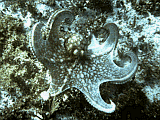
For example, in April 2006 Discover published an article, "What cephalopods can teach us about language" about special chromatophores, or pigment-containing cells, which are found in octopuses (octopi?), squid and other cephalopods. Muscles change the shape of the chromatophores, which causes the cells to change color.

Morphing in cephalopods works somewhat similarly to how it works in computer graphics. Two components are involved: a change in the image or texture visible on a shape's surface and a change in the underlying shape itself. The "pixels" in the skin of a cephalopod are organs called chromatophores. These can expand and contract quickly, and each is filled with a pigment of a particular color. When a nerve signal causes a red chromatophore to expand, the "pixel" turns red. A pattern of nerve firings causes a shifting image—an animation—to appear on the cephalopod's skin. As for shapes, an octopus can quickly arrange its arms to form a wide variety of them, like a fish or a piece of coral, and can even raise welts on its skin to add texture.

To see what that looks like, watch this great National Geographic video of an octopus changing colors. The color change appears to be under visual control, but the exact mechanism is a bit of a mystery, because cephalopods do not appear to have color vision.

In the interactive companion to the article, "Why Not Morph?", Discover issues a challenge to write a story using the science of chromatophores:
Suppose humans had chromatophores that could alter body appearance allowing it to blend perfectly with the background. Think about it. Then, write a science fiction story about a genetically modified individual who has been given this camouflage ability. Remember that good science fiction is based upon science fact.
I'm not aware of any stories in which humans have color-changing skin. However a example of color-changing humanoids are the genetically-enhanced Suliban of the Enterprise universe, who can blend into their surroundings using subcutaneously-implanted pigment sacs. According to creator Brannon Braga the modification was indeed inspired by octopus skin.

If you know of any other examples, please share them in the comments!

Tags:, ,
Image from the Ocean Planet Exhibition at the Smithsonian.
Note: Links to Amazon.com are affiliate links. As an Amazon Associate I earn from qualifying purchases.